



 Chat with AI
Exam 7: Blood

Exam 1: Human Biology, Science, and Society85 Questions
Exam 2: The Chemistry of Living Things118 Questions
Exam 3: Structure and Function of Cells124 Questions
Exam 4: From Cells to Organ Systems107 Questions
Exam 5: The Skeletal System95 Questions
Exam 6: The Muscular System107 Questions
Exam 7: Blood114 Questions
Exam 8: Heart and Blood Vessels112 Questions
Exam 9: The Immune System and Mechanisms of Defense118 Questions
Exam 10: The Respiratory System: Exchange of Gases94 Questions
Exam 11: The Nervous System: Integration and Control111 Questions
Exam 12: Sensory Mechanisms107 Questions
Exam 13: The Endocrine System94 Questions
Exam 14: The Digestive System and Nutrition91 Questions
Exam 15: The Urinary System73 Questions
Exam 16: Reproductive Systems97 Questions
Exam 17: Cell Reproduction and Differentiation95 Questions
Exam 18: Cancer: Uncontrolled Cell Division and Differentiation89 Questions
Exam 19: Genetics and Inheritance81 Questions
Exam 20: DNA Technology and Genetic Engineering75 Questions
Exam 21: Development and Aging84 Questions
Exam 22: Evolution and the Origins of Life89 Questions
Exam 23: Ecosystems and Populations85 Questions
Exam 24: Human Impacts, Biodiversity, and Environmental Issues74 Questions
Select questions type


About 55% of whole blood is ________, which is/are mostly made up of water.
(Multiple Choice)
4.7/5  (72)
(72) The circulatory and lymphatic systems both serve major transport functions in the body, with contents of the lymphatic system essentially derived from the circulatory system.
(True/False)
4.9/5 (81)
(81) Unlike white blood cells, red blood cells lose their ________ and ________ as they mature.
(Multiple Choice)
4.9/5 (84)
(84) An athlete participating in blood doping would be expected to have a low hematocrit.
(True/False)
4.9/5 (84)
(84) Humans may have one of four different blood types - A, B, AB, or O. Explain why a person with type O blood is referred to as the "universal donor" yet can receive blood only from other individuals with type O blood.
(Essay)
4.8/5 (87)
(87) 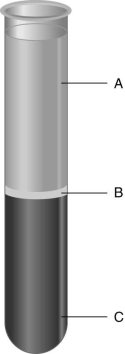 Using the figure above, answer the following question(s).
-The blood components in C are the ________.
Using the figure above, answer the following question(s).
-The blood components in C are the ________. (Short Answer)
4.8/5 (79)
(79) ________ are the agranular circulating white blood cells also found in lymph nodes.
(Short Answer)
4.8/5 (77)
(77) Dead and injured white blood cells are removed from circulation by the
(Multiple Choice)
4.7/5 (73)
(73) Match each of the following cells to its description(s). Answers may be used more than once.
-protects the body from parasitic infections
(Multiple Choice)
4.7/5 (75)
(75) Eosinophils are especially important in defending the human body from infection by
(Multiple Choice)
4.7/5 (70)
(70) All of the following are ways in which blood functions to maintain homeostasis in the human body EXCEPT which one?
(Multiple Choice)
4.8/5 (82)
(82) Which one of the following occurs first in the process of hemostasis?
(Multiple Choice)
5.0/5 (83)
(83) In addition to the circulatory system, the ________ system is also characterized by possessing a series of fluid-filled vessels.
(Short Answer)
5.0/5 (77)
(77) A physician finds that one of his patients has the following problems: Blood clots very slowly or not at all, and severe bruises result from even the most minor bumps. Which one of the following conditions would likely be diagnosed based on this information?
(Multiple Choice)
4.9/5 (86)
(86) Match each of the following conditions with its description
-a condition caused by a decrease in the oxygen-carrying capacity of the blood; may be diagnosed by a low hematocrit
(Multiple Choice)
4.9/5 (85)
(85) An individual with hemophilia generally lacks or has very low numbers of platelets.
(True/False)
4.8/5 (71)
(71) 
Filters
- Essay(0)
- Multiple Choice(0)
- Short Answer(0)
- True False(0)
- Matching(0)