



 Chat with AI
Exam 10: The Respiratory System: Exchange of Gases

Exam 1: Human Biology, Science, and Society85 Questions
Exam 2: The Chemistry of Living Things118 Questions
Exam 3: Structure and Function of Cells124 Questions
Exam 4: From Cells to Organ Systems107 Questions
Exam 5: The Skeletal System95 Questions
Exam 6: The Muscular System107 Questions
Exam 7: Blood114 Questions
Exam 8: Heart and Blood Vessels112 Questions
Exam 9: The Immune System and Mechanisms of Defense118 Questions
Exam 10: The Respiratory System: Exchange of Gases94 Questions
Exam 11: The Nervous System: Integration and Control111 Questions
Exam 12: Sensory Mechanisms107 Questions
Exam 13: The Endocrine System94 Questions
Exam 14: The Digestive System and Nutrition91 Questions
Exam 15: The Urinary System73 Questions
Exam 16: Reproductive Systems97 Questions
Exam 17: Cell Reproduction and Differentiation95 Questions
Exam 18: Cancer: Uncontrolled Cell Division and Differentiation89 Questions
Exam 19: Genetics and Inheritance81 Questions
Exam 20: DNA Technology and Genetic Engineering75 Questions
Exam 21: Development and Aging84 Questions
Exam 22: Evolution and the Origins of Life89 Questions
Exam 23: Ecosystems and Populations85 Questions
Exam 24: Human Impacts, Biodiversity, and Environmental Issues74 Questions
Select questions type


Surfactant is released to reduce surface tension in the alveoli.
(True/False)
4.8/5  (79)
(79) The basic pattern of inhalation and exhalation is controlled by a region at the base of the brain called the ________.
(Short Answer)
4.8/5 (74)
(74) 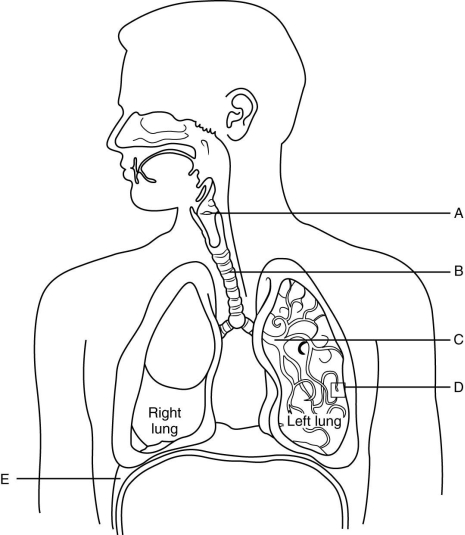 The figure above shows the components of the respiratory system. Match each labeled structure (A-E) to its description.
-Site of external respiration; walls consist of one layer of squamous epithelial cells.
The figure above shows the components of the respiratory system. Match each labeled structure (A-E) to its description.
-Site of external respiration; walls consist of one layer of squamous epithelial cells. (Short Answer)
4.8/5 (79)
(79) Match each of the following disorders associated with the respiratory system with its description.
-inflammation of the epithelial membranes enclosing the lungs
(Multiple Choice)
4.9/5 (80)
(80) Match the following terms to their definitions.
-the air that remains in the lungs after a forceful exhalation
(Multiple Choice)
4.9/5 (69)
(69) Deoxygenated blood is transported to the pulmonary capillaries of the lungs by the pulmonary veins; oxygenated blood is transported away from the pulmonary capillaries by the pulmonary arteries.
(True/False)
4.7/5 (86)
(86) A small amount of fluid is contained in the pleural cavity to
(Multiple Choice)
4.7/5 (74)
(74) During puberty, the increased production of testosterone in males causes the rapid enlargement of which one of the following structures of the respiratory system?
(Multiple Choice)
4.8/5 (79)
(79) The pleural cavity, which is located between the pleural membranes, contains small amounts of ________.
(Short Answer)
4.9/5 (78)
(78) 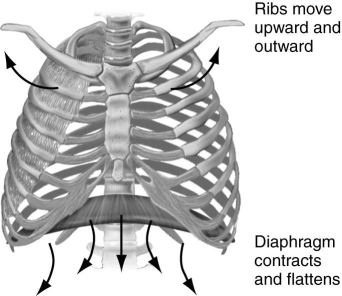 The figure above depicts expiration.
Match the following terms to their definitions.
-the amount of air entering the lungs with every breath
(Multiple Choice)
4.9/5 (69)
(69) Lung capacity is typically measured with the use of a spirometer.
(True/False)
4.9/5 (93)
(93) Longer vocal cords generate higher-pitched tones than longer ones.
(True/False)
4.7/5 (83)
(83) All of the following are TRUE regarding the effect of smoking on the respiratory system EXCEPT which one?
(Multiple Choice)
4.8/5 (84)
(84) Carbaminohemoglobin differs from hemoglobin in that carbaminohemoglobin
(Multiple Choice)
4.7/5 (71)
(71) 
Filters
- Essay(0)
- Multiple Choice(0)
- Short Answer(0)
- True False(0)
- Matching(0)