



 Chat with AI
Exam 10: The Respiratory System: Exchange of Gases

Exam 1: Human Biology, Science, and Society85 Questions
Exam 2: The Chemistry of Living Things118 Questions
Exam 3: Structure and Function of Cells124 Questions
Exam 4: From Cells to Organ Systems107 Questions
Exam 5: The Skeletal System95 Questions
Exam 6: The Muscular System107 Questions
Exam 7: Blood114 Questions
Exam 8: Heart and Blood Vessels112 Questions
Exam 9: The Immune System and Mechanisms of Defense118 Questions
Exam 10: The Respiratory System: Exchange of Gases94 Questions
Exam 11: The Nervous System: Integration and Control111 Questions
Exam 12: Sensory Mechanisms107 Questions
Exam 13: The Endocrine System94 Questions
Exam 14: The Digestive System and Nutrition91 Questions
Exam 15: The Urinary System73 Questions
Exam 16: Reproductive Systems97 Questions
Exam 17: Cell Reproduction and Differentiation95 Questions
Exam 18: Cancer: Uncontrolled Cell Division and Differentiation89 Questions
Exam 19: Genetics and Inheritance81 Questions
Exam 20: DNA Technology and Genetic Engineering75 Questions
Exam 21: Development and Aging84 Questions
Exam 22: Evolution and the Origins of Life89 Questions
Exam 23: Ecosystems and Populations85 Questions
Exam 24: Human Impacts, Biodiversity, and Environmental Issues74 Questions
Select questions type


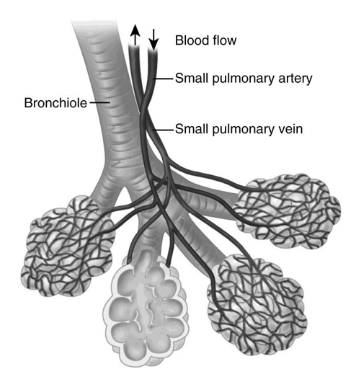 Use the figure above to answer the following question(s).
-At the end of every ________ is a cluster of ________, where gas exchange takes place.
Use the figure above to answer the following question(s).
-At the end of every ________ is a cluster of ________, where gas exchange takes place. (Short Answer)
4.9/5  (92)
(92) Match the following terms to their definitions.
-the amount of air that can be forced out of the lungs beyond the tidal volume
(Multiple Choice)
4.9/5 (79)
(79) In the figure above, ________ must be released over the inner surface of the sac-like structures to reduce surface tension.
(Short Answer)
4.8/5 (75)
(75) Match each of the following disorders associated with the respiratory system with its description.
-inflammation of the lungs due to viral or bacterial infection; secretion of excess fluid in the lungs prevents proper gas exchange
(Multiple Choice)
5.0/5 (69)
(69) During a cough, what is responsible for constricting the size of the trachea?
(Multiple Choice)
4.7/5 (81)
(81) Intrapulmonary ________ must be reduced prior to the process of inhalation.
(Short Answer)
4.8/5 (88)
(88) Which one of the following best explains why humans must constantly breathe in oxygen in order to stay alive?
(Multiple Choice)
4.9/5 (79)
(79) During the ingestion of food or liquid, which one of the following tips to block the opening to the trachea?
(Multiple Choice)
4.8/5 (83)
(83) Sound results from the ________ of the vocal cords as air passes through the larynx.
(Short Answer)
4.7/5 (73)
(73) Arrange the following entries in the order in which air contacts them as air is drawn into the body. a. trachea
B) bronchiole
C) pharynx
D) alveoli
E) larynx
A) e, c, b, a, d
B) c, a, e, d, b
C) b, d, a, c, e
D) c, a, e, b, d
E) c, e, a, b, d
(Short Answer)
5.0/5 (92)
(92) The trachea is completely surrounded by rings of cartilage, resulting in an organ that is inflexible.
(True/False)
4.7/5 (79)
(79) Match the following processes of respiration to their definitions.
-the process that results in water being produced as a byproduct
(Multiple Choice)
4.9/5 (66)
(66) During a normal breathing cycle, pressure changes are essential to the exchange of gases with the environment. Describe what type of pressure changes must occur during ventilation.
(Essay)
4.9/5 (71)
(71)  The figure above shows the components of the respiratory system. Match each labeled structure (A-E) to its description.
-Large airways that enter each lung and then branch into smaller and smaller airways; walls contain connective tissue, smooth muscles, and cartilage.
The figure above shows the components of the respiratory system. Match each labeled structure (A-E) to its description.
-Large airways that enter each lung and then branch into smaller and smaller airways; walls contain connective tissue, smooth muscles, and cartilage. (Short Answer)
5.0/5 (72)
(72) Most of the carbon dioxide released by cells is transported in the venous supply in what form?
(Multiple Choice)
4.8/5 (74)
(74) Which of the following occurs as air is drawn through the nose?
(Multiple Choice)
5.0/5 (81)
(81) Match the following terms to their definitions.
-the amount of air that can be inhaled beyond the tidal volume
(Multiple Choice)
4.9/5 (86)
(86) The figure above shows the components of the respiratory system. Match each labeled structure (A-E) to its description.
-Contraction of this structure causes it to flatten out, increasing lung volume.
The figure above shows the components of the respiratory system. Match each labeled structure (A-E) to its description.
-Contraction of this structure causes it to flatten out, increasing lung volume. (Short Answer)
4.8/5 (80)
(80) E-cigarettes are often regulated as a tobacco product that contains chemicals, but they do not contain tobacco.
(True/False)
4.9/5 (83)
(83) 
Filters
- Essay(0)
- Multiple Choice(0)
- Short Answer(0)
- True False(0)
- Matching(0)