



 Chat with AI
Exam 15: The Urinary System

Exam 1: Human Biology, Science, and Society85 Questions
Exam 2: The Chemistry of Living Things118 Questions
Exam 3: Structure and Function of Cells124 Questions
Exam 4: From Cells to Organ Systems107 Questions
Exam 5: The Skeletal System95 Questions
Exam 6: The Muscular System107 Questions
Exam 7: Blood114 Questions
Exam 8: Heart and Blood Vessels112 Questions
Exam 9: The Immune System and Mechanisms of Defense118 Questions
Exam 10: The Respiratory System: Exchange of Gases94 Questions
Exam 11: The Nervous System: Integration and Control111 Questions
Exam 12: Sensory Mechanisms107 Questions
Exam 13: The Endocrine System94 Questions
Exam 14: The Digestive System and Nutrition91 Questions
Exam 15: The Urinary System73 Questions
Exam 16: Reproductive Systems97 Questions
Exam 17: Cell Reproduction and Differentiation95 Questions
Exam 18: Cancer: Uncontrolled Cell Division and Differentiation89 Questions
Exam 19: Genetics and Inheritance81 Questions
Exam 20: DNA Technology and Genetic Engineering75 Questions
Exam 21: Development and Aging84 Questions
Exam 22: Evolution and the Origins of Life89 Questions
Exam 23: Ecosystems and Populations85 Questions
Exam 24: Human Impacts, Biodiversity, and Environmental Issues74 Questions
Select questions type


Match each region of the nephron to its description.
-region composed of a descending limb that is permeable to water and an ascending limb that is impermeable to water
(Multiple Choice)
4.9/5  (77)
(77) The descending limb of the loop of Henle is impermeable to water so no passive diffusion occurs.
(True/False)
4.9/5 (81)
(81) ADH ________ the permeability of the cells of the collecting duct to water.
(Short Answer)
4.8/5 (83)
(83) The loop of Henle relies on a countercurrent exchange mechanism to promote movement of water and solutes. Explain the significance of this mechanism to the composition of urine.
(Essay)
4.8/5 (74)
(74) Match each of the following disorders associated with the urinary system to its description.
-condition that results from crystallization of minerals in urine; can block the flow of urine out of the body
(Multiple Choice)
5.0/5 (98)
(98) An individual has been diagnosed with persistent proteinuria. This condition is due to damage in which one of the following regions of the nephron?
(Multiple Choice)
4.9/5 (64)
(64) Match each of the following disorders associated with the urinary system to its description.
-condition also known as end-stage renal disease; kidneys no longer function properly due to long-term, irreversible damage
(Multiple Choice)
4.9/5 (75)
(75) Alcohol has diuretic effects, increasing urine output. By which one of the following is this mediated?
(Multiple Choice)
4.8/5 (85)
(85) Match each region of the nephron to its description.
-region where 65-70% of the water in the glomerular filtrate is reabsorbed into the blood
(Multiple Choice)
4.9/5 (91)
(91) 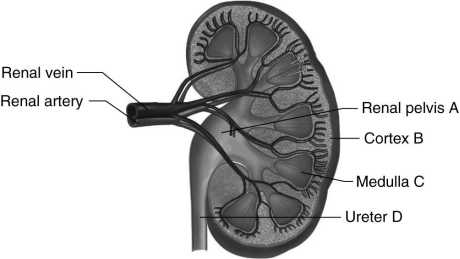 Using the figure above, identify in which one of the following locations a nephron would be found.
A) A
B) B
C) C
D) D
E) B and C
Answer: E
Topic: Sec. 15.3
Bloom's: Remembering/Understanding
LO: 15.3a
GLO: G1
-The capillaries that serve as the major blood supply to the kidneys are called the
Using the figure above, identify in which one of the following locations a nephron would be found.
A) A
B) B
C) C
D) D
E) B and C
Answer: E
Topic: Sec. 15.3
Bloom's: Remembering/Understanding
LO: 15.3a
GLO: G1
-The capillaries that serve as the major blood supply to the kidneys are called the (Multiple Choice)
4.7/5 (85)
(85) If the Bowman's capsule could be surgically removed so that the end (closed) of the proximal tubule was in contact with the glomerulus, what would be the impact on glomerular filtration?
(Essay)
4.9/5 (96)
(96) The nitrogenous waste ammonia is usually converted to a less toxic substance known as
(Multiple Choice)
5.0/5 (75)
(75) The function of the kidneys to concentrate urine is under the control of a negative feedback loop.
(True/False)
4.8/5 (86)
(86) Match each region of the nephron to its description.
-ADH increases the permeability of the cells of this region to water
(Short Answer)
4.8/5 (93)
(93) Many different ions are taken into the body with each meal or produced during cellular metabolism. The kidneys are important in regulating homeostasis of these ions in the body. Match each ion to its function.
-potassium
(Multiple Choice)
4.8/5 (85)
(85) Renin is secreted by which one of the following structures?
(Multiple Choice)
4.7/5 (87)
(87) The glomerulus of each nephron is enclosed by a portion of the nephron known as a glomerular ________.
(Short Answer)
4.8/5 (81)
(81) Match each region of the nephron to its description.
-region where fluids are transported to the collecting duct; active reabsorption of salt occurs
(Short Answer)
4.8/5 (78)
(78) 
Filters
- Essay(0)
- Multiple Choice(0)
- Short Answer(0)
- True False(0)
- Matching(0)