



 Chat with AI
Exam 15: The Urinary System

Exam 1: Human Biology, Science, and Society85 Questions
Exam 2: The Chemistry of Living Things118 Questions
Exam 3: Structure and Function of Cells124 Questions
Exam 4: From Cells to Organ Systems107 Questions
Exam 5: The Skeletal System95 Questions
Exam 6: The Muscular System107 Questions
Exam 7: Blood114 Questions
Exam 8: Heart and Blood Vessels112 Questions
Exam 9: The Immune System and Mechanisms of Defense118 Questions
Exam 10: The Respiratory System: Exchange of Gases94 Questions
Exam 11: The Nervous System: Integration and Control111 Questions
Exam 12: Sensory Mechanisms107 Questions
Exam 13: The Endocrine System94 Questions
Exam 14: The Digestive System and Nutrition91 Questions
Exam 15: The Urinary System73 Questions
Exam 16: Reproductive Systems97 Questions
Exam 17: Cell Reproduction and Differentiation95 Questions
Exam 18: Cancer: Uncontrolled Cell Division and Differentiation89 Questions
Exam 19: Genetics and Inheritance81 Questions
Exam 20: DNA Technology and Genetic Engineering75 Questions
Exam 21: Development and Aging84 Questions
Exam 22: Evolution and the Origins of Life89 Questions
Exam 23: Ecosystems and Populations85 Questions
Exam 24: Human Impacts, Biodiversity, and Environmental Issues74 Questions
Select questions type


Movement of sodium across the cells of the collecting duct relies on which one of the following?
(Multiple Choice)
4.8/5  (75)
(75) Given the following events involved in the regulation of blood volume, which one of the following answers best represents the order in which these events occurs? 1. sodium reabsorbed from distal tubules and collecting ducts
3) secretion of renin from juxtaglomerular apparatus
2) secretion of aldosterone
4) decrease in blood volume
5) production of angiotensin II
(Multiple Choice)
4.9/5 (77)
(77) ________ not only stimulates the release of aldosterone from the adrenal glands but also causes constriction of small blood vessels (vasoconstriction).
(Short Answer)
4.9/5 (72)
(72) Match each of the following disorders associated with the urinary system to its description.
-condition caused by damage to the glomerulus; results in the presence of protein in the urine
(Multiple Choice)
4.8/5 (83)
(83) The primary sources of the nitrogenous wastes that are eliminated by the kidneys are
(Multiple Choice)
4.9/5 (76)
(76) Blood containing metabolic waste is transported to the kidneys by the renal vein; the renal artery removes blood from the kidneys once the waste has been removed.
(True/False)
4.9/5 (69)
(69) Which one of the following is TRUE regarding erythropoietin?
(Multiple Choice)
4.8/5 (82)
(82) Not only are the kidneys considered organs of excretion, but they have an endocrine function as well as an important role in the maintenance of homeostasis through the regulation of blood pH.
(True/False)
4.9/5 (84)
(84) Continuous ambulatory peritoneal dialysis involves the circulation of a patient's blood through an artificial kidney machine in order to remove metabolic waste and excess ions; this procedure can now be done in the home.
(True/False)
4.8/5 (75)
(75) 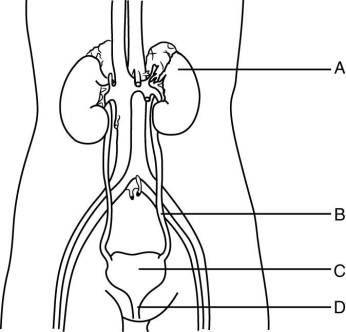 Using the letter choices on the figure above, identify the organs of the urinary system.
-delivers urine to the bladder
Using the letter choices on the figure above, identify the organs of the urinary system.
-delivers urine to the bladder (Short Answer)
4.7/5 (80)
(80) Choose the correct order of steps for the synthesis of Vitamin D. a. Inactive vitamin D is transported to the liver where it is modified.
B) Inactive, chemically altered vitamin D is transported to the kidneys.
C) UV light strikes the skin and converts a steroid molecule into an inactive form of vitamin D.
D) Vitamin D is activated under the influence of PTH.
A) a, b, c, d
B) c, b, a, d
C) c, a, b, d
D) a, c, b, d
E) d, a, c, b
(Short Answer)
4.8/5 (71)
(71) The major nitrogenous waste product in urine is the ammonium ion.
(True/False)
4.8/5 (75)
(75) Tubular reabsorption occurs when most of the fluid and solutes move back into the ________.
(Short Answer)
4.8/5 (80)
(80) Over 99% of the water filtered through the glomerulus is reabsorbed. At which one of the following locations does most of this water reabsorption occur?
(Multiple Choice)
4.8/5 (88)
(88) The hairpin design of the loop of Henle allows events on one side of the loop to influence the events on the other side, by a process referred to as
(Multiple Choice)
4.9/5 (82)
(82) 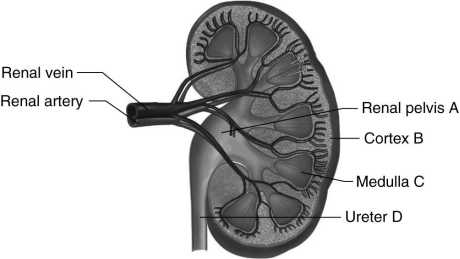 Using the figure above, identify in which one of the following locations a nephron would be found.
A) A
B) B
C) C
D) D
E) B and C
Answer: E
Topic: Sec. 15.3
Bloom's: Remembering/Understanding
LO: 15.3a
GLO: G1
-The efferent arteriole carries blood from the glomerulus to the
Using the figure above, identify in which one of the following locations a nephron would be found.
A) A
B) B
C) C
D) D
E) B and C
Answer: E
Topic: Sec. 15.3
Bloom's: Remembering/Understanding
LO: 15.3a
GLO: G1
-The efferent arteriole carries blood from the glomerulus to the (Multiple Choice)
5.0/5 (84)
(84) Nutrients, water, and ions reabsorbed by the proximal and distal tubules enter the ________ capillaries.
(Short Answer)
4.8/5 (82)
(82) Match each region of the nephron to its description.
-region where blood plasma fluid is filtered from the blood into the nephron
(Multiple Choice)
4.9/5 (67)
(67) 
Filters
- Essay(0)
- Multiple Choice(0)
- Short Answer(0)
- True False(0)
- Matching(0)