



 Chat with AI
Exam 12: Fiscal Policy, Incentives, and Secondary Effects

Exam 1: The Economic Approach164 Questions
Exam 2: Some Tools of the Economist200 Questions
Exam 3: Demand, Supply, and the Market Process336 Questions
Exam 4: Supply and Demand: Applications and Extensions254 Questions
Exam 5: Difficult Cases for the Market, and the Role of Government130 Questions
Exam 6: The Economics of Political Action154 Questions
Exam 7: Taking the Nations Economic Pulse214 Questions
Exam 8: Economic Fluctuations, Unemployment, and Inflation174 Questions
Exam 9: An Introduction to Basic Macroeconomic Markets219 Questions
Exam 10: Dynamic Change, Economic Fluctuations, and the Ad-As Model189 Questions
Exam 11: Fiscal Policy: the Keynesian View and the Historical Development of Macroeconomics109 Questions
Exam 12: Fiscal Policy, Incentives, and Secondary Effects146 Questions
Exam 13: Money and the Banking System209 Questions
Exam 14: Modern Macroeconomics and Monetary Policy192 Questions
Exam 15: Stabilization Policy, Output, and Employment148 Questions
Exam 16: Creating an Environment for Growth and Prosperity120 Questions
Exam 17: Institutions, Policies, and Cross-Country Differences in Income and Growth111 Questions
Exam 18: Gaining From International Trade170 Questions
Exam 19: International Finance and the Foreign Exchange Market148 Questions
Select questions type


A substantial decrease in marginal tax rates will encourage individuals to
(Multiple Choice)
4.8/5  (77)
(77) Which of the following is an argument for tax cuts rather than government spending as a way to promote recovery from a recession?
(Multiple Choice)
4.7/5 (75)
(75) How do new classical economists differ from Keynesian economists in their assumptions about how government borrowing affects household consumption and borrowing patterns?
(Essay)
4.8/5 (75)
(75) Which of the following makes it more likely that a country will get caught in a vicious circle of debt financing, higher taxes, and sluggish growth?
(Multiple Choice)
4.9/5 (75)
(75) Use the figure below to answer the following question(s).
Figure 12-1 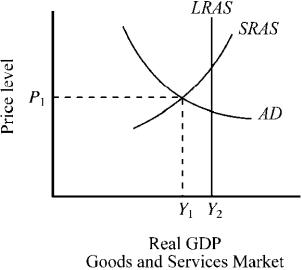 -Refer to Figure 12-2. Which of the following will most likely be favored by a Keynesian economist if the economy is operating at point a?
 (Multiple Choice)
4.8/5 (73)
(73) 
Filters
- Essay(0)
- Multiple Choice(0)
- Short Answer(0)
- True False(0)
- Matching(0)