



 Chat with AI
Exam 12: Fiscal Policy, Incentives, and Secondary Effects

Exam 1: The Economic Approach164 Questions
Exam 2: Some Tools of the Economist200 Questions
Exam 3: Demand, Supply, and the Market Process336 Questions
Exam 4: Supply and Demand: Applications and Extensions254 Questions
Exam 5: Difficult Cases for the Market, and the Role of Government130 Questions
Exam 6: The Economics of Political Action154 Questions
Exam 7: Taking the Nations Economic Pulse214 Questions
Exam 8: Economic Fluctuations, Unemployment, and Inflation174 Questions
Exam 9: An Introduction to Basic Macroeconomic Markets219 Questions
Exam 10: Dynamic Change, Economic Fluctuations, and the Ad-As Model189 Questions
Exam 11: Fiscal Policy: the Keynesian View and the Historical Development of Macroeconomics109 Questions
Exam 12: Fiscal Policy, Incentives, and Secondary Effects146 Questions
Exam 13: Money and the Banking System209 Questions
Exam 14: Modern Macroeconomics and Monetary Policy192 Questions
Exam 15: Stabilization Policy, Output, and Employment148 Questions
Exam 16: Creating an Environment for Growth and Prosperity120 Questions
Exam 17: Institutions, Policies, and Cross-Country Differences in Income and Growth111 Questions
Exam 18: Gaining From International Trade170 Questions
Exam 19: International Finance and the Foreign Exchange Market148 Questions
Select questions type


If a fiscal policy change is going to exert a stabilizing impact on the economy, it must
(Multiple Choice)
4.8/5  (69)
(69) Historically, Keynesian economists have argued that government spending will stimulate aggregate demand more than tax cuts because
(Multiple Choice)
4.9/5 (75)
(75) Which of the following best explains why high marginal tax rates retard output?
(Multiple Choice)
4.9/5 (73)
(73) Use the figure below to answer the following question(s).
Figure 12-3 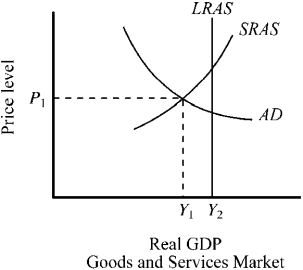 -Refer to Figure 12-3. If an economy is currently operating at Y1, which of the following would a new classical economist be most likely to favor?
 (Multiple Choice)
4.9/5 (85)
(85) Both the crowding-out effect and new classical model indicate that
(Multiple Choice)
4.8/5 (84)
(84) According to the critics of Keynesian economics, the rapid increase in government spending and large budget deficits in response to the recession of 2008-2009 would
(Multiple Choice)
4.9/5 (88)
(88) Fiscal stimulus is most likely to direct resources into productive projects when spending decisions are left in the hands of
(Multiple Choice)
4.7/5 (61)
(61) When government spending flows to areas where resources are already fully employed,
(Multiple Choice)
4.8/5 (71)
(71) Within the framework of the AD-AS model, an increase in savings by households will
(Multiple Choice)
4.9/5 (68)
(68) Fiscal policy moved toward expansion during the 1980s but toward restriction during the 1990s. How did these differences affect the economy?
(Multiple Choice)
4.9/5 (73)
(73) Kimani sells life insurance and is considering buying a $50,000 Cadillac for business purposes (thus, the expense reduces her taxable income). If Kimani is in the 40 percent marginal tax bracket, how much after-tax income will she have to give up in order to enjoy the Cadillac?
(Multiple Choice)
4.9/5 (81)
(81) Which of the following is part of the synthesis view of fiscal policy?
(Multiple Choice)
4.9/5 (80)
(80) In the new classical model, a $100 billion increase in government purchases financed by borrowing will
(Multiple Choice)
5.0/5 (72)
(72) If a reduction in government borrowing leads to lower real interest rates in the United States,
(Multiple Choice)
4.7/5 (60)
(60) Which of the following is most important for long-run growth and a healthy economy?
(Multiple Choice)
4.8/5 (69)
(69) Advocates of the crowding-out effect maintain that the large budget deficits during the recession of 2008-2009
(Multiple Choice)
4.8/5 (83)
(83) Since the mid-1980s, the debt-to-income ratio of American households
(Multiple Choice)
4.8/5 (80)
(80) Measured as a share of GDP, federal spending during 2001-2010
(Multiple Choice)
4.8/5 (83)
(83) 
Filters
- Essay(0)
- Multiple Choice(0)
- Short Answer(0)
- True False(0)
- Matching(0)