



 Chat with AI
Exam 3: Demand, Supply, and the Market Process

Exam 1: The Economic Approach164 Questions
Exam 2: Some Tools of the Economist200 Questions
Exam 3: Demand, Supply, and the Market Process336 Questions
Exam 4: Supply and Demand: Applications and Extensions254 Questions
Exam 5: Difficult Cases for the Market, and the Role of Government130 Questions
Exam 6: The Economics of Political Action154 Questions
Exam 7: Taking the Nations Economic Pulse214 Questions
Exam 8: Economic Fluctuations, Unemployment, and Inflation174 Questions
Exam 9: An Introduction to Basic Macroeconomic Markets219 Questions
Exam 10: Dynamic Change, Economic Fluctuations, and the Ad-As Model189 Questions
Exam 11: Fiscal Policy: the Keynesian View and the Historical Development of Macroeconomics109 Questions
Exam 12: Fiscal Policy, Incentives, and Secondary Effects146 Questions
Exam 13: Money and the Banking System209 Questions
Exam 14: Modern Macroeconomics and Monetary Policy192 Questions
Exam 15: Stabilization Policy, Output, and Employment148 Questions
Exam 16: Creating an Environment for Growth and Prosperity120 Questions
Exam 17: Institutions, Policies, and Cross-Country Differences in Income and Growth111 Questions
Exam 18: Gaining From International Trade170 Questions
Exam 19: International Finance and the Foreign Exchange Market148 Questions
Select questions type


A recent editorial in a local newspaper argues, "Consumers need to know more about products than just their price. They need to know how these prices are determined, who owns the businesses, and the wages of the workers." Is the editorial writer correct? Why or why not?
(Essay)
4.8/5  (76)
(76) Susan says, "If the price of wool coats goes up, suppliers will offer more of the coats for sale." Brad replies, "It takes three months to harvest wool and employ all the steps necessary to produce a wool coat. Quantity supplied cannot possibly increase for three months." Is Brad correct? Why or why not?
(Essay)
4.8/5 (84)
(84) Two students are walking by a department store window that has on display a $400 dress. The English major declares, "I want that dress but can't afford it." The economics major replies, "No, you don't." Explain the logic of this reply.
(Essay)
4.9/5 (83)
(83) The total economic cost of producing a good or service is called the
(Multiple Choice)
4.9/5 (80)
(80) Ceteris paribus, a decrease in the price of a good will cause the
(Multiple Choice)
4.9/5 (86)
(86) If consumer purchases of a good are not very sensitive to the price of the good, this is illustrated by a
(Multiple Choice)
4.7/5 (80)
(80) If coffee and cream are complements, an increase in the price of coffee will cause
(Multiple Choice)
4.9/5 (75)
(75) Suppliers recognize there is a shortage in the market for their product when they notice that
(Multiple Choice)
4.9/5 (71)
(71) Figure 3-20 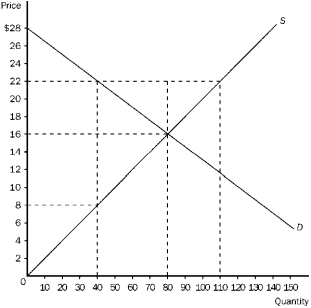 -Refer to Figure 3-20. At the equilibrium price, producer surplus is
 (Multiple Choice)
4.9/5 (86)
(86) Table 3-2
 -Refer to Table 3-2. If the market price is $1,100, the combined total cost of all participating sellers is
 (Multiple Choice)
4.9/5 (65)
(65) Consider the market for grapes. An increase in the wage paid to grape pickers will cause the
(Multiple Choice)
4.8/5 (81)
(81) Suppose the demand for tacos decreases. What will happen to producer surplus in the market for tacos?
(Multiple Choice)
4.9/5 (82)
(82) Liam is willing to cut lawns for a minimum of $200 a week. He is, however, paid $250 for the same service by a lawn maintenance company. This is an example of
(Multiple Choice)
4.8/5 (79)
(79) Figure 3-10 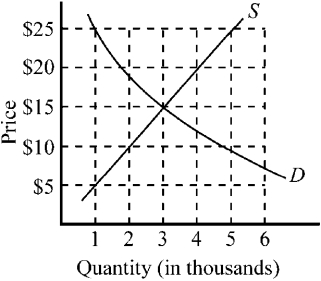 -Figure 3-10 illustrates the conditions of demand and supply in the market for compact discs. Indicate the equilibrium price and quantity.
 (Multiple Choice)
5.0/5 (85)
(85) Use the figure below to answer the following question(s).
Figure 3-13 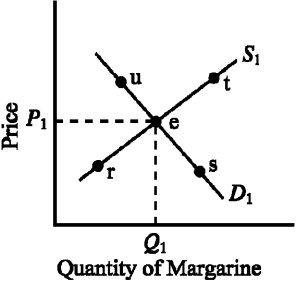 -Refer to Figure 3-13. The market for margarine was initially in equilibrium at point
 (Multiple Choice)
5.0/5 (74)
(74) Figure 3-20
-Refer to Figure 3-20. If 110 units of the good are being bought and sold, then
-Refer to Figure 3-20. If 110 units of the good are being bought and sold, then (Multiple Choice)
4.9/5 (92)
(92) Table 3-1
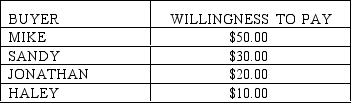 -Refer to Table 3-1. If the table represents the willingness to pay of four buyers and the price of the product is $30, then their total consumer surplus is
 (Multiple Choice)
5.0/5 (90)
(90) 
Filters
- Essay(0)
- Multiple Choice(0)
- Short Answer(0)
- True False(0)
- Matching(0)