



 Chat with AI
Exam 3: Demand, Supply, and the Market Process

Exam 1: The Economic Approach164 Questions
Exam 2: Some Tools of the Economist200 Questions
Exam 3: Demand, Supply, and the Market Process336 Questions
Exam 4: Supply and Demand: Applications and Extensions254 Questions
Exam 5: Difficult Cases for the Market, and the Role of Government130 Questions
Exam 6: The Economics of Political Action154 Questions
Exam 7: Taking the Nations Economic Pulse214 Questions
Exam 8: Economic Fluctuations, Unemployment, and Inflation174 Questions
Exam 9: An Introduction to Basic Macroeconomic Markets219 Questions
Exam 10: Dynamic Change, Economic Fluctuations, and the Ad-As Model189 Questions
Exam 11: Fiscal Policy: the Keynesian View and the Historical Development of Macroeconomics109 Questions
Exam 12: Fiscal Policy, Incentives, and Secondary Effects146 Questions
Exam 13: Money and the Banking System209 Questions
Exam 14: Modern Macroeconomics and Monetary Policy192 Questions
Exam 15: Stabilization Policy, Output, and Employment148 Questions
Exam 16: Creating an Environment for Growth and Prosperity120 Questions
Exam 17: Institutions, Policies, and Cross-Country Differences in Income and Growth111 Questions
Exam 18: Gaining From International Trade170 Questions
Exam 19: International Finance and the Foreign Exchange Market148 Questions
Select questions type


What impact would a severe drought that destroys the wheat crop in several areas of the United States have on the market for wheat?
(Multiple Choice)
5.0/5  (81)
(81) Figure 3-11 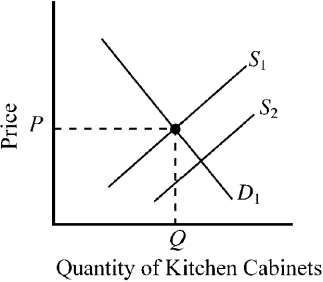 -In Figure 3-11, suppose D1 and S1 indicate initial conditions in the market for kitchen cabinets. Which of the following would tend to cause the supply curve to shift from S1 to S2?
 (Multiple Choice)
4.7/5 (79)
(79) If the price of coffee decreases, the demand curve for tea (a substitute good) will
(Multiple Choice)
5.0/5 (84)
(84) If price rises, what happens to quantity supplied of a product?
(Multiple Choice)
4.8/5 (86)
(86) If price falls, what happens to the quantity demanded for a product?
(Multiple Choice)
4.9/5 (86)
(86) Market prices generally promote social cooperation because they
(Multiple Choice)
4.8/5 (68)
(68) Sebastian drinks Mountain Dew. He can buy as many cans of Mountain Dew as he wishes at a price of $0.50 per can. On a particular day, he is willing to pay $0.95 for the first can, $0.80 for the second can, $0.60 for the third can, and $0.40 for the fourth can. Assume Sebastian is rational in deciding how many cans to buy. His consumer surplus is
(Multiple Choice)
4.9/5 (69)
(69) Figure 3-22 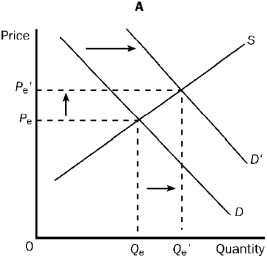
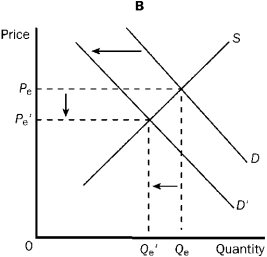
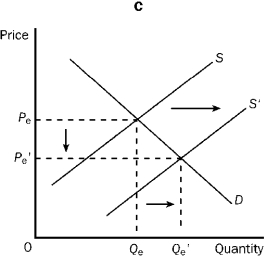
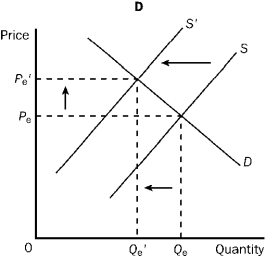 -Refer to Figure 3-22. Which of the four graphs represents the market for peanut butter after a major hurricane hits the peanut-growing south?
 (Multiple Choice)
4.7/5 (88)
(88) Which of the following is the most likely effect of lower apple juice prices on the price and quantity purchased of orange juice, a substitute product?
(Multiple Choice)
4.9/5 (80)
(80) After a hurricane in Florida knocked out the regional water supply for several days, the demand for bottled water increased sharply. In a market economy, how will this increase in demand affect the equilibrium price and quantity of bottled water?
(Multiple Choice)
4.8/5 (80)
(80) Which of the following would lead to an increase in the demand for fast food in Chicago?
(Multiple Choice)
4.8/5 (93)
(93) Table 3-1
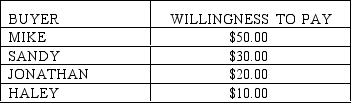 -Refer to Table 3-1. If the table represents the willingness to pay of four buyers and the price of the product is $15, then who would be willing to purchase the product?
 (Multiple Choice)
5.0/5 (81)
(81) Which of the following would most likely increase the supply of beef?
(Multiple Choice)
4.9/5 (76)
(76) According to the invisible hand principle, competitive markets generally
(Multiple Choice)
4.7/5 (92)
(92) In Atlanta, tickets for professional and college football games are substitutes. An increase in the ticket price for professional football, other things being equal, will
(Multiple Choice)
4.8/5 (81)
(81) Laqueta buys a new GPS device for her car for $135. She receives consumer surplus of $25 on her purchase if her willingness to pay is
(Multiple Choice)
4.9/5 (60)
(60) Andre decides that he would pay as much as $3,000 for a new laptop computer. He buys the computer and realizes consumer surplus of $700. How much did Andre pay for his computer?
(Multiple Choice)
4.9/5 (96)
(96) In which statement(s) is "demand" used correctly? (I) "An increase in the price of hamburgers will reduce the demand for hamburgers."
(II) "An increase in the price of hamburgers will reduce the demand for hamburger buns."
(Multiple Choice)
4.9/5 (74)
(74) 
Filters
- Essay(0)
- Multiple Choice(0)
- Short Answer(0)
- True False(0)
- Matching(0)