



 Chat with AI
Exam 2: Motion Along a Straight Line

Exam 1: Measurement37 Questions
Exam 2: Motion Along a Straight Line90 Questions
Exam 3: Vector32 Questions
Exam 4: Motion in Two and Three Dimensions53 Questions
Exam 5: Force and Motion I73 Questions
Exam 6: Force and Motion II74 Questions
Exam 7: Kinetic Energy and Work72 Questions
Exam 8: Potential Energy and Conservation of Energy62 Questions
Exam 9: Center of Mass and Linear Momentum98 Questions
Exam 10: Rotation99 Questions
Exam 11: Rolling, Torque, and Angular Momentum65 Questions
Exam 12: Equilibrium and Elasticity57 Questions
Exam 13: Gravitation54 Questions
Exam 14: Fluids87 Questions
Exam 15: Oscillations75 Questions
Exam 16: Waves I80 Questions
Exam 17: Waves II70 Questions
Exam 18: Temperature, Heat, and the First Law of Thermodynamics96 Questions
Exam 19: The Kinetic Theory of Gases111 Questions
Exam 20: Entropy and the Second Law of Thermodynamics61 Questions
Exam 21: Electric Charge51 Questions
Exam 22: Electric Fields52 Questions
Exam 23: Gauss Law39 Questions
Exam 24: Electric Potential50 Questions
Exam 25: Capacitance59 Questions
Exam 26: Current and Resistance54 Questions
Exam 27: Circuits73 Questions
Exam 28: Magnetic Fields51 Questions
Exam 29: Magnetic Fields Due to Currents48 Questions
Exam 30: Induction and Inductance90 Questions
Exam 31: Electromagnetic Oscillations and Alternating Current86 Questions
Exam 32: Maxwells Equations; Magnetism of Matter81 Questions
Exam 33: Electromagnetic Waves81 Questions
Exam 34: Images78 Questions
Exam 35: Interference45 Questions
Exam 36: Diffraction77 Questions
Exam 37: Relativity68 Questions
Exam 38: Photons and Matter Waves57 Questions
Exam 39: More About Matter Waves41 Questions
Exam 40: All About Atoms76 Questions
Exam 41: Conduction of Electricity in Solids49 Questions
Exam 42: Nuclear Physics68 Questions
Exam 43: Energy From the Nucleus50 Questions
Exam 44: Quarks, Leptons, and the Big Bang55 Questions
Select questions type


A particle moves along the x axis from xi to x f .Of the following values of the initial and final coordinates, which results in a negative displacement?
(Multiple Choice)
4.8/5  (87)
(87) A car, initially at rest, travels 20 m in 4 s along a straight line with constant acceleration.The acceleration of the car is:
(Multiple Choice)
4.9/5 (70)
(70) A stone is released from a balloon that is descending at a constant speed of 10 m/s.Neglecting air resistance, after 20 s the speed of the stone is:
(Multiple Choice)
4.9/5 (88)
(88) Starting at time t = 0, an object moves along a straight line with velocity in m/s given by v(t)= 98 - 2t2, where t is in seconds.When it momentarily stops its acceleration is:
(Multiple Choice)
4.7/5 (79)
(79) A baseball is hit straight up and is caught by the catcher 2.0 s later, at the same height at which it left the bat.The maximum height of the ball during this interval is:
(Multiple Choice)
4.9/5 (98)
(98) An object is released from rest.How far does it fall during the second second of its fall?
(Multiple Choice)
4.9/5 (68)
(68) Over a short interval near time t = 0 the coordinate of an automobile in meters is given by x(t)= 27t - 4.0t3, where t is in seconds.At the end of 1.0 s the acceleration of the auto is:
(Multiple Choice)
4.8/5 (78)
(78) The average speed of a moving object during a given interval of time is always:
(Multiple Choice)
4.9/5 (85)
(85) A particle moves along the x axis according to the equation x = 6t2 where x is in meters and t is in seconds.Therefore:
(Multiple Choice)
4.8/5 (74)
(74) How far does a car travel in 6 s if its initial velocity is 2 m/s and its acceleration is 2 m/s2 in the same direction as its initial velocity?
(Multiple Choice)
4.9/5 (72)
(72) Each of four particles moves along an x axis.Their coordinates (in meters)as functions of time (in seconds)are given by  Which of these particles have constant acceleration?
 (Multiple Choice)
4.9/5 (91)
(91) As a rocket is accelerating vertically upward at 9.8 m/s2 near the Earth's surface, it releases a projectile.Immediately after release the acceleration of the projectile is:
(Multiple Choice)
4.9/5 (89)
(89) One object is thrown vertically upward with an initial velocity of 100 m/s and another object with an initial velocity of 10 m/s.The maximum height reached by the first object will be _______ that of the other.
(Multiple Choice)
4.8/5 (81)
(81) A particle moves along the x axis from xi to x f .Of the following values of the initial and final coordinates, which results in the displacement with the largest magnitude?
(Multiple Choice)
4.9/5 (71)
(71) What is the relationship between instantaneous speed and instantaneous velocity?
(Multiple Choice)
4.7/5 (72)
(72) If you drop a rock and a feather, the rock hits the ground first.This demonstrates that:
(Multiple Choice)
4.7/5 (81)
(81) A stone is dropped from a cliff.The graph (carefully note the axes)that best represents its motion while it falls is: 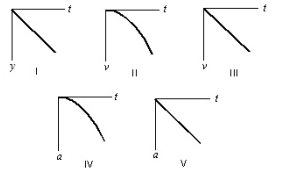
(Multiple Choice)
4.8/5 (86)
(86) 
Filters
- Essay(0)
- Multiple Choice(0)
- Short Answer(0)
- True False(0)
- Matching(0)