



 Chat with AI
Exam 2: Motion Along a Straight Line

Exam 1: Measurement37 Questions
Exam 2: Motion Along a Straight Line90 Questions
Exam 3: Vector32 Questions
Exam 4: Motion in Two and Three Dimensions53 Questions
Exam 5: Force and Motion I73 Questions
Exam 6: Force and Motion II74 Questions
Exam 7: Kinetic Energy and Work72 Questions
Exam 8: Potential Energy and Conservation of Energy62 Questions
Exam 9: Center of Mass and Linear Momentum98 Questions
Exam 10: Rotation99 Questions
Exam 11: Rolling, Torque, and Angular Momentum65 Questions
Exam 12: Equilibrium and Elasticity57 Questions
Exam 13: Gravitation54 Questions
Exam 14: Fluids87 Questions
Exam 15: Oscillations75 Questions
Exam 16: Waves I80 Questions
Exam 17: Waves II70 Questions
Exam 18: Temperature, Heat, and the First Law of Thermodynamics96 Questions
Exam 19: The Kinetic Theory of Gases111 Questions
Exam 20: Entropy and the Second Law of Thermodynamics61 Questions
Exam 21: Electric Charge51 Questions
Exam 22: Electric Fields52 Questions
Exam 23: Gauss Law39 Questions
Exam 24: Electric Potential50 Questions
Exam 25: Capacitance59 Questions
Exam 26: Current and Resistance54 Questions
Exam 27: Circuits73 Questions
Exam 28: Magnetic Fields51 Questions
Exam 29: Magnetic Fields Due to Currents48 Questions
Exam 30: Induction and Inductance90 Questions
Exam 31: Electromagnetic Oscillations and Alternating Current86 Questions
Exam 32: Maxwells Equations; Magnetism of Matter81 Questions
Exam 33: Electromagnetic Waves81 Questions
Exam 34: Images78 Questions
Exam 35: Interference45 Questions
Exam 36: Diffraction77 Questions
Exam 37: Relativity68 Questions
Exam 38: Photons and Matter Waves57 Questions
Exam 39: More About Matter Waves41 Questions
Exam 40: All About Atoms76 Questions
Exam 41: Conduction of Electricity in Solids49 Questions
Exam 42: Nuclear Physics68 Questions
Exam 43: Energy From the Nucleus50 Questions
Exam 44: Quarks, Leptons, and the Big Bang55 Questions
Select questions type


The position y of a particle moving along the y axis depends on the time t according to the equation y = at - bt2.The dimensions of the quantities a and b are respectively:
(Multiple Choice)
4.8/5  (71)
(71) At a location where g = 9.80 m/s2, an object is thrown vertically down with an initial speed of 1.00 m/s.After 5.00 s the object will have traveled:
(Multiple Choice)
4.9/5 (68)
(68) An object is thrown vertically into the air.Which of the following five graphs represents the velocity (v)of the object as a function of the time (t)? The positive direction is taken to be upward. 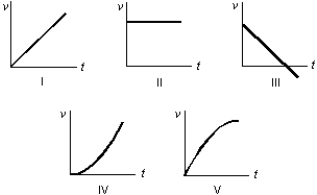
(Multiple Choice)
4.9/5 (74)
(74) Over a short interval, starting at time t = 0, the coordinate of an automobile in meters is given by x(t)= 27t - 4.0t3, where t is in seconds.The magnitudes of the initial (at t = 0)velocity and acceleration of the auto respectively are:
(Multiple Choice)
5.0/5 (75)
(75) An object starts from rest at the origin and moves along the x axis with a constant acceleration of 4 m/s2.Its average velocity as it goes from x = 2 m to x = 8 m is:
(Multiple Choice)
4.8/5 (85)
(85) The coordinate of an object is given as a function of time by x = 7t - 3t2, where x is in meters and t is in seconds.Its average velocity over the interval from t = 0 to t = 2 s is:
(Multiple Choice)
4.8/5 (92)
(92) A racing car traveling with constant acceleration increases its speed from 10 m/s to 30 m/s over a distance of 60 m? How long does this take?
(Multiple Choice)
4.9/5 (68)
(68) An object is thrown straight up from ground level with a speed of 50 m/s.If g = 10 m/s2 its distance above ground level 1.0 second later is:
(Multiple Choice)
4.8/5 (80)
(80) A freely falling body has a constant acceleration of 9.8 m/s2.This means that:
(Multiple Choice)
4.9/5 (92)
(92) An elevator is moving upward with constant acceleration.The dashed curve shows the position y of the ceiling of the elevator as a function of the time t.At the instant indicated by the dot, a bolt breaks loose and drops from the ceiling.Which curve best represents the position of the bolt as a function of time? 
(Multiple Choice)
4.9/5 (73)
(73) An object starts from rest and has a constant acceleration of 3 m/s2.The position versus time graph for this object has a slope:
(Multiple Choice)
4.9/5 (75)
(75) Neglecting the effect of air resistance, a stone dropped off a 175-m high building lands on the ground in:
(Multiple Choice)
4.8/5 (80)
(80) A stone is released from rest from the edge of a building roof 190 m above the ground.Neglecting air resistance, the speed of the stone, just before striking the ground, is:
(Multiple Choice)
4.9/5 (82)
(82) A drag racing car starts from rest at t = 0 and moves along a straight line with velocity given by v = bt2, where b is a constant.The expression for the distance traveled by this car from its position at t = 0 is:
(Multiple Choice)
4.8/5 (83)
(83) At time t = 0 a car has a velocity of 16 m/s.It slows down with an acceleration given by a = -0.50t, in m/s2 for t in seconds.At the end of 4.0 s it has traveled:
(Multiple Choice)
5.0/5 (77)
(77) An object dropped from a window of a tall building hits the ground in 12.0 s.If its acceleration is 9.80 m/s2, the height of the window above the ground is (you may neglect air resistance):
(Multiple Choice)
4.8/5 (72)
(72) All falling objects experience some air resistance, the effect of which is to decrease acceleration.When the falling object's acceleration reaches zero, the acceleration stops changing.Therefore, if you drop an object and it falls far enough for this to happen,
(Multiple Choice)
4.9/5 (70)
(70) An object is thrown vertically upward at 35 m/s.Taking g = 10 m/s2, the velocity of the object 5 seconds later is:
(Multiple Choice)
4.8/5 (79)
(79) This graph shows the velocity of a particle as a function of time.During what interval is its displacement negative? 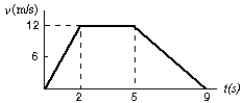
(Multiple Choice)
4.8/5 (74)
(74) The coordinate of an object is given as a function of time by x = 7t - 3t2, where x is in meters and t is in seconds.Its velocity at t = 3s is:
(Multiple Choice)
4.9/5 (78)
(78) 
Filters
- Essay(0)
- Multiple Choice(0)
- Short Answer(0)
- True False(0)
- Matching(0)