



 Chat with AI
Exam 8: Transport Across Membranes: Overcoming the Permeability Barrier

Exam 1: A Preview of Cell Biology56 Questions
Exam 2: The Chemistry of the Cell57 Questions
Exam 3: The Macromolecules of the Cell58 Questions
Exam 4: Cells and Organelles58 Questions
Exam 5: Bioenergetics: the Flow of Energy in the Cell44 Questions
Exam 6: Enzymes: the Catalysts of Life52 Questions
Exam 7: Membranes: Their Structure,function,and Chemistry61 Questions
Exam 8: Transport Across Membranes: Overcoming the Permeability Barrier58 Questions
Exam 9: Chemotrophic Energy Metabolism: Glycolysis and Fermentation60 Questions
Exam 10: Chemotrophic Energy Metabolism: Aerobic Respiration58 Questions
Exam 11: Phototrophic Energy Metabolism: Photosynthesis58 Questions
Exam 12: The Endomembrane System54 Questions
Exam 13: Cytoskeletal Systems61 Questions
Exam 14: Cellular Movement: Motility and Contractility62 Questions
Exam 15: Beyond the Cell: Cell Adhesions, cell Junctions, and Extracellular Structures60 Questions
Exam 16: The Structural Basis of Cellular Information: Dna, chromosomes, and the Nucleus56 Questions
Exam 17: DNA Replication, repair, and Recombination53 Questions
Exam 18: Gene Expression: Ithe Genetic Code and Transcription54 Questions
Exam 19: Gene Expression: Iiprotein Synthesis and Sorting57 Questions
Exam 20: The Regulation of Gene Expression56 Questions
Exam 21: Molecular Biology Techniques for Cell Biology56 Questions
Exam 22: Signal Transduction Mechanisms: Ielectrical and Synaptic Signaling in Neurons53 Questions
Exam 23: Signal Transduction Mechanisms: Iimessengers and Receptors65 Questions
Exam 24: The Cell Cycle and Mitosis66 Questions
Exam 25: Sexual Reproduction,meiosis,and Genetic Recombination64 Questions
Select questions type


Because the procedure you are using to modify plants requires their cell membranes to be pulled away from the cell walls by plasmolysis,you place the cells in a(n)
(Multiple Choice)
5.0/5  (89)
(89) The graph below shows the concentrations of B and C inside the cell over time when the cell that has imported B and C in Figure 8.1 above is transferred to a solution containing a much lower concentration of B and C.Based on these data and coupled with the data observed above,substance C is transported via 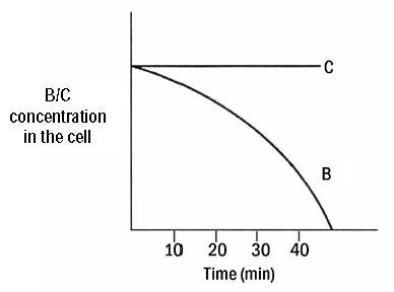
(Multiple Choice)
4.9/5 (70)
(70) When erythrocytes are in the capillaries of body tissues,CO2 diffuses ________ and is converted to ________.
(Short Answer)
4.9/5 (79)
(79) Urea is a small molecule that is transported out of most cells by passive diffusion,but some cells,including kidney cells,have urea-facilitated transporters.Given an assay to measure the amount of urea on one side of the cell plasma,design an experiment to distinguish which mechanism an uncharacterized cell you have isolated uses to transport urea.Include graphs,if this aids in your discussion.
(Essay)
4.7/5 (72)
(72) When Peter Agre and colleagues compared frog oocytes expressing aquaporin with control oocytes lacking aquaporin placed in pure water,they found that
(Multiple Choice)
4.9/5 (95)
(95) Transmembrane movement of a substance down a concentration gradient with no involvement of membrane proteins is called ________.
(Short Answer)
4.8/5 (77)
(77) The energy necessary to drive the bacteriorhodopsin proton pump that creates the proton gradient needed for ATP synthesis is generated by
(Multiple Choice)
4.9/5 (78)
(78) The erythrocyte anion exchange protein "ping-pong" transport mechanism involves
(Multiple Choice)
4.9/5 (80)
(80) Consider a nerve cell with an internal Cl- concentration of 50 mM,a membrane potential of 60 mV and an external Cl- concentration of 100 mM.Each of the following is true for Cl- import into the cell except
(Multiple Choice)
4.8/5 (85)
(85) Transmembrane movement of a substance down a concentration gradient by a membrane protein is called ________.
(Short Answer)
4.9/5 (63)
(63) Which of the following types of transport occur across the erythrocyte membrane?
(Multiple Choice)
4.8/5 (86)
(86) The outer membranes of bacteria,mitochondria,and chloroplasts contain large nonselective channels made of multipass proteins known as ________ in which the transmembrane segment of the protein is composed of a ________.
(Short Answer)
4.8/5 (78)
(78) Consider an erythrocyte with an internal glucose concentration of 0.1 mM and an external glucose concentration of 5 mM.Each of the following is true about GLUT1 transport of glucose across the plasma membrane into the cell except
(Multiple Choice)
4.9/5 (92)
(92) Which of the following is true for the mechanism of the 2Na+/glucose symporter?
(Multiple Choice)
4.9/5 (77)
(77) 
Filters
- Essay(0)
- Multiple Choice(0)
- Short Answer(0)
- True False(0)
- Matching(0)