



 Chat with AI
Exam 1: Discovering the Night Sky

Exam 1: Discovering the Night Sky374 Questions
Exam 2: Gravitation and the Motion of the Planets356 Questions
Exam 3: Light and Telescopes275 Questions
Exam 4: Atomic Physics and Spectra223 Questions
Exam 5: Exoplanets and the Formation of Planetary Systems98 Questions
Exam 6: Formation of the Solar System121 Questions
Exam 7: Earth and the Moon305 Questions
Exam 8: The Other Terrestrial Planets265 Questions
Exam 9: The Outer Planets360 Questions
Exam 10: Vagabonds of the Solar System198 Questions
Exam 11: The Sun: Our Extraordinary Star248 Questions
Exam 12: Characterizing Stars254 Questions
Exam 13: The Lives of Stars From Birth Through Middle Age325 Questions
Exam 14: The Death of Stars235 Questions
Exam 15: Black Holes: Matters of Gravity178 Questions
Exam 16: The Milky Way Galaxy157 Questions
Exam 17: Galaxies207 Questions
Exam 18: Quasars and Other Active Galaxies118 Questions
Exam 19: Cosmology217 Questions
Exam 20: Astrobiology71 Questions
Select questions type


Suppose the Moon moved westward rather than eastward in its orbit. How would eclipses be affected?
(Multiple Choice)
4.8/5  (75)
(75) How long will it take, in solar time, for the Big Dipper, to return to the same position in an observer's sky?
(Multiple Choice)
4.8/5 (69)
(69) An observer is studying the horizon from somewhere in the northern hemisphere, and he sees that the stars are setting, following a slanted path from the observer's upper right to the horizon on their left. Which horizon are they facing?
(Multiple Choice)
4.8/5 (80)
(80) The most recent correction to the calendar to keep the yearly date in tune with the seasons (resulting in the present calendar) was instituted by
(Multiple Choice)
4.8/5 (70)
(70) The Moon is seen to keep one face toward Earth at all times. If viewed from a point directly above the plane of the planetary system, how does it have to rotate to maintain this alignment?
(Multiple Choice)
4.9/5 (82)
(82) How do the alt-azimuth coordinates of a star compare with the R.A., Dec. coordinates of that same star?
(Multiple Choice)
4.8/5 (74)
(74) How much of the total surface of the Moon is illuminated by the Sun when it is at quarter phase?
(Multiple Choice)
4.9/5 (84)
(84) If there are about 6000 stars in the entire sky that can be seen by the unaided human eye, about how many stars would be seen at a particular instant on a given dark night from a single location with an uninterrupted distant horizon?
(Multiple Choice)
4.9/5 (84)
(84) Polaris is the name for the bright star almost directly in line with the north polar axis of Earth. What is the name of the bright star almost directly in line with the south polar axis of Earth?
(Multiple Choice)
4.8/5 (82)
(82) Which of these lines or points is always directly overhead, no matter the location on Earth?
(Multiple Choice)
5.0/5 (80)
(80) The alt-azimuth coordinate system, as defined in the text, is useful
(Multiple Choice)
4.9/5 (69)
(69) For an observer standing on the equator, which of these positions in the sky would pass directly over their head (i.e., through their zenith)? See Figure 1-17. 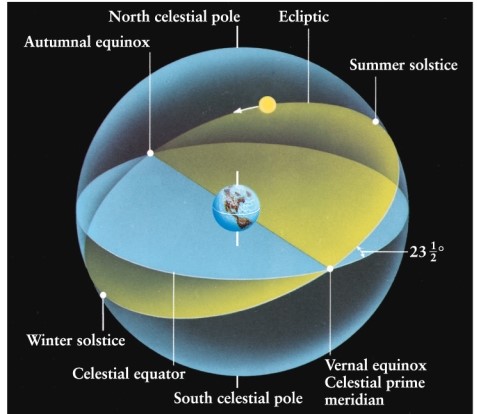
(Multiple Choice)
4.8/5 (72)
(72) The position in Earth's orbit around the Sun that at present corresponds to winter solstice will instead correspond to summer solstice in about _____ years.
(Multiple Choice)
4.8/5 (78)
(78) The average distance from Earth to the Sun, 149,600,000 km, can be written in scientific notation as
(Multiple Choice)
4.7/5 (70)
(70) About how much time passes between a new Moon and the first quarter?
(Multiple Choice)
4.8/5 (90)
(90) A comet that is moving southward from the north celestial pole toward the equator can be described as having its
(Multiple Choice)
4.9/5 (86)
(86) 
Filters
- Essay(0)
- Multiple Choice(0)
- Short Answer(0)
- True False(0)
- Matching(0)