



 Chat with AI
Exam 1: Discovering the Night Sky

Exam 1: Discovering the Night Sky374 Questions
Exam 2: Gravitation and the Motion of the Planets356 Questions
Exam 3: Light and Telescopes275 Questions
Exam 4: Atomic Physics and Spectra223 Questions
Exam 5: Exoplanets and the Formation of Planetary Systems98 Questions
Exam 6: Formation of the Solar System121 Questions
Exam 7: Earth and the Moon305 Questions
Exam 8: The Other Terrestrial Planets265 Questions
Exam 9: The Outer Planets360 Questions
Exam 10: Vagabonds of the Solar System198 Questions
Exam 11: The Sun: Our Extraordinary Star248 Questions
Exam 12: Characterizing Stars254 Questions
Exam 13: The Lives of Stars From Birth Through Middle Age325 Questions
Exam 14: The Death of Stars235 Questions
Exam 15: Black Holes: Matters of Gravity178 Questions
Exam 16: The Milky Way Galaxy157 Questions
Exam 17: Galaxies207 Questions
Exam 18: Quasars and Other Active Galaxies118 Questions
Exam 19: Cosmology217 Questions
Exam 20: Astrobiology71 Questions
Select questions type


The so-called "pointer stars" in Ursa Major, the Big Dipper, are separated by about 5 degrees on the sky. How many Moon diameters would fit between them? See Figure 1-5 for a diagram of these stars in context. 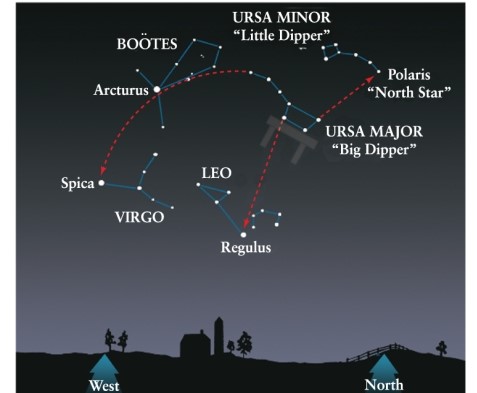
(Multiple Choice)
4.9/5  (78)
(78) The accurate prediction of the time and position of a total solar eclipse is
(Multiple Choice)
4.9/5 (74)
(74) The tropical year is different from the sidereal year because
(Multiple Choice)
4.9/5 (73)
(73) If the horizon is considered to be split into northern and southern parts by the east-west line, can the Sun ever rise in the northern part of the sky when viewed from a mid-latitude site in the southern hemisphere?
(Multiple Choice)
5.0/5 (81)
(81) A particular star is seen to cross the horizon at 10:00 P.M. (22:00 hours) on a particular night. When would this star cross the horizon on the next night, from the same location?
(Multiple Choice)
4.9/5 (86)
(86) If the polar axis of Earth moves through a full circle in 26,000 years as a result of precession (see Figure 1-22a), how long will it take for the line between the center of the circle and the spin axis to move through 180° (i.e., to the other side of the circle)? 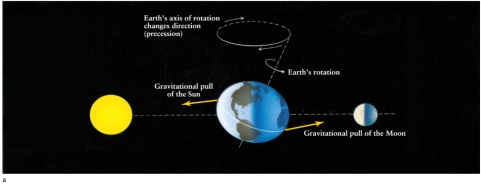
(Multiple Choice)
4.8/5 (69)
(69) The alt-azimuth coordinates an observer measures for Polaris are 37, 0. From what longitude was this observation made?
(Multiple Choice)
4.8/5 (77)
(77) Which of these statements about eclipses in the Sun-Earth-Moon system is correct?
(Multiple Choice)
4.8/5 (87)
(87) What is 1016 divided by a million and multiplied by a hundred?
(Multiple Choice)
4.8/5 (95)
(95) To which constellation will the north celestial pole be closest in the year 14,000 A.D. (see Figure 1-22c)? 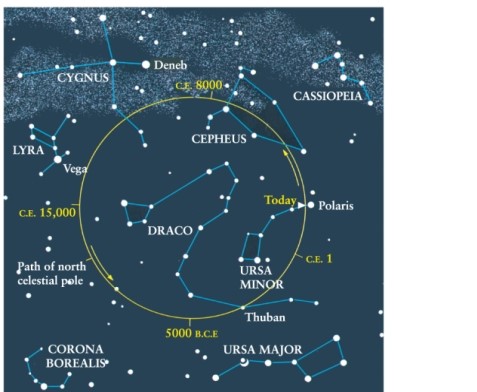
(Multiple Choice)
4.8/5 (76)
(76) From the northern hemisphere, where in the sky would an observer expect to see true astronomical new Moon?
(Multiple Choice)
4.9/5 (80)
(80) The city of Bristol, England, is located to the west of and in the same time zone as London. Astronomical noon in Bristol, when the Sun is highest in the sky, compared to astronomical noon in London occurs
(Multiple Choice)
4.7/5 (75)
(75) Twice per year, when day and night are equal in length, the Sun is at one of two positions in the sky known as equinoxes. These points are the intersections of which two planes in the sky?
(Multiple Choice)
4.9/5 (81)
(81) The reason leap years have an extra day is to account for the fact that the
(Multiple Choice)
4.7/5 (85)
(85) 
Filters
- Essay(0)
- Multiple Choice(0)
- Short Answer(0)
- True False(0)
- Matching(0)