



 Chat with AI
Exam 11: The Sun: Our Extraordinary Star

Exam 1: Discovering the Night Sky374 Questions
Exam 2: Gravitation and the Motion of the Planets356 Questions
Exam 3: Light and Telescopes275 Questions
Exam 4: Atomic Physics and Spectra223 Questions
Exam 5: Exoplanets and the Formation of Planetary Systems98 Questions
Exam 6: Formation of the Solar System121 Questions
Exam 7: Earth and the Moon305 Questions
Exam 8: The Other Terrestrial Planets265 Questions
Exam 9: The Outer Planets360 Questions
Exam 10: Vagabonds of the Solar System198 Questions
Exam 11: The Sun: Our Extraordinary Star248 Questions
Exam 12: Characterizing Stars254 Questions
Exam 13: The Lives of Stars From Birth Through Middle Age325 Questions
Exam 14: The Death of Stars235 Questions
Exam 15: Black Holes: Matters of Gravity178 Questions
Exam 16: The Milky Way Galaxy157 Questions
Exam 17: Galaxies207 Questions
Exam 18: Quasars and Other Active Galaxies118 Questions
Exam 19: Cosmology217 Questions
Exam 20: Astrobiology71 Questions
Select questions type


Which of these features appears in the spectrum of the solar corona and indicates very high gas temperatures?
(Multiple Choice)
4.9/5  (86)
(86) Over the course of a typical sunspot cycle, the position of the appearance of new sunspots moves from
(Multiple Choice)
4.9/5 (74)
(74) What type of intensity distribution is seen across the image of the visible Sun from center to edge?
(Multiple Choice)
4.7/5 (73)
(73) Galileo observed the phenomenon of solar rotation in the early 1600s by
(Multiple Choice)
4.8/5 (81)
(81) How much longer can the Sun continue to generate energy by nuclear reactions in its core?
(Multiple Choice)
4.9/5 (76)
(76) The young Sun had a core containing less helium and more hydrogen than it has now. Which of these was NOT true of the young Sun, compared with the present Sun?
(Multiple Choice)
5.0/5 (76)
(76) If granulation on the Sun's surface is a result of convective motion below it, with material upwelling at cell centers and returning between the cells, what is the expected temperature distribution across a granular cell?
(Multiple Choice)
4.9/5 (77)
(77) Why is the solar corona so much hotter than the photosphere?
(Multiple Choice)
4.9/5 (78)
(78) Which of these bodies does NOT exhibit some differential rotation?
(Multiple Choice)
4.8/5 (62)
(62) Many images of the chromosphere are taken through a filter that allows only specific wavelengths to pass. One reason for this is
(Multiple Choice)
4.8/5 (78)
(78) Which of these is NOT a characteristic of coronal mass ejections?
(Multiple Choice)
4.9/5 (70)
(70) What is the average length of a complete cycle of sunspots and magnetic fields on the Sun?
(Multiple Choice)
4.8/5 (71)
(71) To what does the term "hydrostatic equilibrium" in the Sun refer?
(Multiple Choice)
4.9/5 (81)
(81) The average sunspot group on the solar surface will last for about
(Multiple Choice)
4.8/5 (75)
(75) According to the theoretical model of the Sun shown graphically in Figure 11-23 in the text, where is the vast majority of solar energy generated? 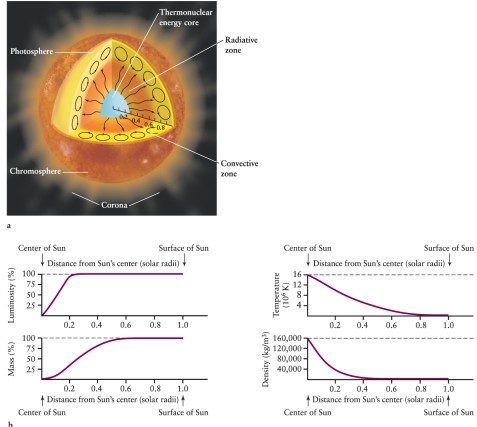
(Multiple Choice)
4.9/5 (88)
(88) 
Filters
- Essay(0)
- Multiple Choice(0)
- Short Answer(0)
- True False(0)
- Matching(0)