



 Chat with AI
Exam 16: The Milky Way Galaxy

Exam 1: Discovering the Night Sky374 Questions
Exam 2: Gravitation and the Motion of the Planets356 Questions
Exam 3: Light and Telescopes275 Questions
Exam 4: Atomic Physics and Spectra223 Questions
Exam 5: Exoplanets and the Formation of Planetary Systems98 Questions
Exam 6: Formation of the Solar System121 Questions
Exam 7: Earth and the Moon305 Questions
Exam 8: The Other Terrestrial Planets265 Questions
Exam 9: The Outer Planets360 Questions
Exam 10: Vagabonds of the Solar System198 Questions
Exam 11: The Sun: Our Extraordinary Star248 Questions
Exam 12: Characterizing Stars254 Questions
Exam 13: The Lives of Stars From Birth Through Middle Age325 Questions
Exam 14: The Death of Stars235 Questions
Exam 15: Black Holes: Matters of Gravity178 Questions
Exam 16: The Milky Way Galaxy157 Questions
Exam 17: Galaxies207 Questions
Exam 18: Quasars and Other Active Galaxies118 Questions
Exam 19: Cosmology217 Questions
Exam 20: Astrobiology71 Questions
Select questions type


When astronomers look out into the plane of the Milky Way Galaxy, how far can they see?
(Multiple Choice)
5.0/5  (82)
(82) The presence of a very large amount of unseen matter ("dark matter") in the halo of the Milky Way Galaxy is deduced from
(Multiple Choice)
4.9/5 (86)
(86) The 21-cm line is one of the most important wavelengths in radio astronomy. It is produced mainly in
(Multiple Choice)
5.0/5 (80)
(80) A small galaxy orbits a larger one. After many orbits, the stars in the small galaxy have dispersed throughout the halo of the larger. This is an example of
(Multiple Choice)
4.8/5 (64)
(64) How far away from Earth is the Andromeda Galaxy compared with the diameter of the Milky Way Galaxy?
(Multiple Choice)
4.8/5 (93)
(93) A map of the Milky Way Galaxy deduced from radio observations of the 21-cm line emission from cool hydrogen gas and observations of spiral arm tracers such as giant molecular clouds reveals
(Multiple Choice)
4.9/5 (79)
(79) What quantum transition occurs inside a hydrogen atom to produce a 21-cm radio photon?
(Multiple Choice)
4.8/5 (67)
(67) If the Sun were to be at or close to the galactic center of the Milky Way, the intensity of starlight in the nighttime sky on Earth would be
(Multiple Choice)
5.0/5 (84)
(84) The present estimate for the total mass of the Milky Way Galaxy in units of solar mass is about _____.
(Multiple Choice)
4.7/5 (81)
(81) Interstellar matter obscures Earth's view of the disk of the Milky Way Galaxy
(Multiple Choice)
4.9/5 (75)
(75) Which component of the Milky Way Galaxy accounts for interstellar extinction, the dimming of light from distant objects?
(Multiple Choice)
4.9/5 (66)
(66) If interstellar dust obscures astronomers' view of distant regions of space at optical wavelengths, which of these statements is true?
(Multiple Choice)
4.8/5 (65)
(65) Who won the Shapley-Curtis debate when it concluded in 1920?
(Multiple Choice)
4.8/5 (76)
(76) What has microlensing told astronomers about the role of brown dwarfs in the Milky Way Galaxy?
(Multiple Choice)
4.9/5 (85)
(85) Positrons (positively charged electrons) are being produced in the galactic center of the Milky Way. How have the positrons been detected?
(Multiple Choice)
4.8/5 (69)
(69) What atomic transition occurs in the atoms of hydrogen gas in the spiral arms of the Milky Way Galaxy to produce the 21-cm radio emission?
(Multiple Choice)
5.0/5 (98)
(98) A classical Cepheid variable star in a distant galaxy has an apparent magnitude of +20.3. By measuring its period and using the period-luminosity relation, its absolute magnitude is -6.0. Assuming that there is no interstellar absorption, what is the distance to the galaxy in parsecs?
(Multiple Choice)
4.8/5 (84)
(84) What is the significance of the object Sagittarius A* ("Sagittarius A-star") in the Milky Way Galaxy?
(Multiple Choice)
4.8/5 (74)
(74) A radio astronomer points a radio telescope through the Milky Way's disk in a direction directly away from the center of the Galaxy. If the astronomer measures the Doppler shift of the 21-cm radio line of hydrogen from interstellar clouds at several different distances from the Sun along this line of sight, what should be the result? Refer to Figure 16-8 from the text. 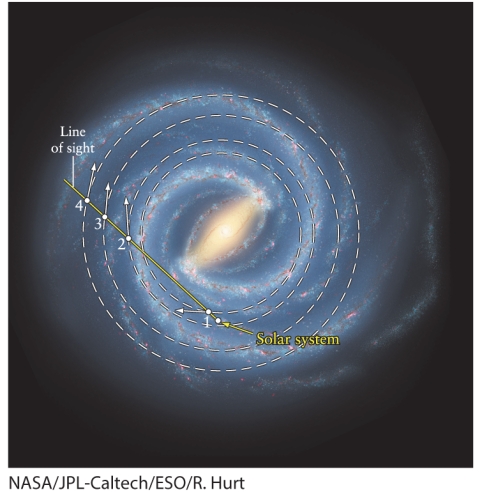
(Multiple Choice)
4.8/5 (85)
(85) The luminosity of a Cepheid variable star compared with that of the Sun is
(Multiple Choice)
4.9/5 (84)
(84) 
Filters
- Essay(0)
- Multiple Choice(0)
- Short Answer(0)
- True False(0)
- Matching(0)