



 Chat with AI
Exam 16: The Milky Way Galaxy

Exam 1: Discovering the Night Sky374 Questions
Exam 2: Gravitation and the Motion of the Planets356 Questions
Exam 3: Light and Telescopes275 Questions
Exam 4: Atomic Physics and Spectra223 Questions
Exam 5: Exoplanets and the Formation of Planetary Systems98 Questions
Exam 6: Formation of the Solar System121 Questions
Exam 7: Earth and the Moon305 Questions
Exam 8: The Other Terrestrial Planets265 Questions
Exam 9: The Outer Planets360 Questions
Exam 10: Vagabonds of the Solar System198 Questions
Exam 11: The Sun: Our Extraordinary Star248 Questions
Exam 12: Characterizing Stars254 Questions
Exam 13: The Lives of Stars From Birth Through Middle Age325 Questions
Exam 14: The Death of Stars235 Questions
Exam 15: Black Holes: Matters of Gravity178 Questions
Exam 16: The Milky Way Galaxy157 Questions
Exam 17: Galaxies207 Questions
Exam 18: Quasars and Other Active Galaxies118 Questions
Exam 19: Cosmology217 Questions
Exam 20: Astrobiology71 Questions
Select questions type


Why is the black hole at the center of the Milky Way growing very slowly in comparison to some other black holes?
(Multiple Choice)
4.9/5  (86)
(86) The idea that some of the nebulae that are observed in the sky might be "island universes," immense collections of stars far beyond the Milky Way, was first proposed by
(Multiple Choice)
4.8/5 (74)
(74) Recent observations seem to indicate that, rather than being a spiral galaxy, the Milky Way may be
(Multiple Choice)
4.9/5 (82)
(82) The major features of the Milky Way Galaxy have been found to include all of these EXCEPT
(Multiple Choice)
4.9/5 (83)
(83) Why are astronomers on Earth able to see only a relatively small part of the Milky Way Galaxy?
(Multiple Choice)
4.9/5 (80)
(80) If the black hole in the center of the Galaxy is 4 * 106 solar masses, what would be its radius (that is, the radius of its event horizon)?
(Multiple Choice)
4.8/5 (83)
(83) Suppose astronomers could examine a star and determine its apparent magnitude M without any intervening gas and dust. Compared to its apparent magnitude measured with gas and dust between Earth and the star, this "clean" measurement of M would be
(Multiple Choice)
4.9/5 (81)
(81) What evidence now exists for a supermassive black hole at the center of the Milky Way Galaxy?
(Multiple Choice)
4.8/5 (71)
(71) The period-luminosity relationship for Cepheid variable stars, relating variability to absolute overall brightness, was discovered by
(Multiple Choice)
4.8/5 (81)
(81) In 1917, Harlow Shapley plotted the positions of almost a hundred globular clusters. But the galactic plane is cloaked by gas and dust, and the best way to "see" through this is with long wavelength radio waves. However, in 1917 radio astronomy did not exist. How did Shapley accomplish his task?
(Multiple Choice)
4.8/5 (71)
(71) A classical Cepheid variable star is seen to vary regularly with a period of 25 days. Approximately how many times brighter than the Sun would this star appear to be if it were to replace the Sun in the solar system? Refer to Figure 16-4 from the text. 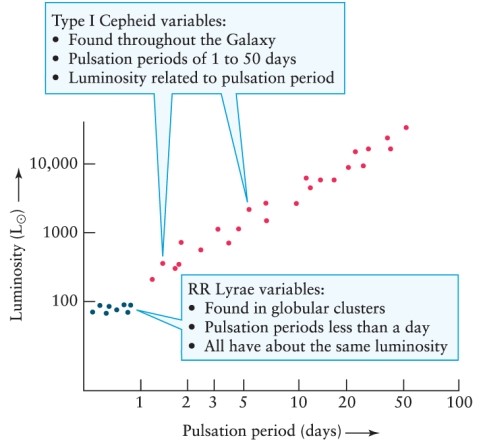
(Multiple Choice)
4.9/5 (84)
(84) Radio waves of 21-cm wavelength originate from which component of the interstellar medium?
(Multiple Choice)
4.9/5 (75)
(75) What was the implication of the observation by Hubble that the Cepheid variable stars he measured in the Andromeda "nebula" appeared to be very faint compared with what was expected?
(Multiple Choice)
4.8/5 (72)
(72) The orbits of stars around the center of the Milky Way Galaxy suggest that the mass at the center of the Galaxy is about 4 million solar masses. What is believed to be the diameter of this supermassive object?
(Multiple Choice)
4.9/5 (83)
(83) The ratio of thickness to diameter of the Milky Way Galaxy is
(Multiple Choice)
4.9/5 (84)
(84) What physical process has allowed astronomers to rule out brown dwarfs as the source of dark matter in the Milky Way Galaxy?
(Multiple Choice)
4.8/5 (71)
(71) Harlow Shapley's original estimate of the distance from the Sun to the galactic center was incorrect because it did not take scattering by interstellar dust into account. Shapley's original estimate was
(Multiple Choice)
4.8/5 (79)
(79) The 21-cm line is one of the most important wavelengths in radio astronomy. The fact that it is a relatively long wavelength is important because long wavelengths
(Multiple Choice)
4.7/5 (85)
(85) In a recent survey of stars in the sky, it was found that occasionally a star that is normally of constant brightness will slowly brighten and then fade back to its original brightness again over the space of several weeks. What is believed to be the cause of this change in brightness?
(Multiple Choice)
4.8/5 (77)
(77) 
Filters
- Essay(0)
- Multiple Choice(0)
- Short Answer(0)
- True False(0)
- Matching(0)