



 Chat with AI
Exam 16: Externalities, Public Goods, and Common Resources

Exam 1: The Scope and Method of Economics241 Questions
Exam 2: The Economic Problem: Scarcity and Choice218 Questions
Exam 3: Demand, Supply, and Market Equilibrium309 Questions
Exam 4: Demand and Supply Applications173 Questions
Exam 5: Elasticity188 Questions
Exam 6: Household Behavior and Consumer Choice272 Questions
Exam 7: The Production Process: the Behavior of Profit-Maximizing Firms287 Questions
Exam 8: Short-Run Costs and Output Decisions386 Questions
Exam 9: Long-Run Costs and Output Decisions363 Questions
Exam 10: Input Demand: the Labor and Land Markets200 Questions
Exam 11: Input Demand: the Capital Market and the Investment Decision218 Questions
Exam 12: General Equilibrium and the Efficiency of Perfect Competition202 Questions
Exam 13: Monopoly and Antitrust Policy394 Questions
Exam 14: Oligopoly219 Questions
Exam 15: Monopolistic Competition235 Questions
Exam 16: Externalities, Public Goods, and Common Resources275 Questions
Exam 17: Uncertainty and Asymmetric Information134 Questions
Exam 18: Income Distribution and Poverty197 Questions
Exam 19: Public Finance: the Economics of Taxation281 Questions
Exam 20: International Trade, Comparative Advantage, and Protectionism287 Questions
Exam 21: Economic Growth in Developing Economies133 Questions
Exam 22: Critical Thinking About Research104 Questions
Select questions type


Refer to the information provided in Figure 16.4 below to answer the question(s) that follow.
Los Angeles International Airport (LAX) is located next to Playa Del Rey. The noise from air traffic negatively affects individuals living in Playa Del Rey, however, this cost is not considered by airlines or air travelers. The airlines feel they have a right to use the airspace while the individuals living in Playa Del Rey feel they have the right to quiet. The following diagram depicts the marginal costs and marginal benefits associated with air travel. 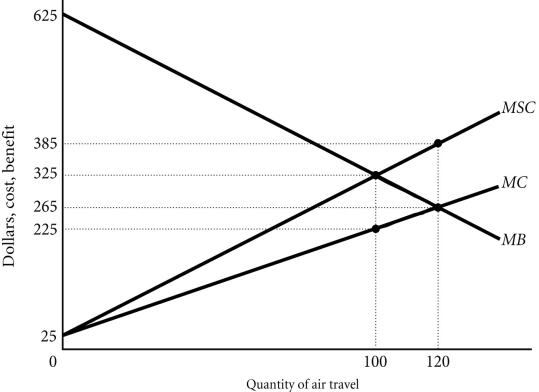 Figure 16.4
-Refer to Figure 16.4. Suppose the government assigns property rights to the airlines. No negotiations occur between the parties. The resulting level of air travel is
Figure 16.4
-Refer to Figure 16.4. Suppose the government assigns property rights to the airlines. No negotiations occur between the parties. The resulting level of air travel is (Multiple Choice)
4.9/5  (71)
(71) There are 12 families in a gated community that are affected by air pollution from a local factory. The pollution could be reduced if the company spent $24,000 on upgraded ventilators. The company agrees to install the ventilators if the affected families contribute the $24,000. Since there are no legal restrictions governing the factory's air pollution the negotiations fail. This outcome is an example of the
(Multiple Choice)
4.9/5 (95)
(95) You will still be able to get public broadcasting whether or not you contribute to their fund-raising campaign, so you decide ________ contribute. This is an example of the free-rider problem, and is intrinsic to ________ goods.
(Multiple Choice)
4.8/5 (64)
(64) There are 10,000 families in a neighborhood that are affected by noise pollution from a local factory. The noise could be reduced if the company spent $5,000 on technological improvements. The company agrees to make these improvements if the affected families contribute the $5,000. Since there are so many families, they fail to come to a resolution to which they will all agree. This outcome is an example of the
(Multiple Choice)
4.9/5 (86)
(86) For private goods, market demand is the ________ summation of individual demand curves and for public goods, market demand is the ________ summation of individual demand curves.
(Multiple Choice)
4.9/5 (90)
(90) Assuming no externalities exist, if a good's price is more than its marginal cost, then the benefits consumers derive are ________ than the cost of resources needed to produce it and ________ should be produced.
(Multiple Choice)
4.7/5 (83)
(83) Refer to the information provided in Figure 16.3 below to answer the question(s) that follow. 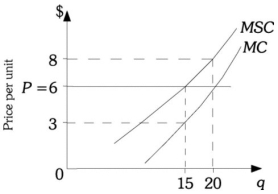 Figure 16.3
-Refer to Figure 16.3. The ________ level of output of this product is 15.
Figure 16.3
-Refer to Figure 16.3. The ________ level of output of this product is 15. (Multiple Choice)
4.8/5 (81)
(81) When a perfectly competitive firm weighs price and marginal cost and no externalities exist, it is weighing the full benefits to ________ of additional production against the full costs to ________ of that production.
(Multiple Choice)
4.9/5 (85)
(85) A ________ is nonrival in consumption and listeners are nonexcludable.
(Multiple Choice)
4.8/5 (88)
(88) If there are external costs of production and perfectly competitive firms do not account for these costs, at the equilibrium level of output
(Multiple Choice)
4.7/5 (85)
(85) You accidentally run into your next door neighbor's fence and destroy it. Your neighbor sues you and you are required to pay $1,000 to repair the fence. This is an example of
(Multiple Choice)
4.9/5 (74)
(74) Refer to the information given in Table 16.8 below to answer the question that follows.
Table 16.8
Number of Police Officers Tim's Willingness to Pay Al's Willingness to Pay 1 \ 200 \ 120 2 160 40 3 100 20
-Refer to Table 16.8. Assume that the marginal cost of hiring a police officer is $120. If A and B are the only two people in the society, the optimal number of police officers is
(Multiple Choice)
4.8/5 (72)
(72) If, at a low cost, you cannot prevent a person from benefiting from the consumption of a good you produced, the good is
(Multiple Choice)
4.8/5 (92)
(92) ________ demonstrates that an optimal (or most efficient) level of output exists for every public good.
(Multiple Choice)
4.8/5 (82)
(82) A radio signal broadcast through the air is ________ in consumption, and listeners are ________.
(Multiple Choice)
4.9/5 (95)
(95) Refer to the information provided in Figure 16.2 below to answer the question(s) that follow. 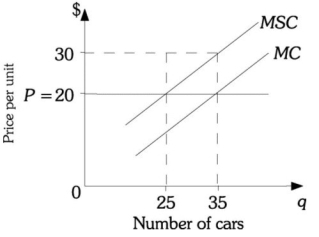 Figure 16.2
-Refer to Figure 16.2. The ________ imposed as a result of producing cars is $10.00 per car.
Figure 16.2
-Refer to Figure 16.2. The ________ imposed as a result of producing cars is $10.00 per car. (Multiple Choice)
4.8/5 (68)
(68) Refer to the information provided in Figure 16.3 below to answer the question(s) that follow. Figure 16.3
-Refer to Figure 16.3. The efficient level of output of this product is
Figure 16.3
-Refer to Figure 16.3. The efficient level of output of this product is (Multiple Choice)
5.0/5 (81)
(81) 
Filters
- Essay(0)
- Multiple Choice(0)
- Short Answer(0)
- True False(0)
- Matching(0)