



 Chat with AI
Exam 16: Externalities, Public Goods, and Common Resources

Exam 1: The Scope and Method of Economics241 Questions
Exam 2: The Economic Problem: Scarcity and Choice218 Questions
Exam 3: Demand, Supply, and Market Equilibrium309 Questions
Exam 4: Demand and Supply Applications173 Questions
Exam 5: Elasticity188 Questions
Exam 6: Household Behavior and Consumer Choice272 Questions
Exam 7: The Production Process: the Behavior of Profit-Maximizing Firms287 Questions
Exam 8: Short-Run Costs and Output Decisions386 Questions
Exam 9: Long-Run Costs and Output Decisions363 Questions
Exam 10: Input Demand: the Labor and Land Markets200 Questions
Exam 11: Input Demand: the Capital Market and the Investment Decision218 Questions
Exam 12: General Equilibrium and the Efficiency of Perfect Competition202 Questions
Exam 13: Monopoly and Antitrust Policy394 Questions
Exam 14: Oligopoly219 Questions
Exam 15: Monopolistic Competition235 Questions
Exam 16: Externalities, Public Goods, and Common Resources275 Questions
Exam 17: Uncertainty and Asymmetric Information134 Questions
Exam 18: Income Distribution and Poverty197 Questions
Exam 19: Public Finance: the Economics of Taxation281 Questions
Exam 20: International Trade, Comparative Advantage, and Protectionism287 Questions
Exam 21: Economic Growth in Developing Economies133 Questions
Exam 22: Critical Thinking About Research104 Questions
Select questions type


A resource that is nonexcludable and rival in consumption is a
(Multiple Choice)
4.9/5  (85)
(85) Assuming no externalities exist, if a good's price is less than its marginal cost, then the benefits consumers derive are
(Multiple Choice)
4.8/5 (88)
(88) To find the optimal level of provision for a public good, the government must know
(Multiple Choice)
4.7/5 (86)
(86) Instruments that can be used to control overuse of a common resource include
(Multiple Choice)
4.8/5 (71)
(71) Refer to Scenario 16.2 below to answer the question(s) that follow.
SCENARIO 16.2: The marginal benefit for a particular food is described by MB = 60 - q, where q refers to the quantity of the food. The marginal cost of producing the food is described by MC = 3q. There is a negative externality associated with food production and the marginal social cost of food production is MSC = 5q.
-Refer to Scenario 16.2. The efficient output level is ________ and the efficient price is ________.
(Multiple Choice)
4.9/5 (94)
(94) If one person's enjoyment of the benefits of a good does not interfere with another's consumption of it, the good is
(Multiple Choice)
4.9/5 (82)
(82) As pollution emissions increase, the added cost of one more unit of emissions goes down.
(True/False)
4.8/5 (77)
(77) Refer to the information in Figure 16.5 below to answer the question(s) that follow. 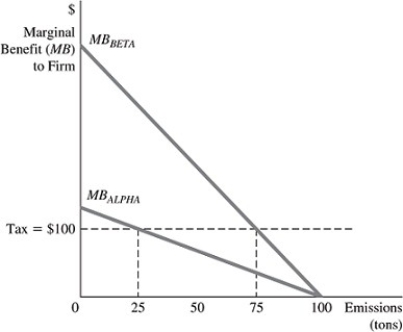 Figure 16.5
 shows the marginal benefits of emitting pollution for the only two chemical companies in an industry, Alpha Chemicals and Beta Chemicals. Before any tax on pollution emissions is imposed, each company views pollution as being free.
-Refer to Figure 16.5. The government decides to impose a tax on pollution emissions to cut total emissions in this industry in half, and based on this decision it has set the tax at $100 per ton of emissions. Following the implementation of this tax, Beta will reduce its emissions to ________ tons.
Figure 16.5
Figure 16.5 shows the marginal benefits of emitting pollution for the only two chemical companies in an industry, Alpha Chemicals and Beta Chemicals. Before any tax on pollution emissions is imposed, each company views pollution as being free.
-Refer to Figure 16.5. The government decides to impose a tax on pollution emissions to cut total emissions in this industry in half, and based on this decision it has set the tax at $100 per ton of emissions. Following the implementation of this tax, Beta will reduce its emissions to ________ tons. (Multiple Choice)
4.9/5 (75)
(75) The issuing of tradeable pollution permits is a government-involved approach to dealing with pollution.
(True/False)
4.8/5 (65)
(65) The total cost to society of producing an additional unit of a good or service is the marginal
(Multiple Choice)
4.9/5 (74)
(74) We assume the marginal benefit of consumption ________ as we consume fewer units of a good.
(Multiple Choice)
4.8/5 (83)
(83) Refer to the information provided in Figure 16.2 below to answer the question(s) that follow. 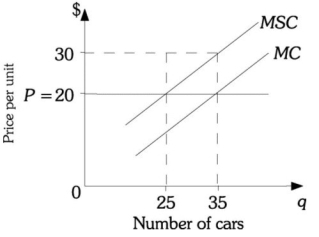 Figure 16.2
-Refer to Figure 16.2. The marginal damage cost imposed as a result of producing cars is
Figure 16.2
-Refer to Figure 16.2. The marginal damage cost imposed as a result of producing cars is (Multiple Choice)
4.9/5 (83)
(83) If a profit-maximizing competitive firm ________ compensate society for a negative externality, the firm will choose to produce where price equals marginal cost.
(Multiple Choice)
4.7/5 (75)
(75) If the production of a good generates external ________, the government could increase efficiency by ________ production of the good.
(Multiple Choice)
4.8/5 (79)
(79) Refer to the information provided in Figure 16.1 below to answer the question(s) that follow. 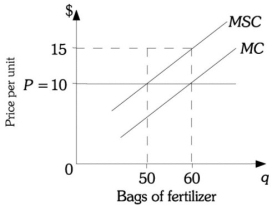 Figure 16.1
-Refer to Figure 16.1. To force this firm to produce the ________ level of output, the government should ________ of $5.00 per bag of fertilizer.
Figure 16.1
-Refer to Figure 16.1. To force this firm to produce the ________ level of output, the government should ________ of $5.00 per bag of fertilizer. (Multiple Choice)
4.9/5 (68)
(68) Refer to the information provided in Figure 16.1 below to answer the question(s) that follow. Figure 16.1
-Refer to Figure 16.1. What is the total damage imposed as a result of producing the efficient level of fertilizer?
Figure 16.1
-Refer to Figure 16.1. What is the total damage imposed as a result of producing the efficient level of fertilizer? (Multiple Choice)
4.8/5 (73)
(73) 
Filters
- Essay(0)
- Multiple Choice(0)
- Short Answer(0)
- True False(0)
- Matching(0)