



 Chat with AI
Exam 17: Uncertainty and Asymmetric Information

Exam 1: The Scope and Method of Economics241 Questions
Exam 2: The Economic Problem: Scarcity and Choice218 Questions
Exam 3: Demand, Supply, and Market Equilibrium309 Questions
Exam 4: Demand and Supply Applications173 Questions
Exam 5: Elasticity188 Questions
Exam 6: Household Behavior and Consumer Choice272 Questions
Exam 7: The Production Process: the Behavior of Profit-Maximizing Firms287 Questions
Exam 8: Short-Run Costs and Output Decisions386 Questions
Exam 9: Long-Run Costs and Output Decisions363 Questions
Exam 10: Input Demand: the Labor and Land Markets200 Questions
Exam 11: Input Demand: the Capital Market and the Investment Decision218 Questions
Exam 12: General Equilibrium and the Efficiency of Perfect Competition202 Questions
Exam 13: Monopoly and Antitrust Policy394 Questions
Exam 14: Oligopoly219 Questions
Exam 15: Monopolistic Competition235 Questions
Exam 16: Externalities, Public Goods, and Common Resources275 Questions
Exam 17: Uncertainty and Asymmetric Information134 Questions
Exam 18: Income Distribution and Poverty197 Questions
Exam 19: Public Finance: the Economics of Taxation281 Questions
Exam 20: International Trade, Comparative Advantage, and Protectionism287 Questions
Exam 21: Economic Growth in Developing Economies133 Questions
Exam 22: Critical Thinking About Research104 Questions
Select questions type


Jacinda, a college student, waits tables at a local diner to earn extra cash. In order to differentiate herself from other wait staff, Jacinda took a life saving course from the local hospital, where she learned the proper procedures to use in cases of choking. This is an example of a market signal.
(True/False)
5.0/5  (76)
(76) The insurance industry is susceptible to moral hazard problems, but not problems of adverse selection.
(True/False)
4.7/5 (83)
(83) For a risk-averse individual, marginal utility of income does not diminish.
(True/False)
4.7/5 (63)
(63) Consider the following game. You roll a six-sided die and each time you roll a 6, you get $30. For all other outcomes you pay $6. The $30 when you "win" and the -$6 when you "lose" are called
(Multiple Choice)
4.9/5 (94)
(94) Refer to the data provided in Table 17.1 below to answer the following question(s). The table shows the relationship between income and utility for Jane.
Table 17.1
Income Total Utility \ 0 0 \ 20,000 25 \ 40,000 45 \ 60,000 60 \ 80,000 70
-Refer to Table 17.1. Suppose Jane has a 1/3 chance of becoming disabled in any given year. If she does become disabled, she will earn $0. If Jane does not become disabled, she will earn her usual salary of $60,000. Jane has the opportunity to purchase disability insurance which will pay her her full salary in the event she becomes disabled. How much would such an insurance policy be worth to Jane?
(Multiple Choice)
4.8/5 (80)
(80) Refer to the data provided in Table 17.2 below to answer the following question(s). The table shows the relationship between income and utility for Sue.
Table 17.2
Income Total Utility \ 0 0 \ 20,000 20 \ 40,000 40 \ 60,000 60 \ 80,000 80
-Refer to Table 17.2. From the table, we can see that Sue is
(Multiple Choice)
4.8/5 (77)
(77) Hudson has two job offers when he graduates from college. Hudson views the offers as identical, except for the salary terms. The first offer is at a fixed annual salary of $45,000. The second offer is at a fixed salary of $25,000 plus a possible bonus of $40,000. Hudson believes that he has a 50-50 chance of earning the bonus. If Hudson takes the offer that maximizes his expected utility and he is risk-neutral, then
(Multiple Choice)
5.0/5 (92)
(92) Related to the Economics in Practice on page 359: The individual mandate feature of the Affordable Care Act potentially broadens the pool of people who are in the health insurance market, and this should ________ the problem of adverse selection.
(Multiple Choice)
4.7/5 (89)
(89) Adverse selection is a situation in which asymmetric information results in low-quality goods or low-quality consumers being squeezed out of transactions because they are unable to demonstrate their quality.
(True/False)
4.9/5 (80)
(80) Refer to the data provided in Table 17.5 below to answer the following question(s). The table shows the relationship between income and utility for Lucy.
Table 17.5
Income Total Utility \ 0 0 \ 10,000 10 \ 20,000 20 \ 30,000 30 \ 40,000 40
-Refer to Table 17.5. Lucy earns $20,000 annually. She has the opportunity to bet her entire salary on the upcoming super bowl. If Lucy takes the bet, she will pick the Packers. She believes that the Packers have a 50-50 chance of winning the game. If the Packers win, Lucy will double her money ($40,000) but if they lose she loses her entire salary ($0). This bet can be characterized as
(Multiple Choice)
5.0/5 (80)
(80) Refer to the information provided in Figure 17.1 below to answer the question(s) that follow. 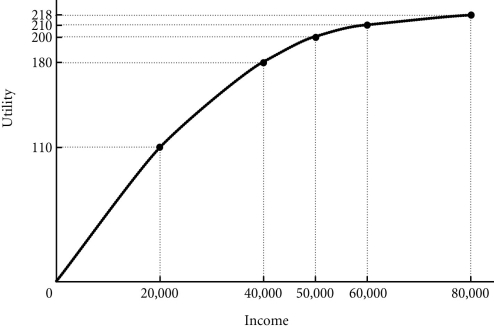 Figure 17.1
-Refer to Figure 17.1. John has two job offers when he graduates from college. John views the offers as identical, except for the salary terms. The first offer is at a fixed annual salary of $50,000. The second offer is at a fixed salary of $20,000 plus a possible bonus of $60,000. John believes that he has a 50-50 chance of earning the bonus. If John takes the offer that maximizes his expected utility and is risk-averse, which job offer will he choose?
Figure 17.1
-Refer to Figure 17.1. John has two job offers when he graduates from college. John views the offers as identical, except for the salary terms. The first offer is at a fixed annual salary of $50,000. The second offer is at a fixed salary of $20,000 plus a possible bonus of $60,000. John believes that he has a 50-50 chance of earning the bonus. If John takes the offer that maximizes his expected utility and is risk-averse, which job offer will he choose? (Multiple Choice)
4.8/5 (84)
(84) Jim used to be very careful with his car. However, once he bought full auto insurance on it, he stopped turning on his alarm or even locking it when parking it. This is an example of moral hazard.
(True/False)
4.8/5 (73)
(73) Relating to the Economics in Practice on page 360: Which of the following is an example of an advertisement in which the fact that something is not mentioned indicates that the product is unlikely to be desirable?
(Multiple Choice)
4.7/5 (81)
(81) 
Filters
- Essay(0)
- Multiple Choice(0)
- Short Answer(0)
- True False(0)
- Matching(0)