



 Chat with AI
Exam 17: Uncertainty and Asymmetric Information

Exam 1: The Scope and Method of Economics241 Questions
Exam 2: The Economic Problem: Scarcity and Choice218 Questions
Exam 3: Demand, Supply, and Market Equilibrium309 Questions
Exam 4: Demand and Supply Applications173 Questions
Exam 5: Elasticity188 Questions
Exam 6: Household Behavior and Consumer Choice272 Questions
Exam 7: The Production Process: the Behavior of Profit-Maximizing Firms287 Questions
Exam 8: Short-Run Costs and Output Decisions386 Questions
Exam 9: Long-Run Costs and Output Decisions363 Questions
Exam 10: Input Demand: the Labor and Land Markets200 Questions
Exam 11: Input Demand: the Capital Market and the Investment Decision218 Questions
Exam 12: General Equilibrium and the Efficiency of Perfect Competition202 Questions
Exam 13: Monopoly and Antitrust Policy394 Questions
Exam 14: Oligopoly219 Questions
Exam 15: Monopolistic Competition235 Questions
Exam 16: Externalities, Public Goods, and Common Resources275 Questions
Exam 17: Uncertainty and Asymmetric Information134 Questions
Exam 18: Income Distribution and Poverty197 Questions
Exam 19: Public Finance: the Economics of Taxation281 Questions
Exam 20: International Trade, Comparative Advantage, and Protectionism287 Questions
Exam 21: Economic Growth in Developing Economies133 Questions
Exam 22: Critical Thinking About Research104 Questions
Select questions type


Performance compensation that is tied to outcomes out of the employees' control will provide employees with the incentive to work hard.
(True/False)
4.8/5  (72)
(72) Labor market compensation contracts can be designed to screen out poor quality workers as well as provide employees with incentives to work hard.
(True/False)
4.7/5 (84)
(84) Consider the following game. You pick a card from a deck and each time you select an ace, you get $260. For all other cards you must pay $13. This game is a fair bet.
(True/False)
4.9/5 (74)
(74) A lender faces a(n) ________ problem if borrowers with a greater chance of defaulting on their loans get loans from the lender.
(Multiple Choice)
4.8/5 (86)
(86) Refer to the data provided in Table 17.6 below to answer the following question(s). The table shows the relationship between income and utility for Isabel.
Table 17.6
Income Total Utility \ 0 0 \ 40,000 20 \ 80,000 50 \ 120,000 90 \ 160,000 150
-Refer to Table 17.6. Suppose Isabel has a 25% chance of becoming disabled in any given year. If she does become disabled, she will earn $0. If Isabel does not become disabled, she will earn her usual salary of $160,000. Isabel has the opportunity to purchase disability insurance for $40,000 which will pay her her full salary in the event she becomes disabled. Would Isabel purchase such a policy?
(Multiple Choice)
4.7/5 (76)
(76) Consider the following game. You pick a card from a deck and each time you select an ace, you get $260. For all other cards you must pay $13. What is the expected value of the game?
(Multiple Choice)
4.8/5 (82)
(82) You cause an automobile liability insurance company to face a moral hazard problem when you take ________ driving precautions ________ you buy automobile liability insurance from the company.
(Multiple Choice)
4.8/5 (94)
(94) In general, risk-loving individuals experience increasing marginal utility from income.
(True/False)
4.9/5 (77)
(77) Refer to the data provided in Table 17.4 below to answer the following question(s). The table shows the relationship between income and utility for Celeste.
Table 17.4
Income Total Utility \ 0 0 \ 40,000 50 \ 80,000 90 \ 120,000 120 \ 160,000 140
-Refer to Table 17.4. Suppose Celeste has a 1/3 chance of becoming disabled in any given year. If she does become disabled, she will earn $0. If Celeste does not become disabled, she will earn her usual salary of $120,000. Celeste has the opportunity to purchase disability insurance which will pay her her full salary in the event she becomes disabled. On average, such a contract would cost the insurance company ________ per insured person.
(Multiple Choice)
4.8/5 (77)
(77) Refer to the data provided in Table 17.5 below to answer the following question(s). The table shows the relationship between income and utility for Lucy.
Table 17.5
Income Total Utility \ 0 0 \ 10,000 10 \ 20,000 20 \ 30,000 30 \ 40,000 40
-Refer to Table 17.5. From the table, we can see that Lucy is
(Multiple Choice)
4.9/5 (73)
(73) You cause a fire insurance company to face a moral hazard problem when you take ________ you buy fire insurance from the company.
(Multiple Choice)
4.7/5 (69)
(69) Refer to the data provided in Table 17.3 below to answer the following question(s). The table shows the relationship between income and utility for Terri.
Table 17.3
Income Total Utility \ 0 0 \ 20,000 10 \ 40,000 25 \ 60,000 45 \ 80,000 75
-Refer to Table 17.3. Suppose Terri has a 25% chance of becoming disabled in any given year. If she does become disabled, she will earn $0. If Terri does not become disabled, she will earn her usual salary of $80,000. Terri has the opportunity to purchase disability insurance which will pay her her full salary in the event she becomes disabled. How much would such an insurance policy be worth to Terri?
(Multiple Choice)
4.8/5 (76)
(76) Refer to the information provided in Figure 17.1 below to answer the question(s) that follow. 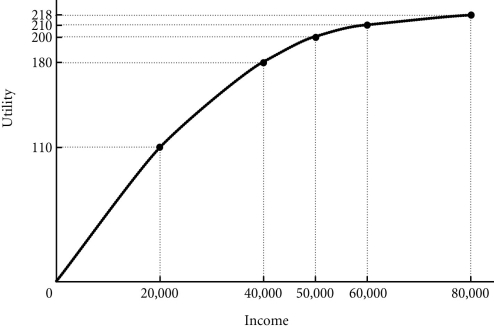 Figure 17.1
-Refer to Figure 17.1. Suppose John's utility from income is given in the figure. From this we would say that John is
Figure 17.1
-Refer to Figure 17.1. Suppose John's utility from income is given in the figure. From this we would say that John is (Multiple Choice)
4.8/5 (81)
(81) Consider the following game. You roll a 6-sided die and each time you roll a 1, you get $50. For all other outcomes you pay $10. The $50 when you "win" and the -$10 when you "lose" are known as
(Multiple Choice)
4.8/5 (78)
(78) Related to the Economics in Practice on page 359: The individual mandate feature of the Affordable Care Act potentially broadens the pool of people who are in the health insurance market. Including young, healthy people in this pool via the mandate should potentially reduce ________ and ________ overall health care costs.
(Multiple Choice)
4.9/5 (90)
(90) Relating to the Economics in Practice on page 357: A long-term study of Huntington's disease patients found that individuals who carry the Huntington's disease genetic mutation are up to five times as likely as the general population to buy long-term care insurance. This is an example of ________ in the health insurance market.
(Multiple Choice)
4.9/5 (81)
(81) All of the following statements about asymmetric information are true except
(Multiple Choice)
4.8/5 (79)
(79) Consider the following game. You roll a six-sided die and each time you roll a 1, you get $50. For all other outcomes you pay $10. The expected value of the game is
(Multiple Choice)
4.9/5 (72)
(72) 
Filters
- Essay(0)
- Multiple Choice(0)
- Short Answer(0)
- True False(0)
- Matching(0)