



 Chat with AI
Exam 10: Capital Markets and the Pricing of Risk

Exam 1: The Corporation38 Questions
Exam 2: Introduction to Financial Statement Analysis103 Questions
Exam 3: Financial Decision Making and the Law of One Price89 Questions
Exam 4: The Time Value of Money91 Questions
Exam 5: Interest Rates68 Questions
Exam 6: Valuing Bonds115 Questions
Exam 7: Investment Decision Rules86 Questions
Exam 8: Fundamentals of Capital Budgeting95 Questions
Exam 9: Valuing Stocks96 Questions
Exam 10: Capital Markets and the Pricing of Risk103 Questions
Exam 11: Optimal Portfolio Choice and the Capital Asset Pricing Model134 Questions
Exam 12: Estimating the Cost of Capital104 Questions
Exam 13: Investor Behavior and Capital Market Efficiency77 Questions
Exam 14: Capital Structure in a Perfect Market99 Questions
Exam 15: Debt and Taxes97 Questions
Exam 16: Financial Distress,managerial Incentives,and Information111 Questions
Exam 17: Payout Policy96 Questions
Exam 18: Capital Budgeting and Valuation With Leverage99 Questions
Exam 19: Valuation and Financial Modeling: a Case Study49 Questions
Exam 20: Financial Options57 Questions
Exam 21: Option Valuation42 Questions
Exam 22: Real Options64 Questions
Exam 23: Raising Equity Capital51 Questions
Exam 24: Debt Financing54 Questions
Exam 25: Leasing46 Questions
Exam 26: Working Capital Management47 Questions
Exam 27: Short-Term Financial Planning47 Questions
Exam 28: Mergers and Acquisitions59 Questions
Exam 29: Corporate Governance46 Questions
Exam 30: Risk Management53 Questions
Exam 31: International Corporate Finance48 Questions
Select questions type


The excess return is the difference between the average return on a security and the average return for:
(Multiple Choice)
4.9/5  (77)
(77) Use the following information to answer the problem(s)below.
Consider two banks.Bank A has 1000 loans outstanding each for $100,000,that it expects to be fully repaid today.Each of Bank A's loans have a 6% probability of default,in which case the bank will receive $0 for each of the defaulting loans.Bank B has 100 loans of $1 million outstanding,which it also expects to be fully repaid today.Each of Bank B's loans have a 5% probability of default,in which case the bank will receive $0 for each of the defaulting loans.The chance of default is independent across all the loans.
-The standard deviation of the overall payoff to Bank B is closest to:
(Multiple Choice)
4.8/5 (84)
(84) Use the information for the question(s)below.
Big Cure and Little Cure are both pharmaceutical companies.Big Cure presently has a potential "blockbuster" drug before the Food and Drug Administration (FDA)waiting for approval.If approved,Big Cure's blockbuster drug will produce $1 billion in net income for Big Cure.Little Cure has 10 separate less important drugs before the FDA waiting for approval.If approved,each of Little Cure's drugs would produce $100 million in net income for Little Cure.The probability of the FDA approving a drug is 50%.
-What is the expected payoff for Big Cure's Blockbuster drug?
(Multiple Choice)
4.9/5 (85)
(85) Use the table for the question(s)below.
Consider the following price and dividend data for J.P.Morgan Chase: 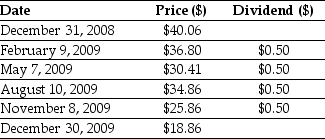 -Assume that you purchased J.P.Morgan Chase stock at the closing price on December 31,2008 and sold it at the closing price on December 30,2009.Calculate your realized annual return for the year 2005.
 (Essay)
5.0/5 (82)
(82) Use the information for the question(s)below.
Consider an economy with two types of firms,S and I.S firms always move together,but I firms move independently of each other.For both types of firm there is a 70% probability that the firm will have a 20% return and a 30% probability that the firm will have a -30% return.
-The standard deviation for the return on a portfolio of 20 type I firms is closest to:
(Multiple Choice)
4.8/5 (67)
(67) Use the table for the question(s)below.
Consider the following average annual returns:  -What is the excess return for corporate bonds?
 (Multiple Choice)
4.8/5 (78)
(78) Use the following information to answer the question(s)below.
Suppose that the market portfolio is equally likely to increase by 24% or decrease by 8%.Security "X" goes up on average by 29% when the market goes up and goes down by 11% when the market goes down.Security "Y" goes down on average by 16% when the market goes up and goes up by 16% when the market goes down.Security "Z" goes up on average by 4% when the market goes up and goes up by 4% when the market goes down.
-The expected return on a security with a beta of 1 is closest to:
(Multiple Choice)
4.8/5 (85)
(85) Use the information for the question(s)below.
Consider an economy with two types of firms,S and I.S firms always move together,but I firms move independently of each other.For both types of firm there is a 70% probability that the firm will have a 20% return and a 30% probability that the firm will have a -30% return.
-What is the expected return for an individual firm?
(Multiple Choice)
4.7/5 (70)
(70) Use the following information to answer the question(s)below.  -If the risk-free rate is 5% and the expected return of investing in Merck is 11.3%,then the expected return on the market must be:
 (Multiple Choice)
4.7/5 (86)
(86) Use the following information to answer the question(s)below.
-If the expected return on the market is 11% and the expected return of investing in Merck is 10.35%,then the risk-free rate must be:
-If the expected return on the market is 11% and the expected return of investing in Merck is 10.35%,then the risk-free rate must be: (Multiple Choice)
4.9/5 (76)
(76) Use the following information to answer the question(s)below.
Suppose that the market portfolio is equally likely to increase by 24% or decrease by 8%.Security "X" goes up on average by 29% when the market goes up and goes down by 11% when the market goes down.Security "Y" goes down on average by 16% when the market goes up and goes up by 16% when the market goes down.Security "Z" goes up on average by 4% when the market goes up and goes up by 4% when the market goes down.
-The expected return on security "Y" is closest to:
(Multiple Choice)
4.8/5 (84)
(84) Use the information for the question(s)below.
Big Cure and Little Cure are both pharmaceutical companies.Big Cure presently has a potential "blockbuster" drug before the Food and Drug Administration (FDA)waiting for approval.If approved,Big Cure's blockbuster drug will produce $1 billion in net income for Big Cure.Little Cure has 10 separate less important drugs before the FDA waiting for approval.If approved,each of Little Cure's drugs would produce $100 million in net income for Little Cure.The probability of the FDA approving a drug is 50%.
-Which pharmaceutical company faces less risk?
(Essay)
4.8/5 (98)
(98) Use the table for the question(s)below.
Consider the following realized annual returns:  -The average annual return on Stock A from 2000 to 2009 is closest to:
 (Multiple Choice)
4.7/5 (88)
(88) 
Filters
- Essay(0)
- Multiple Choice(0)
- Short Answer(0)
- True False(0)
- Matching(0)