



 Chat with AI
Exam 15: Chemical Equilibrium

Exam 1: Introduction: Matter and Measurement118 Questions
Exam 2: Atoms, Molecules, and Ions201 Questions
Exam 3: Stoichiometry: Calculations With Chemical Formulas and Equations134 Questions
Exam 4: Aqueous Reactions and Solution Stoichiometry147 Questions
Exam 6: Electronic Structure of Atoms161 Questions
Exam 7: Periodic Properties of the Elements149 Questions
Exam 8: Basic Concepts of Chemical Bonding116 Questions
Exam 10: Gases146 Questions
Exam 11: Intermolecular Forces, Liquids, and Solids103 Questions
Exam 12: Modern Materials47 Questions
Exam 13: Properties of Solutions121 Questions
Exam 14: Chemical Kinetics110 Questions
Exam 15: Chemical Equilibrium58 Questions
Exam 16: Acid-Base Equilibria97 Questions
Exam 17: Additional Aspects of Equilibria88 Questions
Exam 18: Chemistry of the Environment105 Questions
Exam 19: Chemical Thermodynamics101 Questions
Exam 20: Electrochemistry90 Questions
Exam 21: Nuclear Chemistry128 Questions
Exam 22: Chemistry of the Nonmetals176 Questions
Exam 23: Metals and Metallurgy112 Questions
Exam 24: Chemistry of Coordination Compounds124 Questions
Exam 25: The Chemistry of Life: Organic and Biological Chemistry115 Questions
Select questions type


Pure and pure are excluded from equilibrium- constant expressions.
(Short Answer)
4.8/5  (85)
(85) Phosphorous trichloride and phosphorous pentachloride equilibrate in the presence of molecular chlorine according to the reaction:
PCl3 (g) + Cl2 (g) -PCl5 (g)
An equilibrium mixture at 450 K contains PPCl3 = 0.202 atm,
PCl2 = 0.256 atm, and
PPCl5 = 3.45 atm. What is the value of Kp at this temperature?
(Multiple Choice)
4.9/5 (74)
(74) Consider the following equilibrium.
 The equilibrium cannot be established when _ _ is/are placed in a 1.0- L container.
 (Multiple Choice)
4.9/5 (79)
(79) What role did Karl Bosch play in development of the Haber- Bosch process?
(Multiple Choice)
4.9/5 (90)
(90) Consider the following chemical reaction:
H2 (g) + I2 (g)  2HI (g)
At equilibrium in a particular experiment, the concentrations of H2, I2, and HI were 0.15 M,
0)033 M, and 0.55 M, respectively. The value of Keq for this reaction is .
2HI (g)
At equilibrium in a particular experiment, the concentrations of H2, I2, and HI were 0.15 M,
0)033 M, and 0.55 M, respectively. The value of Keq for this reaction is . (Multiple Choice)
4.8/5 (79)
(79) The equilibrium- constant expression for the reaction
 is given by
 (Multiple Choice)
4.8/5 (74)
(74) The equilibrium- constant expression for a reaction written in one direction is the
of the one for the reaction written for the reverse direction.
(Short Answer)
4.9/5 (65)
(65) The equilibrium constant for reaction 1 is K. The equilibrium constant for reaction 2 is . (1) SO2 (g) + (1/2) O2 (g)  SO3 (g)
(2) 2SO3 (g)
 2SO2 (g) + O2 (g)
SO3 (g)
(2) 2SO3 (g) 2SO2 (g) + O2 (g) (Multiple Choice)
5.0/5 (72)
(72) The relationship between the rate constants for the forward and reverse reactions and the equilibrium constant for the process is Keq= .
(Multiple Choice)
4.7/5 (80)
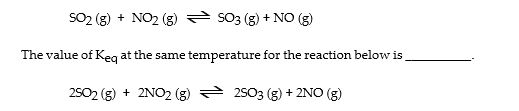
(80) 
Nitrosyl bromide decomposes according to the following equation.  A sample of NOBr (0.64 mol) was placed in a 1.00- L flask containing no NO or Br2. At equilibrium the flask contained 0.46 mol of NOBr. How many moles of NO and Br2, respectively, are in the flask at equilibrium?
 (Multiple Choice)
4.7/5 (70)
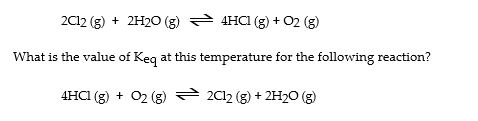
(70) The Keq for the equilibrium below is 7.52 × 10- 2 at 480 °C.
(Multiple Choice)
4.8/5 (94)
(94) How is the reaction quotient used to determine whether a system is at equilibrium?
(Multiple Choice)
4.9/5 (58)
(58) Which one of the following is true concerning the Haber process?
(Multiple Choice)
4.9/5 (81)
(81) At 22 °C, Kp = 0.070 for the equilibrium:
NH4HS (s)  NH3 (g) + H2S (g)
A sample of solid NH4HS is placed in a closed vessel and allowed to equilibrate. Calculate the equilibrium partial pressure (atm) of ammonia, assuming that some solid NH4HS remains.
NH3 (g) + H2S (g)
A sample of solid NH4HS is placed in a closed vessel and allowed to equilibrate. Calculate the equilibrium partial pressure (atm) of ammonia, assuming that some solid NH4HS remains. (Multiple Choice)
4.8/5 (78)
(78) At 900 K, the equilibrium constant (Kp) for the following reaction is 0.345. 2SO2 + O2 (g) -2SO3 (g)
At equilibrium, the partial pressure of SO2 is 35.0 atm and that of O2 is 15.9 atm. The partial pressure of SO3 is _ atm.
(Multiple Choice)
4.7/5 (74)
(74) The Keq for the equilibrium below is 7.52 × 10- 2 at 480 °C.
2Cl2 (g) + 2H2O (g)  4HCl (g) + O2 (g)
What is the value of Keq at this temperature for the following reaction?
Cl2 (g) + H2O (g)
 2HCl (g) + 1 O2 (g)
4HCl (g) + O2 (g)
What is the value of Keq at this temperature for the following reaction?
Cl2 (g) + H2O (g) 2HCl (g) + 1 O2 (g) (Multiple Choice)
4.9/5 (85)
(85) Which one of the following will change the value of an equilibrium constant?
(Multiple Choice)
4.9/5 (86)
(86) 
Filters
- Essay(0)
- Multiple Choice(0)
- Short Answer(0)
- True False(0)
- Matching(0)