



 Chat with AI
Exam 19: Chemical Thermodynamics

Exam 1: Introduction: Matter and Measurement118 Questions
Exam 2: Atoms, Molecules, and Ions201 Questions
Exam 3: Stoichiometry: Calculations With Chemical Formulas and Equations134 Questions
Exam 4: Aqueous Reactions and Solution Stoichiometry147 Questions
Exam 6: Electronic Structure of Atoms161 Questions
Exam 7: Periodic Properties of the Elements149 Questions
Exam 8: Basic Concepts of Chemical Bonding116 Questions
Exam 10: Gases146 Questions
Exam 11: Intermolecular Forces, Liquids, and Solids103 Questions
Exam 12: Modern Materials47 Questions
Exam 13: Properties of Solutions121 Questions
Exam 14: Chemical Kinetics110 Questions
Exam 15: Chemical Equilibrium58 Questions
Exam 16: Acid-Base Equilibria97 Questions
Exam 17: Additional Aspects of Equilibria88 Questions
Exam 18: Chemistry of the Environment105 Questions
Exam 19: Chemical Thermodynamics101 Questions
Exam 20: Electrochemistry90 Questions
Exam 21: Nuclear Chemistry128 Questions
Exam 22: Chemistry of the Nonmetals176 Questions
Exam 23: Metals and Metallurgy112 Questions
Exam 24: Chemistry of Coordination Compounds124 Questions
Exam 25: The Chemistry of Life: Organic and Biological Chemistry115 Questions
Select questions type


Given the following table of thermodynamic data,
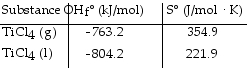 Complete the following sentence. The vaporization of TiCl4 is _ .
 (Multiple Choice)
4.9/5  (81)
(81) Phosphorous and chlorine gases combine to produce phosphorous trichloride:
 ΔG° at 298 oK for this reaction is - 642.9 kJ/mol. The value of ΔG at 298 K for a reaction mixture that consists of 1.5 atm P2, 1.6 atm Cl2, and 0.65 atm PCl3 is _ .
 (Multiple Choice)
4.7/5 (74)
(74) A system that doesn't exchange matter or energy with its surroundings is called an system.
(Multiple Choice)
4.8/5 (65)
(65) Use the table below to answer the questions that follow.
 Thermodynamic Quantities for Selected Substances at 298.15 K (25°C)
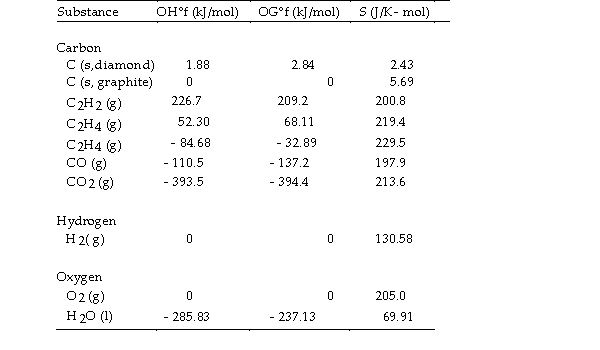 -The value of ΔS° for the catalytic hydrogenation of acetylene to ethane,
 is J/K.
Thermodynamic Quantities for Selected Substances at 298.15 K (25°C)
-The value of ΔS° for the catalytic hydrogenation of acetylene to ethane, is J/K. (Multiple Choice)
4.8/5 (84)
(84) The value of ΔG° at 100.0 °C for the formation of calcium chloride from its constituent elements:
 Is kJ/mol. At 25.0 oC for this reaction, ΔH° is - 795.8 kJ/mol, ΔG° is - 748.1 kJ/mol, and
ΔS° is - 159.8 J/K.
Is kJ/mol. At 25.0 oC for this reaction, ΔH° is - 795.8 kJ/mol, ΔG° is - 748.1 kJ/mol, and
ΔS° is - 159.8 J/K. (Multiple Choice)
4.8/5 (82)
(82) Use the table below to answer the questions that follow.
 Thermodynamic Quantities for Selected Substances at 298.15 K (25°C)
-
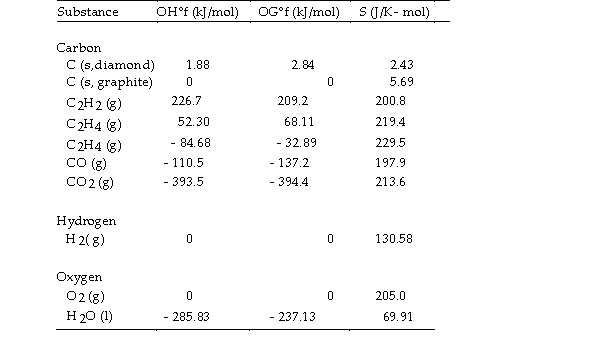 The combustion of acetylene in the presence of excess oxygen yields carbon dioxide
 The value of ΔSo for this reaction is J/K.
Thermodynamic Quantities for Selected Substances at 298.15 K (25°C)
- The combustion of acetylene in the presence of excess oxygen yields carbon dioxide
The value of ΔSo for this reaction is J/K. (Multiple Choice)
4.8/5 (89)
(89) Calculate OG○(in kJ/mol) for the following reaction at 1 atm and 25○C:  OHf○C2H6 (g) = - 84.7 kJ/mol; S○C2H6 (g) = 229.5 J/K · mol; OHf○CO2 (g) = - 393.5
kJ/mol; S○CO2 (g) = 213.6 J/K · mol; OHf○H2O (l) = - 285.8 kJ/mol; S○H2O (l) = 69.9 J/K ·
mol
OHf○C2H6 (g) = - 84.7 kJ/mol; S○C2H6 (g) = 229.5 J/K · mol; OHf○CO2 (g) = - 393.5
kJ/mol; S○CO2 (g) = 213.6 J/K · mol; OHf○H2O (l) = - 285.8 kJ/mol; S○H2O (l) = 69.9 J/K ·
mol (Short Answer)
4.9/5 (77)
(77) For a given reaction, OH = +35.5 kJ/mol and OS = +83.6 J/K- mol. The reaction is spontaneous
) Assume that OH and OS do not vary with temperature.
(Multiple Choice)
4.9/5 (82)
(82) Use the table below to answer the questions that follow.
Thermodynamic Quantities for Selected Substances at 298.15 K (25°C)  -The value of ΔS° for the decomposition of phosphorous trichloride into its constituent elements,
 is J/K.
-The value of ΔS° for the decomposition of phosphorous trichloride into its constituent elements, is J/K. (Multiple Choice)
4.8/5 (82)
(82) Which reaction produces a decrease in the entropy of the system?
(Multiple Choice)
4.9/5 (81)
(81) Consider the reaction:
 Given the following table of thermodynamic data,
 Determine the temperature (in °C) above which the reaction is nonspontaneous.
Given the following table of thermodynamic data,
Determine the temperature (in °C) above which the reaction is nonspontaneous. (Multiple Choice)
4.9/5 (85)
(85) Use the table below to answer the questions that follow.
Thermodynamic Quantities for Selected Substances at 298.15 K (25°C) 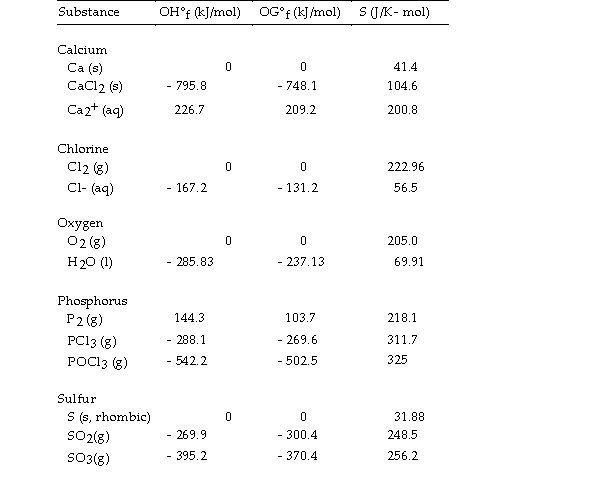 -The value of ΔG° at 25 °C for the oxidation of solid elemental sulfur to gaseous sulfur trioxide,
 is kJ/mol.
-The value of ΔG° at 25 °C for the oxidation of solid elemental sulfur to gaseous sulfur trioxide, is kJ/mol. (Multiple Choice)
4.8/5 (77)
(77) Use the table below to answer the questions that follow.
Thermodynamic Quantities for Selected Substances at 298.15 K (25°C) 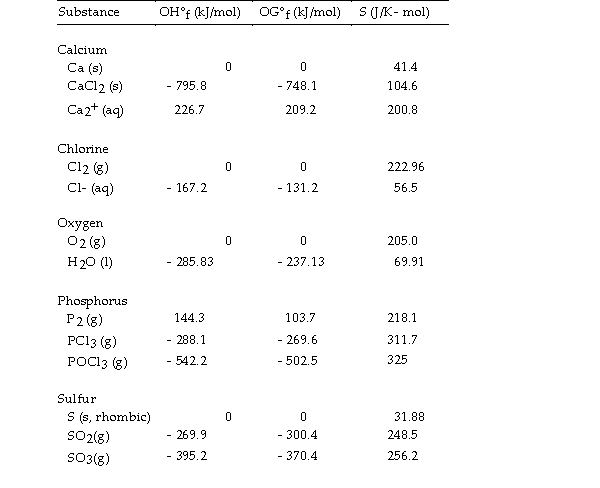 -The value of ΔG° at 25 °C for the decomposition of gaseous sulfur dioxide to solid elemental sulfur and gaseous oxygen,
 is kJ/mol.
-The value of ΔG° at 25 °C for the decomposition of gaseous sulfur dioxide to solid elemental sulfur and gaseous oxygen, is kJ/mol. (Multiple Choice)
4.9/5 (88)
(88) Use the table below to answer the questions that follow.
 Thermodynamic Quantities for Selected Substances at 298.15 K (25°C)
-The value of ΔS° for the catalytic hydrogenation of ethene to ethane,
 is J/K.
Thermodynamic Quantities for Selected Substances at 298.15 K (25°C)
-The value of ΔS° for the catalytic hydrogenation of ethene to ethane, is J/K. (Multiple Choice)
4.8/5 (64)
(64) Use the table below to answer the questions that follow.
Thermodynamic Quantities for Selected Substances at 298.15 K (25°C)
-The value of ΔG° at 373 K for the oxidation of solid elemental sulfur to gaseous sulfur trioxide,  is kJ/mol.
-The value of ΔG° at 373 K for the oxidation of solid elemental sulfur to gaseous sulfur trioxide, is kJ/mol. (Multiple Choice)
4.9/5 (89)
(89) Which one of the following processes produces a decrease of the entropy of the system?
(Multiple Choice)
4.9/5 (77)
(77) The value of ΔG° at 100.0 °C for the oxidation of solid elemental sulfur to gaseous sulfur dioxide,
S (s,rhombic) + O2 (g) →SO2 (g)
Is kJ/mol. At 25.0 oC for this reaction, ΔH° is - 269.9 kJ/mol, ΔG° is - 300.4 kJ/mol, and
ΔS° is +11.6 J/K.
(Multiple Choice)
4.9/5 (82)
(82) 
Filters
- Essay(0)
- Multiple Choice(0)
- Short Answer(0)
- True False(0)
- Matching(0)