



 Chat with AI
Exam 19: Chemical Thermodynamics

Exam 1: Introduction: Matter and Measurement118 Questions
Exam 2: Atoms, Molecules, and Ions201 Questions
Exam 3: Stoichiometry: Calculations With Chemical Formulas and Equations134 Questions
Exam 4: Aqueous Reactions and Solution Stoichiometry147 Questions
Exam 6: Electronic Structure of Atoms161 Questions
Exam 7: Periodic Properties of the Elements149 Questions
Exam 8: Basic Concepts of Chemical Bonding116 Questions
Exam 10: Gases146 Questions
Exam 11: Intermolecular Forces, Liquids, and Solids103 Questions
Exam 12: Modern Materials47 Questions
Exam 13: Properties of Solutions121 Questions
Exam 14: Chemical Kinetics110 Questions
Exam 15: Chemical Equilibrium58 Questions
Exam 16: Acid-Base Equilibria97 Questions
Exam 17: Additional Aspects of Equilibria88 Questions
Exam 18: Chemistry of the Environment105 Questions
Exam 19: Chemical Thermodynamics101 Questions
Exam 20: Electrochemistry90 Questions
Exam 21: Nuclear Chemistry128 Questions
Exam 22: Chemistry of the Nonmetals176 Questions
Exam 23: Metals and Metallurgy112 Questions
Exam 24: Chemistry of Coordination Compounds124 Questions
Exam 25: The Chemistry of Life: Organic and Biological Chemistry115 Questions
Select questions type


The vaporization of a substance at its boiling point is an isothermal process
(True/False)
4.7/5  (89)
(89) Use the table below to answer the questions that follow.
Thermodynamic Quantities for Selected Substances at 298.15 K (25°C) 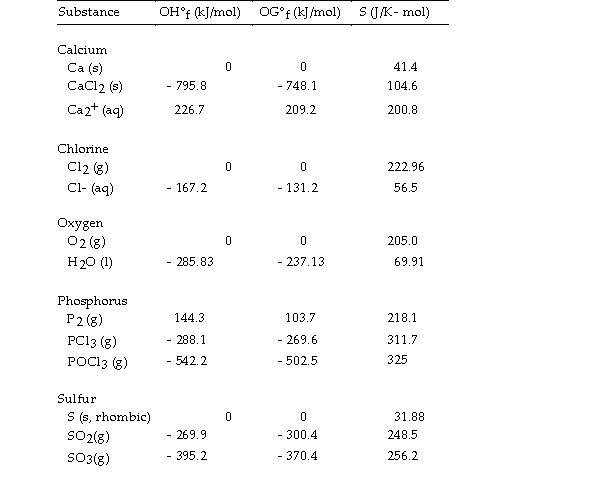 -The value of ΔG°at 25 °C for the decomposition of phosphorous trichloride into its constituent elements,
 is kJ/mol.
-The value of ΔG°at 25 °C for the decomposition of phosphorous trichloride into its constituent elements, is kJ/mol. (Multiple Choice)
4.8/5 (72)
(72) The quantity of energy gained by a system equals the quantity of energy gained by its surroundings.
(True/False)
4.9/5 (79)
(79) Use the table below to answer the questions that follow.
Thermodynamic Quantities for Selected Substances at 298.15 K (25°C) 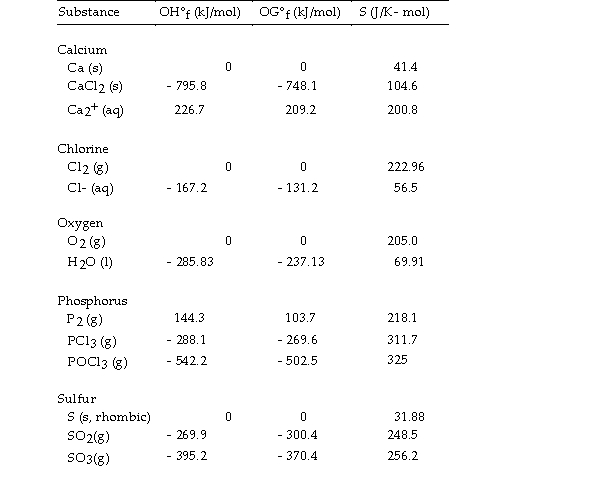 -The value of ΔH° for the decomposition of calcium chloride into its constituent elements,
 is kJ/mol.
-The value of ΔH° for the decomposition of calcium chloride into its constituent elements, is kJ/mol. (Multiple Choice)
4.9/5 (64)
(64) The equilibrium position corresponds to which letter on the graph of G vs f (course of reaction) below?
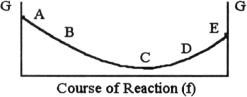
(Multiple Choice)
4.7/5 (90)
(90) Use the table below to answer the questions that follow.
Thermodynamic Quantities for Selected Substances at 298.15 K (25°C) 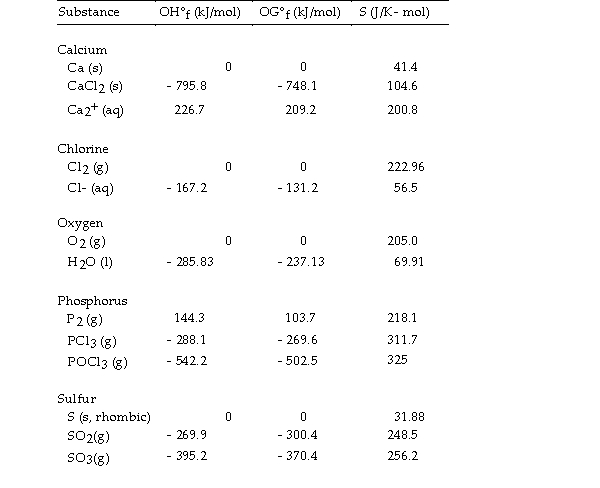 -The value of ΔS° for the decomposition of gaseous sulfur trioxide to solid elemental sulfur and gaseous oxygen,
 is J/K.
-The value of ΔS° for the decomposition of gaseous sulfur trioxide to solid elemental sulfur and gaseous oxygen, is J/K. (Multiple Choice)
4.7/5 (80)
(80) The thermodynamic quantity that expresses the degree of disorder in a system is _ _.
(Multiple Choice)
4.8/5 (78)
(78) Use the table below to answer the questions that follow.
 Thermodynamic Quantities for Selected Substances at 298.15 K (25°C)
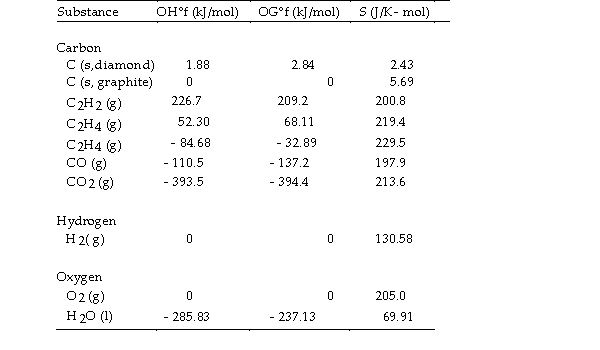 -The combustion of ethane in the presence of excess oxygen yields carbon dioxide and water:
 The value of OSo for this reaction is J/K.
Thermodynamic Quantities for Selected Substances at 298.15 K (25°C)
-The combustion of ethane in the presence of excess oxygen yields carbon dioxide and water:
The value of OSo for this reaction is J/K. (Multiple Choice)
4.9/5 (82)
(82) The standard Gibbs free energy of formation of is zero.
(a) H2O (l)
(b) O (g)
(c) H2 (g)
(Multiple Choice)
4.8/5 (84)
(84) Use the table below to answer the questions that follow.
Thermodynamic Quantities for Selected Substances at 298.15 K (25°C) 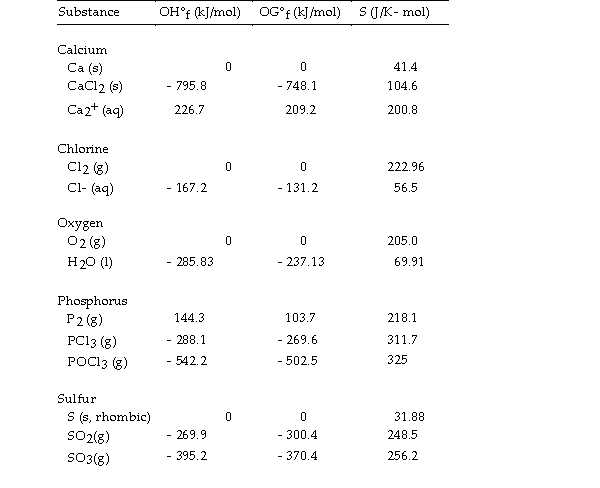 -The value of ΔG° at 25 °C for the oxidation of solid elemental sulfur to gaseous sulfur dioxide,
 is kJ/mol.
-The value of ΔG° at 25 °C for the oxidation of solid elemental sulfur to gaseous sulfur dioxide, is kJ/mol. (Multiple Choice)
4.7/5 (72)
(72) Which one of the following statements is true about the equilibrium constant for a reaction if ΔG° for the reaction is negative?
(Multiple Choice)
4.8/5 (80)
(80) Use the table below to answer the questions that follow.
Thermodynamic Quantities for Selected Substances at 298.15 K (25°C)
-The value of ΔG° at 25 °C for the formation of POCl3 from its constituent elements,  is kJ/mol.
-The value of ΔG° at 25 °C for the formation of POCl3 from its constituent elements, is kJ/mol. (Multiple Choice)
4.9/5 (90)
(90) Use the table below to answer the questions that follow.
Thermodynamic Quantities for Selected Substances at 298.15 K (25°C)  -The value of ΔS° for the decomposition of POCl3 into its constituent elements,
 is J/K.
-The value of ΔS° for the decomposition of POCl3 into its constituent elements, is J/K. (Multiple Choice)
4.8/5 (82)
(82) Calculate OG○for the autoionization of water at 25○C. Kw = 1.0 × 10- 14
(Short Answer)
4.9/5 (73)
(73) Use the table below to answer the questions that follow.
Thermodynamic Quantities for Selected Substances at 298.15 K (25°C)
-The value of ΔH° for the oxidation of solid elemental sulfur to gaseous sulfur dioxide,  is kJ/mol.
-The value of ΔH° for the oxidation of solid elemental sulfur to gaseous sulfur dioxide, is kJ/mol. (Multiple Choice)
4.7/5 (63)
(63) Use the table below to answer the questions that follow.
Thermodynamic Quantities for Selected Substances at 298.15 K (25°C)
-Consider the reaction:
 Given the following table of thermodynamic data at 298 oK:
 The value K for the reaction at 25 °C is .
-Consider the reaction:
Given the following table of thermodynamic data at 298 oK:
The value K for the reaction at 25 °C is . (Multiple Choice)
4.8/5 (89)
(89) Use the table below to answer the questions that follow.
Thermodynamic Quantities for Selected Substances at 298.15 K (25°C)
-The value of ΔS° for the oxidation of solid elemental sulfur to gaseous sulfur trioxide,  is J/K.
-The value of ΔS° for the oxidation of solid elemental sulfur to gaseous sulfur trioxide, is J/K. (Multiple Choice)
4.8/5 (84)
(84) Find the temperature above which a reaction with a OH of 53 .00 kJ/mol and a OS of 100.0 J/K·mol becomes spontaneous.
(Short Answer)
4.7/5 (76)
(76) Use the table below to answer the questions that follow.
 Thermodynamic Quantities for Selected Substances at 298.15 K (25°C)
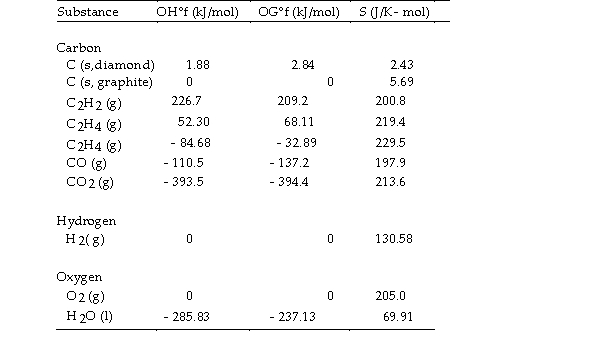 -The value of ΔS° for the oxidation of carbon to carbon monoxide, 2C (s, graphite) + O2 (g) -2CO (g)
Is J/K. Carbon monoxide is produced in the combustion of carbon with limited oxygen.
Thermodynamic Quantities for Selected Substances at 298.15 K (25°C)
-The value of ΔS° for the oxidation of carbon to carbon monoxide, 2C (s, graphite) + O2 (g) -2CO (g)
Is J/K. Carbon monoxide is produced in the combustion of carbon with limited oxygen. (Multiple Choice)
4.7/5 (69)
(69) 
Filters
- Essay(0)
- Multiple Choice(0)
- Short Answer(0)
- True False(0)
- Matching(0)