



 Chat with AI
Exam 19: The International Monetary System Order Or Disorder

Exam 1: What Is Economics226 Questions
Exam 2: The Economy Myth and Reality152 Questions
Exam 3: The Fundamental Economic Problem Scarcity and Choice250 Questions
Exam 4: Supply and Demand An Initial Look298 Questions
Exam 5: An Introduction To Macroeconomics215 Questions
Exam 6: The Goals Of Macroeconomic Policy211 Questions
Exam 7: Economic Growth Theory And Policy228 Questions
Exam 8: Aggregate Demand and The Powerful Consumer218 Questions
Exam 9: Demand Side Equilibrium Unemployment Or Inflation 212 Questions
Exam 10: Bringing In The Supply Side Unemployment and Inflation 228 Questions
Exam 11: Managing Aggregate Demand Fiscal Policy209 Questions
Exam 12: Money and The Banking System222 Questions
Exam 13: Monetary Policy Conventional and Unconventional204 Questions
Exam 14: The Financial Crisis and The Great Recession61 Questions
Exam 15: The Debate Over Monetary and Fiscal Policy215 Questions
Exam 16: Budget Deficits In The Short and Long Run210 Questions
Exam 17: The Trade Off Between Inflation and Unemployment219 Questions
Exam 18: International Trade and Comparative Advantage207 Questions
Exam 19: The International Monetary System Order Or Disorder 217 Questions
Exam 20: Exchange Rates and The Macroeconomy209 Questions
Select questions type


The exchange rate of Country X is set by government decisions and maintained by government actions.Country X follows a
(Multiple Choice)
4.8/5  (81)
(81) If interest rates in the United States are higher than interest rates in Europe,what is most likely to happen?
(Multiple Choice)
4.8/5 (89)
(89) Under a gold standard,a balance of payments surplus automatically
(Multiple Choice)
4.7/5 (86)
(86) The purchasing power parity theory is useful in making ____ predictions about exchange rates and their fluctuations.
(Multiple Choice)
5.0/5 (75)
(75) If a country is in a major recessionary phase of the business cycle,one can expect that its currency will
(Multiple Choice)
4.9/5 (88)
(88) Figure 19-2 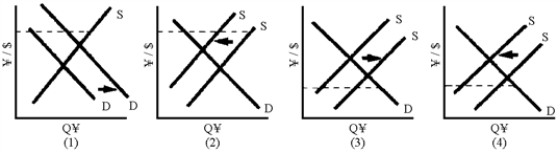 -Of the graphs in Figure 19-2,which one shows Japan practicing "dirty" floating to keep an undervalued currency?
 (Multiple Choice)
4.9/5 (90)
(90) Purchasing power parity explains how the exchange rate will adjust to differences in price levels between two countries.
(True/False)
4.7/5 (79)
(79) Countries like Malaysia and Thailand that tried to maintain overvalued currencies in the late 1990s inevitably faced increased
(Multiple Choice)
4.7/5 (77)
(77) An economic recession in the United States would shift the demand for foreign currencies outward,that is,increase demand.
(True/False)
4.9/5 (93)
(93) Is it possible for a currency to appreciate relative to one currency,and depreciate relative to another?
(Multiple Choice)
4.8/5 (86)
(86) An overvalued currency,such as the Argentinean peso in 2001,is an indicator of a balance of payments surplus.
(True/False)
4.9/5 (82)
(82) Figure 19-2
-Of the graphs in Figure 19-2,which one shows the effect of an increase in interest rates in Japan?
-Of the graphs in Figure 19-2,which one shows the effect of an increase in interest rates in Japan? (Multiple Choice)
4.8/5 (77)
(77) Which of the following would cause a decrease in the demand for U.S.dollars?
(Multiple Choice)
4.9/5 (79)
(79) If British government bonds pay a higher interest rate than U.S.government bonds,the dollar should appreciate.
(True/False)
4.8/5 (80)
(80) 
Filters
- Essay(0)
- Multiple Choice(0)
- Short Answer(0)
- True False(0)
- Matching(0)