



 Chat with AI
Exam 19: The International Monetary System Order Or Disorder

Exam 1: What Is Economics226 Questions
Exam 2: The Economy Myth and Reality152 Questions
Exam 3: The Fundamental Economic Problem Scarcity and Choice250 Questions
Exam 4: Supply and Demand An Initial Look298 Questions
Exam 5: An Introduction To Macroeconomics215 Questions
Exam 6: The Goals Of Macroeconomic Policy211 Questions
Exam 7: Economic Growth Theory And Policy228 Questions
Exam 8: Aggregate Demand and The Powerful Consumer218 Questions
Exam 9: Demand Side Equilibrium Unemployment Or Inflation 212 Questions
Exam 10: Bringing In The Supply Side Unemployment and Inflation 228 Questions
Exam 11: Managing Aggregate Demand Fiscal Policy209 Questions
Exam 12: Money and The Banking System222 Questions
Exam 13: Monetary Policy Conventional and Unconventional204 Questions
Exam 14: The Financial Crisis and The Great Recession61 Questions
Exam 15: The Debate Over Monetary and Fiscal Policy215 Questions
Exam 16: Budget Deficits In The Short and Long Run210 Questions
Exam 17: The Trade Off Between Inflation and Unemployment219 Questions
Exam 18: International Trade and Comparative Advantage207 Questions
Exam 19: The International Monetary System Order Or Disorder 217 Questions
Exam 20: Exchange Rates and The Macroeconomy209 Questions
Select questions type


The dollar appreciates against the euro when U.S.demand for European goods increases.
(True/False)
4.8/5  (81)
(81) The Bretton Woods system worked fairly well for a number of years,but it finally broke down over
(Multiple Choice)
4.8/5 (78)
(78) A country running a balance of payments surplus in a fixed exchange rate system may have to ____ its currency.
(Multiple Choice)
4.8/5 (93)
(93) Figure 19-3 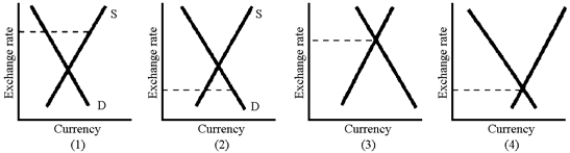 -Of the graphs in Figure 19-3,where the dotted line shows the actual exchange rate,which one shows a country with an undervalued currency and a balance of trade surplus?
 (Multiple Choice)
4.9/5 (83)
(83) Which of the following companies would gain from foreign currency depreciation?
(Multiple Choice)
4.9/5 (96)
(96) The appropriate "medicine" for correcting payments imbalances under a fixed exchange rate system is
(Multiple Choice)
4.9/5 (79)
(79) Exchange rates determined by the forces of demand and supply are called
(Multiple Choice)
4.9/5 (73)
(73) To "cure" their balance of payments deficits without altering exchange rates,Southeast Asian countries in 1997 were forced to create
(Multiple Choice)
4.7/5 (75)
(75) Figure 19-1  -Of the graphs in Figure 19-1,which one shows that an expansion of the Japanese economy leads to a depreciation of the yen?
 (Multiple Choice)
5.0/5 (68)
(68) In a floating exchange market,the exchange rate for pesos and yen will not change when:
(Multiple Choice)
4.9/5 (82)
(82) A recession in the United States will tend to cause recessions in other countries because as U.S.GDP falls,U.S.
(Multiple Choice)
4.8/5 (72)
(72) Under the gold standard of a century ago,the world's commerce
(Multiple Choice)
5.0/5 (82)
(82) Assuming free trade between countries,exchange rates will change so that goods cost the same in all countries.This concept is known as the
(Multiple Choice)
4.8/5 (80)
(80) Balance of payments deficits arise whenever the exchange rate is set at an artificially high level.
(True/False)
4.9/5 (80)
(80) In the spring of 2002,Argentina was forced to devalue its peso and disband its currency board that was responsible for the fixed exchange rate between the peso and the U.S.dollar.Explain the origin of this crisis and the painful remedies that Argentina has had to endure.
(Essay)
4.9/5 (82)
(82) Which of the following had prompted the Chinese authorities to stand ready to buy or sell dollars steadily and in large volume?
(Multiple Choice)
4.8/5 (81)
(81) In 2001,the Argentine peso was overvalued relative to the U.S.dollar.
(True/False)
4.8/5 (94)
(94) The purchasing power parity theory of exchange rate determination states that
(Multiple Choice)
4.8/5 (77)
(77) 
Filters
- Essay(0)
- Multiple Choice(0)
- Short Answer(0)
- True False(0)
- Matching(0)