



 Chat with AI
Exam 18: The Cell-Division Cycle

Exam 1: Cells: The Fundamental Units of Life64 Questions
Exam 2: Chemical Components of Cells74 Questions
Exam 3: Energy, Catalysis, and Biosynthesis73 Questions
Exam 4: Protein Structure and Function71 Questions
Exam 5: DNA and Chromosomes69 Questions
Exam 6: DNA Replication and Repair61 Questions
Exam 7: From DNA to Protein62 Questions
Exam 8: Control of Gene Expression68 Questions
Exam 9: How Genes and Genomes Evolve60 Questions
Exam 10: Analyzing the Structure and Function of Genes59 Questions
Exam 11: Membrane Structure57 Questions
Exam 12: Transport Across Cell Membranes67 Questions
Exam 13: How Cells Obtain Energy From Food71 Questions
Exam 14: Energy Generation in Mitochondria and Chloroplasts72 Questions
Exam 15: Intracellular Compartments and Protein Transport55 Questions
Exam 16: Cell Signaling60 Questions
Exam 17: Cytoskeleton59 Questions
Exam 18: The Cell-Division Cycle67 Questions
Exam 19: Sexual Reproduction and the Power of Genetics61 Questions
Exam 20: Cell Communities: Tissues, Stem Cells, and Cancer57 Questions
Select questions type


You create cells with a version of the origin recognition complex, ORC, that cannot be phosphorylated by S-Cdk and thus cannot be inactivated.Which of the following statements describes the likely consequence of this change in ORC?
(Multiple Choice)
4.8/5  (73)
(73) What would happen to the progeny of a cell that proceeded to mitosis and cell division after entering S phase but had not completed S phase? Keep in mind that highly condensed chromatin, including the centromere region, is replicated late in S phase.Explain your answer.
(Essay)
4.8/5 (82)
(82) Figure 18-10 shows a living cell from the lung epithelium of a newt at different stages in M phase.Order these light micrographs into the correct sequence and identify the stage in M phase that each represents. 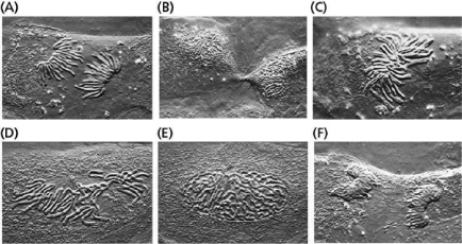 Figure 18-10
 (Essay)
4.7/5 (82)
(82) The lengths of microtubules in various stages of mitosis depend on the balance between the activities of proteins that destabilize microtubules, and microtubule-associated proteins that stabilize them.If you created cells with an increased number of proteins that destabilize molecules, do you predict the length of the mitotic spindle will be longer, shorter, or unchanged, relative to the corresponding stage of mitosis in wild-type cells? What do you predict for a cell with increased numbers of microtubule stabilizing proteins? Explain your reasoning.
(Essay)
4.9/5 (76)
(76) For each of the following sentences, fill in the blanks with the best word or phrase selected from the list below.Not all words or phrases will be used; each word or phrase should be used only once.
able hexokinase short asynchronously inhibitory sperm long steady conserved stimulatory cyclin maturation promoting factor substrate divergent oscillate synchronously egg PI 3-kinase ubiquitin fibroblast regulin unable uniform
Many features of __________ cells make them suitable for biochemical studies of the cell-cycle control system.For example, the cells are unusually large and are arrested in a __________-like phase.When the cells are triggered to resume cycling, the cell divisions have especially __________ G1 and G2 phases and occur __________.Studies with Xenopus eggs identified a partly purified activity called __________ that drives a resting Xenopus oocyte into M phase.MPF activity was found to __________ during the cell cycle, although the amount of its kinase component, called __________, remained constant.The regulatory component of MPF, called __________, has a __________ effect on MPF activity and plays a part in regulating interactions with its __________s.The components of MPF are evolutionarily __________ from yeast to humans, so that the corresponding human genes are __________ to function in yeast.
(Essay)
4.9/5 (79)
(79) Why should it be that drugs such as colchicine, which inhibit microtubule polymerization, and drugs such as Taxol®, which stabilize microtubules, both inhibit mitosis?
(Essay)
4.8/5 (67)
(67) Progression through the cell cycle requires a cyclin to bind to a Cdk because
(Multiple Choice)
4.7/5 (83)
(83) What would be the most obvious outcome of repeated cell cycles consisting of S phase and M phase only?
(Multiple Choice)
4.7/5 (82)
(82) Which of the following events does NOT usually occur during interphase?
(Multiple Choice)
4.9/5 (86)
(86) Which of the following is NOT good direct evidence that the cell-cycle control system is conserved through billions of years of divergent evolution?
(Multiple Choice)
4.9/5 (77)
(77) Name the stage of M phase in which the following events occur.Place the numbers 1-8 next to the letter headings to indicate the normal order of events.
A.alignment of the chromosomes at the spindle equator
B.attachment of spindle microtubules to chromosomes
C.breakdown of nuclear envelope
D.pinching of cell in two
E.separation of two centrosomes and initiation of mitotic spindle assembly
F.re-formation of the nuclear envelope
G.condensation of the chromosomes
H.separation of sister chromatids
(Short Answer)
4.8/5 (82)
(82) Which word or phrase below best describes the phase in mitosis depicted in Figure 18-29? 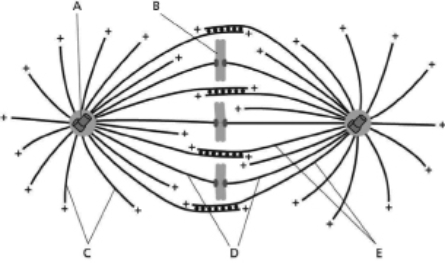 Figure 18-29
 (Multiple Choice)
4.9/5 (93)
(93) Your friend is intrigued by Cdks and purifies Cdk from the daisy plant.She is able to determine the sequence of 18 amino acids from the daisy Cdk protein.Using these data, she aligns the daisy Cdk sequence with one human Cdk protein and the Cdk proteins from two different kinds of yeast, as shown in Figure 18-25.Sequences identical between the human and fungal proteins have been boxed. 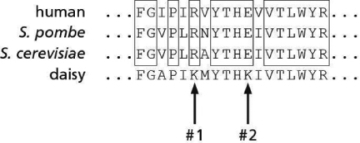 Figure 18-25
Such conserved amino acid sequences are often involved in protein-protein interactions.Indeed, the threonine (T) in the central "YTHE" block is known to be phosphorylated by a kinase that activates Cdks in human and yeast.The surrounding conserved sequences could thus be important for the interaction of this Cdk-activating kinase with Cdk.In the daisy Cdk, however, not all of the amino acids in these conserved blocks match the sequences from yeast and human, as indicated by the arrows marked #1 and #2.
A.When you replace the S.cerevisiae (budding yeast) Cdk with the daisy Cdk, you discover the daisy Cdk does not interact with the Cdk-activating kinase inside the yeast cell.Circle the amino acid in the daisy Cdk that is likely to be the most disruptive to its interaction with Cdk-activating kinase.Explain.
B.Based on the information in Figure 18-25 and what you know about the Cdk1-Cdk-activating kinase interaction, would you predict that the human Cdk will interact with yeast Cdk-activating kinase? Explain.
Figure 18-25
Such conserved amino acid sequences are often involved in protein-protein interactions.Indeed, the threonine (T) in the central "YTHE" block is known to be phosphorylated by a kinase that activates Cdks in human and yeast.The surrounding conserved sequences could thus be important for the interaction of this Cdk-activating kinase with Cdk.In the daisy Cdk, however, not all of the amino acids in these conserved blocks match the sequences from yeast and human, as indicated by the arrows marked #1 and #2.
A.When you replace the S.cerevisiae (budding yeast) Cdk with the daisy Cdk, you discover the daisy Cdk does not interact with the Cdk-activating kinase inside the yeast cell.Circle the amino acid in the daisy Cdk that is likely to be the most disruptive to its interaction with Cdk-activating kinase.Explain.
B.Based on the information in Figure 18-25 and what you know about the Cdk1-Cdk-activating kinase interaction, would you predict that the human Cdk will interact with yeast Cdk-activating kinase? Explain. (Essay)
4.7/5 (80)
(80) 
Filters
- Essay(0)
- Multiple Choice(0)
- Short Answer(0)
- True False(0)
- Matching(0)