



 Chat with AI
Exam 15: Intracellular Compartments and Protein Transport

Exam 1: Cells: The Fundamental Units of Life64 Questions
Exam 2: Chemical Components of Cells74 Questions
Exam 3: Energy, Catalysis, and Biosynthesis73 Questions
Exam 4: Protein Structure and Function71 Questions
Exam 5: DNA and Chromosomes69 Questions
Exam 6: DNA Replication and Repair61 Questions
Exam 7: From DNA to Protein62 Questions
Exam 8: Control of Gene Expression68 Questions
Exam 9: How Genes and Genomes Evolve60 Questions
Exam 10: Analyzing the Structure and Function of Genes59 Questions
Exam 11: Membrane Structure57 Questions
Exam 12: Transport Across Cell Membranes67 Questions
Exam 13: How Cells Obtain Energy From Food71 Questions
Exam 14: Energy Generation in Mitochondria and Chloroplasts72 Questions
Exam 15: Intracellular Compartments and Protein Transport55 Questions
Exam 16: Cell Signaling60 Questions
Exam 17: Cytoskeleton59 Questions
Exam 18: The Cell-Division Cycle67 Questions
Exam 19: Sexual Reproduction and the Power of Genetics61 Questions
Exam 20: Cell Communities: Tissues, Stem Cells, and Cancer57 Questions
Select questions type


Your friend has just joined a lab that studies vesicle budding from the Golgi and has been given a cell line that does not form mature vesicles.He wants to start designing some experiments but was not listening carefully when he was told about the molecular defect of this cell line.He is too embarrassed to ask and comes to you for help.He does recall that this cell line forms coated pits but vesicle budding and the removal of coat proteins don't happen.Which of the following proteins might be lacking in this cell line?
(Multiple Choice)
4.8/5  (76)
(76) What is the role of the nuclear localization sequence in a nuclear protein?
(Multiple Choice)
4.8/5 (74)
(74) Signal sequences that direct proteins to the correct compartment are
(Multiple Choice)
4.8/5 (90)
(90) Your friend works in a biotechnology company and has discovered a drug that blocks the ability of Ran to exchange GDP for GTP.What is the most likely effect of this drug on nuclear transport?
(Multiple Choice)
4.9/5 (89)
(89) What would happen in each of the following cases? Assume in each case that the protein involved is a soluble protein, not a membrane protein.
A.You add a signal sequence (for the ER) to the N-terminal end of a normally cytosolic protein.
B.You change the hydrophobic amino acids in an ER signal sequence into charged amino acids.
C.You change the hydrophobic amino acids in an ER signal sequence into other hydrophobic amino acids.
D.You move the N-terminal ER signal sequence to the C-terminal end of the protein.
(Essay)
4.9/5 (82)
(82) Which of the following statements about disulfide bond formation is FALSE?
(Multiple Choice)
4.9/5 (79)
(79) Which of the following statements about a protein in the lumen of the ER is FALSE?
(Multiple Choice)
4.7/5 (73)
(73) Molecules to be packaged into vesicles for transport are selected by
(Multiple Choice)
4.8/5 (88)
(88) For each of the following sentences, fill in the blanks with the best word or phrase selected from the list below.Not all words or phrases will be used; use each word or phrase only once.
amino acid sequence Golgi apparatus sorting signal endoplasmic reticulum plasma membrane transport vesicles folded protein translocators unfolded
Plasma membrane proteins are inserted into the membrane in the __________.The address information for protein sorting in a eukaryotic cell is contained in the __________ of the proteins.Proteins enter the nucleus in their __________ form.Proteins that remain in the cytosol do not contain a __________.Proteins are transported into the Golgi apparatus via __________.The proteins transported into the endoplasmic reticulum by __________ are in their __________form.
(Essay)
4.9/5 (76)
(76) Figure 15-22 shows the organization of a protein that normally resides in the plasma membrane.The boxes labeled 1 and 2 represent membrane-spanning sequences and the arrow represents a site of action of signal peptidase.Given this diagram, which of the following statements must be TRUE?  Figure 15-22
 (Multiple Choice)
4.9/5 (76)
(76) You have created a green fluorescent protein (GFP) fusion to a protein that is normally secreted from yeast cells.Because you have learned about the use of temperature-sensitive mutations in yeast to study protein and vesicle transport, you obtain three mutant yeast strains, each defective in some aspect of the protein secretory process.Being a good scientist, you of course also obtain a wild-type control strain.You decide to examine the fate of your GFP fusion protein in these various yeast strains and engineer the mutant strains to express your GFP fusion protein.However, in your excitement to do the experiment, you realize that you did not label any of the mutant yeast strains and no longer know which strain is defective in what process.You end up numbering your strains with the numbers 1 to 4, and then you carry out the experiment anyway, obtaining the results shown in Figure 15-17 (the black dots represent your GFP fusion protein).  Figure 15-17
Name the process that is defective in each of these strains.Remember that one of these strains is your wild-type control.
Figure 15-17
Name the process that is defective in each of these strains.Remember that one of these strains is your wild-type control. (Essay)
5.0/5 (85)
(85) Proteins that are fully translated in the cytosol and lack a sorting signal will end up in the
(Multiple Choice)
4.8/5 (73)
(73) A gene regulatory protein, A, contains a typical nuclear localization signal but surprisingly is usually found in the cytosol.When the cell is exposed to hormones, protein A moves from the cytosol into the nucleus, where it turns on genes involved in cell division.When you purify protein A from cells that have not been treated with hormones, you find that protein B is always complexed with it.To determine the function of protein B, you engineer cells lacking the gene for protein B.You compare normal and defective cells by using differential centrifugation to separate the nuclear fraction from the cytoplasmic fraction, and then separating the proteins in these fractions by gel electrophoresis.You identify the presence of protein A and protein B by looking for their characteristic bands on the gel.The gel you run is shown in Figure 15-4. 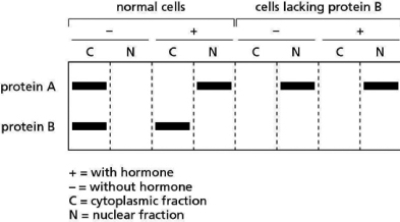 Figure 15-4
On the basis of these results, what is the function of protein B? Explain your conclusion and propose a mechanism for how protein B works.
Figure 15-4
On the basis of these results, what is the function of protein B? Explain your conclusion and propose a mechanism for how protein B works. (Essay)
5.0/5 (69)
(69) Different glycoproteins can have a diverse array of oligosaccharides.Which of the statements below about this diversity is TRUE?
(Multiple Choice)
4.9/5 (78)
(78) 
Filters
- Essay(0)
- Multiple Choice(0)
- Short Answer(0)
- True False(0)
- Matching(0)