



 Chat with AI
Exam 15: Intracellular Compartments and Protein Transport

Exam 1: Cells: The Fundamental Units of Life64 Questions
Exam 2: Chemical Components of Cells74 Questions
Exam 3: Energy, Catalysis, and Biosynthesis73 Questions
Exam 4: Protein Structure and Function71 Questions
Exam 5: DNA and Chromosomes69 Questions
Exam 6: DNA Replication and Repair61 Questions
Exam 7: From DNA to Protein62 Questions
Exam 8: Control of Gene Expression68 Questions
Exam 9: How Genes and Genomes Evolve60 Questions
Exam 10: Analyzing the Structure and Function of Genes59 Questions
Exam 11: Membrane Structure57 Questions
Exam 12: Transport Across Cell Membranes67 Questions
Exam 13: How Cells Obtain Energy From Food71 Questions
Exam 14: Energy Generation in Mitochondria and Chloroplasts72 Questions
Exam 15: Intracellular Compartments and Protein Transport55 Questions
Exam 16: Cell Signaling60 Questions
Exam 17: Cytoskeleton59 Questions
Exam 18: The Cell-Division Cycle67 Questions
Exam 19: Sexual Reproduction and the Power of Genetics61 Questions
Exam 20: Cell Communities: Tissues, Stem Cells, and Cancer57 Questions
Select questions type


You are trying to identify the peroxisome-targeting sequence in the thiolase enzyme in yeast.The thiolase enzyme normally resides in the peroxisome and therefore must contain amino acid sequences that are used to target the enzyme for import into the peroxisome.To identify the targeting sequences, you create a set of hybrid genes that encode fusion proteins containing part of the thiolase protein fused to another protein, histidinol dehydrogenase (HDH).HDH is a cytosolic enzyme required for the synthesis of the amino acid histidine and cannot function if it is localized in the peroxisome.You genetically engineer a series of yeast cells to express these fusion proteins instead of their own versions of these enzymes.If the fusion proteins are imported into the peroxisome, the HDH portion of the protein cannot function and the yeast cells cannot grow on a medium lacking histidine.You obtain the results shown in Figure 15-5.  Figure 15-5
What region of the thiolase protein contains the peroxisomal targeting sequence? Explain your answer.
Figure 15-5
What region of the thiolase protein contains the peroxisomal targeting sequence? Explain your answer. (Essay)
4.9/5  (89)
(89) Cells have oligosaccharides displayed on their cell surface that are important for cell-cell recognition.Your friend discovered a transmembrane glycoprotein, GP1, on a pathogenic yeast cell that is recognized by human immune cells.He decides to purify large amounts of GP1 by expressing it in bacteria.To his purified protein he then adds a branched 14-sugar oligosaccharide to the asparagine of the only Asn-X-Ser sequence found on GP1 (Figure 15-32).Unfortunately, immune cells do not seem to recognize this synthesized glycoprotein.Which of the following statements is a likely explanation for this problem?  Figure 15-32
 (Multiple Choice)
4.9/5 (77)
(77) Which of the following statements about peroxisomes is FALSE?
(Multiple Choice)
4.9/5 (89)
(89) Which of the following statements about transport into mitochondria and chloroplasts is FALSE?
(Multiple Choice)
5.0/5 (80)
(80) Which of the following statements about the endoplasmic reticulum (ER) is FALSE?
(Multiple Choice)
4.9/5 (80)
(80) Which of the following choices reflects the appropriate order of locations through which a protein destined for the plasma membrane travels?
(Multiple Choice)
4.8/5 (90)
(90) For each of the following sentences, fill in the blanks with the best word or phrase selected from the list below.Not all words or phrases will be used; each word or phrase should be used only once.
chaperone Golgi apparatus pseudopods cholesterol mycobacterium rough ER clathrin phagocytosis SNARE endosome pinocytosis transcytosis
Eukaryotic cells are continually taking up materials from the extracellular space by the process of endocytosis.One type of endocytosis is __________, which uses __________ proteins to form small vesicles containing fluids and molecules.After these vesicles have pinched off from the plasma membrane, they will fuse with the __________, where materials that are taken into the vesicle are sorted.A second type of endocytosis is __________, which is used to take up large vesicles that can contain microorganisms and cellular debris.Macrophages are especially suited for this process, as they extend __________ (sheetlike projections of their plasma membrane) to surround the invading microorganisms.
(Essay)
4.9/5 (77)
(77) After isolating the rough endoplasmic reticulum from the rest of the cytoplasm, you purify the RNAs attached to it.Which of the following proteins do you expect the RNA from the rough endoplasmic reticulum to encode?
(Multiple Choice)
4.8/5 (78)
(78) Which of the following is NOT a process that delivers material to the lysosome?
(Multiple Choice)
4.7/5 (85)
(85) Which of the following statements about the unfolded protein response (UPR) is FALSE?
(Multiple Choice)
4.9/5 (73)
(73) A large protein that passes through the nuclear pore must have an appropriate
(Multiple Choice)
4.8/5 (91)
(91) Which of the following statements about vesicular membrane fusion is FALSE?
(Multiple Choice)
4.9/5 (88)
(88) v-SNAREs and t-SNAREs mediate the recognition of a vesicle at its target membrane so that a vesicle displaying a particular type of v-SNARE will only fuse with a target membrane containing a complementary type of t-SNARE.In some cases, v-SNAREs and t-SNAREs may also mediate the fusion of identical membranes.In yeast cells, right before the formation of a new cell, vesicles derived from the vacuole will come together and fuse to form a new vacuole destined for the new cell.Unlike the situation we have discussed in class, the vacuolar vesicles contain both v-SNAREs and t-SNAREs.Your friend is trying to understand the role of these SNAREs in the formation of the new vacuole and consults with you regarding the interpretation of his data.
Your friend has designed an ingenious assay for the fusion of vacuolar vesicles by using alkaline phosphatase.The protein alkaline phosphatase is made in a "pro" form that must be cleaved for the protein to be active.Your friend has designed two different strains of yeast: strain A produces the "pro" form of alkaline phosphatase (pro-Pase), whereas strain B produces the protease that can cleave pro-Pase into the active form (Pase).Neither strain has the active form of the alkaline phosphatase, but when vacuolar vesicles from the strains A and B are mixed, fusion of vesicles generates active alkaline phosphatase, whose activity can be measured and quantified (Figure 15-9A). (A)
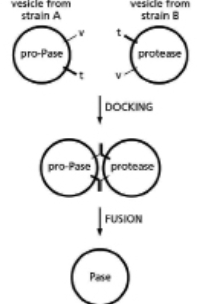
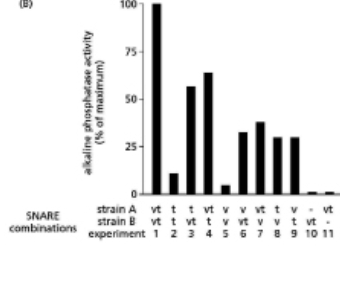 Figure 15-9
Your friend has taken each of these yeast strains and further engineered them so that they express only the v-SNAREs, only the t-SNAREs, both SNAREs (the normal situation), or neither SNARE.He then isolates vacuolar vesicles from all strains and tests the ability of each variant form of strain A to fuse with each variant form of strain B, by using the alkaline phosphatase assay.The data are shown in the graph in Figure 15-9B.On this graph, the SNARE present on the vesicle of the particular yeast strain is indicated as "v" (for the presence of the v-SNARE) and "t" (for the presence of the t-SNARE).
What do his data say about the requirements for v-SNAREs and t-SNAREs in the vacuolar vesicles? Is it important to have a specific type of SNARE (that is, v-SNARE or t-SNARE) on each vesicle?
Figure 15-9
Your friend has taken each of these yeast strains and further engineered them so that they express only the v-SNAREs, only the t-SNAREs, both SNAREs (the normal situation), or neither SNARE.He then isolates vacuolar vesicles from all strains and tests the ability of each variant form of strain A to fuse with each variant form of strain B, by using the alkaline phosphatase assay.The data are shown in the graph in Figure 15-9B.On this graph, the SNARE present on the vesicle of the particular yeast strain is indicated as "v" (for the presence of the v-SNARE) and "t" (for the presence of the t-SNARE).
What do his data say about the requirements for v-SNAREs and t-SNAREs in the vacuolar vesicles? Is it important to have a specific type of SNARE (that is, v-SNARE or t-SNARE) on each vesicle? (Essay)
4.7/5 (81)
(81) If you remove the ER retention signal from a protein that normally resides in the ER lumen, where do you predict the protein will ultimately end up? Explain your reasoning.
(Essay)
4.9/5 (75)
(75) Which of the following statements about the protein quality control system in the ER is FALSE?
(Multiple Choice)
4.8/5 (73)
(73) Which of the following statements about membrane-enclosed organelles is TRUE?
(Multiple Choice)
4.9/5 (95)
(95) The interior of the organelle contains ribosomes.
How might this organelle have arisen?
(Essay)
4.9/5 (85)
(85) Briefly describe the mechanism by which an internal stop-transfer sequence in a protein causes the protein to become embedded in the lipid bilayer as a transmembrane protein with a single membrane-spanning region.Assume that the protein has an N-terminal signal sequence and just one internal hydrophobic stop-transfer sequence.
(Essay)
4.8/5 (76)
(76) Name a type of protein modification that can occur in the ER but not in the cytosol.
(Essay)
5.0/5 (80)
(80) 
Filters
- Essay(0)
- Multiple Choice(0)
- Short Answer(0)
- True False(0)
- Matching(0)