



 Chat with AI
Exam 13: How Cells Obtain Energy From Food

Exam 1: Cells: The Fundamental Units of Life64 Questions
Exam 2: Chemical Components of Cells74 Questions
Exam 3: Energy, Catalysis, and Biosynthesis73 Questions
Exam 4: Protein Structure and Function71 Questions
Exam 5: DNA and Chromosomes69 Questions
Exam 6: DNA Replication and Repair61 Questions
Exam 7: From DNA to Protein62 Questions
Exam 8: Control of Gene Expression68 Questions
Exam 9: How Genes and Genomes Evolve60 Questions
Exam 10: Analyzing the Structure and Function of Genes59 Questions
Exam 11: Membrane Structure57 Questions
Exam 12: Transport Across Cell Membranes67 Questions
Exam 13: How Cells Obtain Energy From Food71 Questions
Exam 14: Energy Generation in Mitochondria and Chloroplasts72 Questions
Exam 15: Intracellular Compartments and Protein Transport55 Questions
Exam 16: Cell Signaling60 Questions
Exam 17: Cytoskeleton59 Questions
Exam 18: The Cell-Division Cycle67 Questions
Exam 19: Sexual Reproduction and the Power of Genetics61 Questions
Exam 20: Cell Communities: Tissues, Stem Cells, and Cancer57 Questions
Select questions type


For each of the following sentences, fill in the blanks with the best word or phrase selected from the list below.Not all words or phrases will be used; each word or phrase may be used more than once.
ADP moderately protons ATP favorable higher severely cytosol glucose lower slightly electrons GTP matrix unfavorable
High-energy electrons are transferred through a series of molecules, and the energy released during these transfers is used to generate a gradient of __________, or __________.Because their concentration is __________ outside than inside the mitochondria, the flow of __________, or __________, down the concentration gradient is energetically very __________ and can thus be coupled to the production of ATP from ADP.Thus, oxidative phosphorylation refers to the oxidation of __________ and __________ molecules and the phosphorylation of __________.Without this process, the yield of ATP from each glucose molecule would be __________ decreased.
(Essay)
5.0/5  (77)
(77) In step 1 of the citric acid cycle, citrate is generated by the enzyme citrate synthase.The enzyme combines the two-carbon acetyl group from acetyl CoA and the four-carbon oxaloacetate.What is the source of energy that drives this reaction forward?
(Multiple Choice)
4.8/5 (89)
(89) Pyruvate can be converted into many other molecules by various biosynthetic and metabolic pathways, which makes it a central hub in the regulation of cellular metabolism.Which of the following molecules is NOT made from pyruvate?
(Multiple Choice)
5.0/5 (79)
(79) In step 3 of the citric acid cycle, the oxidation of isocitrate and the production of CO2 are coupled to the reduction of NAD+, generating NADH and an α-ketoglutarate molecule.In the isocitrate molecule shown in Figure 13-32, which carbon is lost as CO2 and which is converted to a carbonyl carbon? 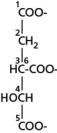 Figure 13-32
 (Multiple Choice)
4.7/5 (70)
(70) In the final stage of the oxidation of food molecules, a gradient of protons is formed across the inner mitochondrial membrane, which is normally impermeable to protons.If cells were exposed to an agent that causes the membrane to become freely permeable to protons, which of the following effects would you expect to observe?
(Multiple Choice)
4.7/5 (67)
(67) Glyceraldehyde 3-phosphate dehydrogenase operates by stripping a hydride ion from its substrate.Which molecule is the recipient of the proton and two electrons during this transfer?
(Multiple Choice)
4.9/5 (88)
(88) Explain how the generation of ATP by oxidative phosphorylation differs from ATP generation by substrate-level phosphorylation.
(Essay)
4.8/5 (91)
(91) Do you expect the cell to produce more ATP from one glucose molecule or from one fatty acid molecule? Explain your answer.
(Essay)
4.9/5 (85)
(85) Which of the following descriptions best matches the function of a kinase?
(Multiple Choice)
4.9/5 (83)
(83) The citric acid cycle is a series of oxidation reactions that removes carbon atoms from substrates in the form of CO2.Once a molecule of acetyl CoA enters the citric acid cycle, how many complete cycles are required for both of the carbon atoms in its acetyl group to be oxidized to CO2?
(Multiple Choice)
4.9/5 (75)
(75) The citric acid cycle is a series of oxidation reactions that removes carbon atoms from substrates in the form of CO2.Where do the oxygen atoms in the carbon dioxide molecules come from?
(Multiple Choice)
4.9/5 (85)
(85) On a diet consisting of nothing but protein, which of the following is the most likely outcome?
(Multiple Choice)
4.9/5 (82)
(82) Provide a brief description of the process by which the body derives energy from food.Include in your description the three stages of catalysis, and delineate the input and output that connect each stage.
(Essay)
5.0/5 (76)
(76) Although the outer mitochondrial membrane is permeable to all small molecules, the inner mitochondrial membrane is essentially impermeable in the absence of specific transport proteins.Consider this information and what you have learned about the citric acid cycle to address the following questions.
A.The ATP generated by oxidative respiration is used throughout the cell.The majority of ATP production occurs in the mitochondrial matrix.How do you think ATP is made accessible to enzymes in the cytosol and other organelles?
B.If the inner mitochondrial membrane were rendered as permeable as the outer membrane, how would that affect oxidative phosphorylation? Which specific processes would stop and which remain?
C.Present two types of benefits derived from separating the reactions of glycolysis in the cytosol from those that occur during the citric acid cycle in the mitochondrion.
(Essay)
4.9/5 (86)
(86) In the absence of oxygen, yeast cells can switch to a completely anaerobic metabolism called fermentation.Which of the following is a final product of fermentation in yeast? (a)
 (c)
 (b)
 (d)
 Figure 13-24
(c)
(b)
(d)
Figure 13-24 (Multiple Choice)
4.8/5 (87)
(87) In step 4 of the citric acid cycle, the reduction of NAD+ to NADH is coupled to the generation of CO2 and the formation of a high-energy thioester bond.The energy of the thioester bond is harnessed in step 5.What is the energy used for?
(Multiple Choice)
5.0/5 (83)
(83) The first energy-generating steps in glycolysis begin when glyceraldehyde 3-phosphate undergoes an energetically favorable reaction in which it is simultaneously oxidized and phosphorylated by the enzyme glyceraldehyde 3-phosphate dehydrogenase to form 1,3-bisphosphoglycerate, with the accompanying conversion of NAD+ to NADH.In a second energetically favorable reaction catalyzed by a second enzyme, the 1,3-bisphosphoglycerate is then converted to 3-phosphoglycerate, with the accompanying conversion of ADP to ATP.Which of the following statements is TRUE about this reaction?
(Multiple Choice)
4.9/5 (86)
(86) Which of the following descriptions best matches the function of an isomerase?
(Multiple Choice)
4.9/5 (95)
(95) Foods are broken down into simple molecular subunits for distribution and use throughout the body.Which type of simple subunits, listed below, is used preferentially as an energy source?
(Multiple Choice)
4.8/5 (91)
(91) Pyruvate is an important metabolic intermediate that can be converted into several other compounds, depending on which enzyme is catalyzing the reaction.Which of the following CANNOT be produced from pyruvate in a single enzyme-catalyzed reaction?
(Multiple Choice)
4.9/5 (68)
(68) 
Filters
- Essay(0)
- Multiple Choice(0)
- Short Answer(0)
- True False(0)
- Matching(0)