



 Chat with AI
Exam 3: Energy, Catalysis, and Biosynthesis

Exam 1: Cells: The Fundamental Units of Life64 Questions
Exam 2: Chemical Components of Cells74 Questions
Exam 3: Energy, Catalysis, and Biosynthesis73 Questions
Exam 4: Protein Structure and Function71 Questions
Exam 5: DNA and Chromosomes69 Questions
Exam 6: DNA Replication and Repair61 Questions
Exam 7: From DNA to Protein62 Questions
Exam 8: Control of Gene Expression68 Questions
Exam 9: How Genes and Genomes Evolve60 Questions
Exam 10: Analyzing the Structure and Function of Genes59 Questions
Exam 11: Membrane Structure57 Questions
Exam 12: Transport Across Cell Membranes67 Questions
Exam 13: How Cells Obtain Energy From Food71 Questions
Exam 14: Energy Generation in Mitochondria and Chloroplasts72 Questions
Exam 15: Intracellular Compartments and Protein Transport55 Questions
Exam 16: Cell Signaling60 Questions
Exam 17: Cytoskeleton59 Questions
Exam 18: The Cell-Division Cycle67 Questions
Exam 19: Sexual Reproduction and the Power of Genetics61 Questions
Exam 20: Cell Communities: Tissues, Stem Cells, and Cancer57 Questions
Select questions type


Enzymes A and B catalyze different reactions, but use the same reactant molecule as a substrate.The graph in Figure 3-74 presents the reaction rates observed when enzyme A and enzyme B are mixed together in a single test tube containing molecule X.What are the Vmax and the apparent Km values for each enzyme under these conditions? How might these values change for enzyme B if it were analyzed in the absence of enzyme A? Explain your answer. (A)
x Y X z
(B)
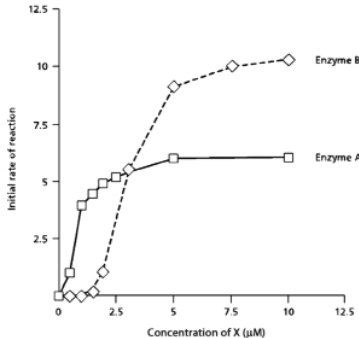 Figure 3-74
 (Essay)
4.8/5  (93)
(93) The potential energy stored in high-energy bonds is commonly harnessed when the bonds are split by the addition of __________ in a process called __________.
(Multiple Choice)
4.9/5 (78)
(78) Although the biochemical study of reaction rates and free energies is important for understanding each biological reaction individually, these studies do not provide an accurate picture of what is happening to reactants and products inside the cell.Why not?
(Essay)
4.9/5 (94)
(94) Indicate whether the following statements are TRUE or FALSE.If a statement is false, explain why it is false.
Correct Answer: Verified
Premises:
Responses:
(Matching)
4.9/5 (86)
(86) Energy cannot be created or destroyed, but it can be converted into other types of energy.Cells harvest some of the potential energy in the chemical bonds of foodstuffs to generate stored chemical energy in the form of activated carrier molecules, which are often employed to join two molecules together in __________ reactions.
(Multiple Choice)
4.8/5 (83)
(83) Arrange the following molecules in order with respect to their relative levels of oxidation (assign 5 to the most oxidized and 1 to the most reduced).
_______ CH2O (formaldehyde)
_______ CH4 (methane)
_______ CHOOH (formic acid)
_______ CH3OH (methanol)
_______ CO2 (carbon dioxide)
(Short Answer)
4.9/5 (71)
(71) Chemical reactions are reversible; they can proceed in both the forward and reverse directions.If the ΔG° for the reaction Y→X is energetically favorable, how can you explain the fact that not all of the Y molecules will be converted to X molecules?
(Essay)
4.9/5 (78)
(78) The net distance a molecule travels through the cytosol via diffusion is relatively short in comparison with the total distance it may need to travel.This is because movement governed by diffusion alone is a __________ process that is most effective for the dispersion of small molecules over short distances.
(Multiple Choice)
4.8/5 (64)
(64) Unlike what occurs when fuel is burned to make a fire, all living systems use the energy from heat-generating reactions to create and maintain
(Multiple Choice)
4.8/5 (76)
(76) Fill in the blanks, selecting from the choices below.
CO, CO2, O2, H2, H2O, N2, NO
Light + _________ + _________ → _________ + heat + sugars
(Essay)
4.8/5 (75)
(75) During respiration, energy is retrieved from the high-energy bonds found in certain organic molecules.Which of the following, in addition to energy, are the ultimate products of respiration?
(Multiple Choice)
4.8/5 (80)
(80) Activated carriers store energy in different types of high energy bonds.Match the groups used in high-energy linkages (right column) for each of the of the activated carriers (left column).Each group number may be used more than once.
_____ ATP 1.glucose
_____ NADH 2.electrons and hydrogens
_____ acetyl CoA 3.carboxyl group
_____ carboxylated biotin 4.phosphate
_____ NADPH 5.methyl group
_____ S-adenosylmethionine 6.acetyl group
_____ FADH2
_____ uridine diphosphate
(Short Answer)
4.8/5 (67)
(67) The synthesis of glutamine from glutamic acid requires the production of an activated intermediate followed by a condensation step that completes the process.Both amino acids are shown in Figure 3-47. 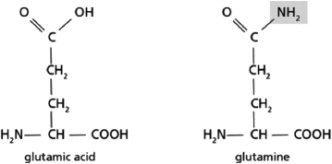 Figure 3-47
In the condensation step, __________ is displaced by __________.
Figure 3-47
In the condensation step, __________ is displaced by __________. (Multiple Choice)
4.9/5 (67)
(67) 
Filters
- Essay(0)
- Multiple Choice(0)
- Short Answer(0)
- True False(0)
- Matching(0)