



 Chat with AI
Exam 3: Energy, Catalysis, and Biosynthesis

Exam 1: Cells: The Fundamental Units of Life64 Questions
Exam 2: Chemical Components of Cells74 Questions
Exam 3: Energy, Catalysis, and Biosynthesis73 Questions
Exam 4: Protein Structure and Function71 Questions
Exam 5: DNA and Chromosomes69 Questions
Exam 6: DNA Replication and Repair61 Questions
Exam 7: From DNA to Protein62 Questions
Exam 8: Control of Gene Expression68 Questions
Exam 9: How Genes and Genomes Evolve60 Questions
Exam 10: Analyzing the Structure and Function of Genes59 Questions
Exam 11: Membrane Structure57 Questions
Exam 12: Transport Across Cell Membranes67 Questions
Exam 13: How Cells Obtain Energy From Food71 Questions
Exam 14: Energy Generation in Mitochondria and Chloroplasts72 Questions
Exam 15: Intracellular Compartments and Protein Transport55 Questions
Exam 16: Cell Signaling60 Questions
Exam 17: Cytoskeleton59 Questions
Exam 18: The Cell-Division Cycle67 Questions
Exam 19: Sexual Reproduction and the Power of Genetics61 Questions
Exam 20: Cell Communities: Tissues, Stem Cells, and Cancer57 Questions
Select questions type


The reduction of a molecule can sometimes result in the acquisition of a proton, a reaction referred to as
(Multiple Choice)
4.8/5  (74)
(74) The best way to know if an organic molecule has been reduced is to see if there was an increase in the number of __________ bonds.
(Multiple Choice)
4.9/5 (75)
(75) Indicate whether the following statements about enzymes are TRUE or FALSE.If a statement is false, explain why it is false.
Correct Answer: Verified
Premises:
Responses:
(Matching)
4.9/5 (92)
(92) Chemical reactions carried out by living systems depend on the ability of some organisms to capture and use atoms from nonliving sources in the environment.The specific subset of these reactions that break down nutrients in food can be described as
(Multiple Choice)
4.8/5 (67)
(67) All of the biological molecules listed below contain high-energy phosphate bonds.Which one is the key driver of most phosphorylation reactions and the transfer of metabolic energy?
(Multiple Choice)
4.7/5 (78)
(78) Protein E can bind to two different proteins, S and I.The binding reactions are described by the following equations and values:
E + S → ES Keq for ES = 10
E + I → EI Keq for EI = 2
Given the equilibrium constant values, which one of the following statements is TRUE?
(Multiple Choice)
4.8/5 (73)
(73) When elemental sodium is added to water, the sodium atoms ionize spontaneously.Uncharged Na becomes Na+.This means that the Na atoms have been
(Multiple Choice)
4.9/5 (81)
(81) For each of the following sentences, fill in the blanks with the best word or phrase selected from the list below.Not all words or phrases will be used; each word or phrase should be used only once.
activation free selectively chemical bond kinetic slowly completely rapidly unfavorable favorable
By definition, catalysts allow a reaction to occur more __________.
Chemical reactions occur only when there is a loss of __________ energy.Enzymes act more __________ than other catalysts.A catalyst decreases the __________ energy of a reaction.
(Essay)
4.7/5 (73)
(73) In the cytoplasm, materials are organized, separated, and sorted by membranes.Cells exploit the selective permeability of these membranes to partition populations of molecules and generate chemical energy for the cell.Use the principles of the first and second laws of thermodynamics to explain how membranes can be used to produce chemical energy.
(Essay)
4.7/5 (85)
(85) Indicate whether the following statements are TRUE or FALSE.If a statement is false, explain why it is false.
Correct Answer:Verified
VerifiedPremises:
Responses:
(Matching)
4.9/5 (78)
(78) Seed oils are often dehydrogenated and added back into processed foods.The new fatty acids have an increased number of carbon-carbon double bonds.The dehydrogenation reaction could also be described as a/an __________ reaction.
(Multiple Choice)
4.8/5 (80)
(80) The study of enzyme kinetics is usually performed with purified components and requires the characterization of several aspects of the reaction, including the rate of association with the substrate, the rate of catalysis, and
(Multiple Choice)
4.9/5 (80)
(80) The synthesis of glutamine from glutamic acid requires the production of an activated intermediate followed by a condensation step that completes the process.Both amino acids are shown in Figure 3-46. 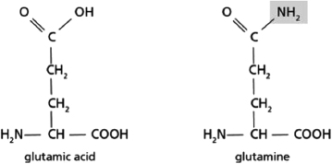 Figure 3-46
Which molecule is added to glutamic acid in the activation step?
Figure 3-46
Which molecule is added to glutamic acid in the activation step? (Multiple Choice)
4.8/5 (75)
(75) For the reaction Y→X at standard conditions with [Y] = 1 M and [X] = 1 M, ΔG is initially a large negative number.As the reaction proceeds, [Y] decreases and [X] increases until the system reaches equilibrium.How do the values of ΔG and ΔG° change as the reaction equilibrates?
(Multiple Choice)
4.7/5 (83)
(83) NADH and NADPH are activated carrier molecules that function in completely different metabolic reactions.Both carry two additional __________ and one additional __________.This combination can also be referred to as a hydride ion.
(Multiple Choice)
4.8/5 (74)
(74) When the polymer X-X-X ...is broken down into monomers, it is "phosphorylyzed" rather than hydrolyzed, in the following repeated reaction:
X-X-X ...+ P ? X-P + X-X ...(reaction 1)
Given the ?G° values of the reactions listed in Table 3-27, what is the expected ratio of X-phosphate (X-P) to free phosphate (P) at equilibrium for reaction 1?
X-X-X ...+ H2O ? X + X-X ...?G° = ?4.5 kcal/mole
X + ATP ? X-P + ADP ?G° = ?2.8 kcal/mole
ATP + H2O ? ADP + P ?G° = ?7.3 kcal/mole
Table 3-27
(Multiple Choice)
4.9/5 (87)
(87) Assume that the average human adult requires 2000 kilocalories per day to sustain all normal processes and maintain a constant weight.If manufactured solar panels could somehow provide power directly to the human body, what size solar panel would be required (in cm2)? Assume there are 10 hours of sunlight per day, and that the usable energy output for a typical solar panel is 850 kJ/ft2 per hour.
Note: 1 kcal = 4.184 kJ
1 ft2 = 929.03 cm2
(Essay)
5.0/5 (87)
(87) Indicate whether the following statements are TRUE or FALSE.If a statement is false, explain why it is false.
Correct Answer:Verified
VerifiedPremises:
Responses:
(Matching)
4.7/5 (86)
(86) Figure 3-72 illustrates the amount of energy per molecule for a population in a contained, controlled environment.Most molecules will have the average energy of the population, shown in region 1.The number of molecules in the population with enough energy to be converted to product is shown in region 2.The number of molecules with enough energy to react in the presence of enzyme is shown in region 3.Use this information to explain how enzymes catalyze reactions. 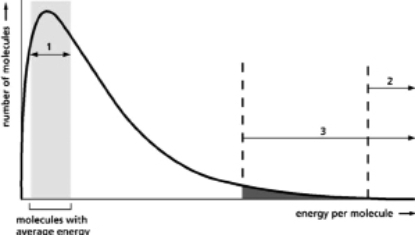 Figure 3-72
 (Essay)
4.8/5 (81)
(81) The graph in Figure 3-34 illustrates the relationship between reaction rates and substrate concentration for an enzyme-catalyzed reaction.What does the Km value indicate with respect to enzyme-substrate interactions? 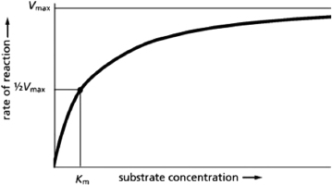 Figure 3-34
 (Multiple Choice)
4.8/5 (80)
(80) 
Filters
- Essay(0)
- Multiple Choice(0)
- Short Answer(0)
- True False(0)
- Matching(0)