



 Chat with AI
Exam 13: Fiscal Policy

Exam 1: What Is Economics644 Questions
Exam 2: The Economic Problem503 Questions
Exam 3: Demand and Supply558 Questions
Exam 4: Measuring Gdp and Economic Growth375 Questions
Exam 5: Monitoring Jobs and Inflation434 Questions
Exam 6: Economic Growth450 Questions
Exam 7: Finance, Saving, and Investment260 Questions
Exam 8: Money, the Price Level, and Inflation616 Questions
Exam 9: The Exchange Rate and the Balance of Payments547 Questions
Exam 10: Aggregate Supply and Aggregate Demand452 Questions
Exam 11: Expenditure Multipliers: They Keynesian Model484 Questions
Exam 12: U.S. Inflation, Unemployment, and Business Cycle443 Questions
Exam 13: Fiscal Policy328 Questions
Exam 14: Monetary Policy284 Questions
Exam 15: International Trade Policy207 Questions
Select questions type


When tax revenues exceed outlays, the government has a , and when outlays exceed tax revenues, the government has a .
(Multiple Choice)
4.8/5  (89)
(89) Rank the following federal government outlays from the largest to the smallest.
I. debt interest
II. transfer payments
III. expenditure on goods and services
(Multiple Choice)
4.9/5 (83)
(83) Changes in which of the following is included as part of fiscal policy?
(Multiple Choice)
4.7/5 (80)
(80) 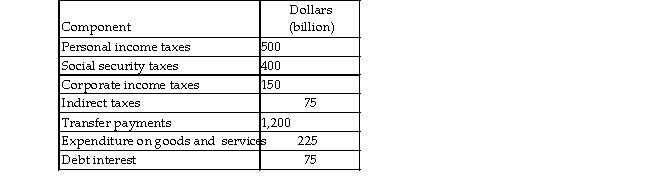 -Consider the above table with data for a country's government budget. The country has government revenues of billion.
 (Multiple Choice)
4.7/5 (87)
(87) During an expansion, tax revenues _, while during a recession, tax revenues .
(Multiple Choice)
4.8/5 (91)
(91) Which of the following is true regarding induced taxes?
I. Induced taxes vary with disposable income.
II. Induced taxes cause the multiplier effect to be greater than it would be otherwise.
III. Induced taxes weaken the link between real GDP and disposable income.
(Multiple Choice)
4.9/5 (71)
(71) Taxes and government expenditures that, without need for additional government action, change in response to changes in the level of economic activity are called
(Multiple Choice)
4.9/5 (80)
(80) An increase in the tax rates as a result of a new tax law passed by Congress is an example of
)
(Multiple Choice)
4.9/5 (83)
(83) 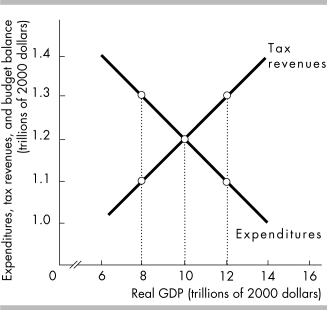 -Using the above figure, if full employment occurs at $10 trillion, but the economy is actually producing $12 trillion, then there is a
 (Multiple Choice)
4.7/5 (93)
(93) The government could increase aggregate demand by $1 trillion by
(Multiple Choice)
4.9/5 (77)
(77) In response to the economic downturn, New Zealand's government had enacted a $3.8 stimulus pa
HYPERLINK "http://www.iht.com/" www.iht.com, 11/26/20
The stimulus plan is considered
(Multiple Choice)
4.7/5 (84)
(84) If the government's outlays are $1.5 trillion and its tax revenues are $2.2 trillion, the government is running a budget
(Multiple Choice)
4.9/5 (77)
(77) Using the two GDP identities, in a formula show the impact of a government sector deficit on the supply of saving and briefly discuss its effect on the saving supply curve.
(Essay)
4.9/5 (74)
(74) 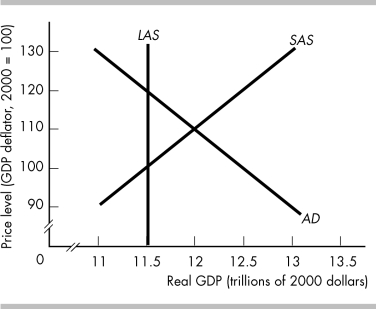 -Does the figure above illustrate a recessionary or an inflationary gap? What do potential GDP and real GDP equal? What is an appropriate fiscal policy to restore real GDP to potential real GDP?
 (Essay)
5.0/5 (73)
(73) Induced taxes decrease the size of the government expenditure multiplier.
(True/False)
4.8/5 (73)
(73) What is needs- tested spending and how does it affect the government expenditure multiplier?
(Essay)
4.9/5 (70)
(70) 
Filters
- Essay(0)
- Multiple Choice(0)
- Short Answer(0)
- True False(0)
- Matching(0)