



 Chat with AI
Exam 13: Fiscal Policy

Exam 1: What Is Economics644 Questions
Exam 2: The Economic Problem503 Questions
Exam 3: Demand and Supply558 Questions
Exam 4: Measuring Gdp and Economic Growth375 Questions
Exam 5: Monitoring Jobs and Inflation434 Questions
Exam 6: Economic Growth450 Questions
Exam 7: Finance, Saving, and Investment260 Questions
Exam 8: Money, the Price Level, and Inflation616 Questions
Exam 9: The Exchange Rate and the Balance of Payments547 Questions
Exam 10: Aggregate Supply and Aggregate Demand452 Questions
Exam 11: Expenditure Multipliers: They Keynesian Model484 Questions
Exam 12: U.S. Inflation, Unemployment, and Business Cycle443 Questions
Exam 13: Fiscal Policy328 Questions
Exam 14: Monetary Policy284 Questions
Exam 15: International Trade Policy207 Questions
Select questions type


Suppose the economy is at a short- run equilibrium with real GDP greater than potential GDP. Which of the following fiscal policies would decrease real GDP and the price level?
(Multiple Choice)
4.8/5  (72)
(72) All developed countries have about the same ratio of the government surplus to GDP.
(True/False)
4.9/5 (67)
(67) 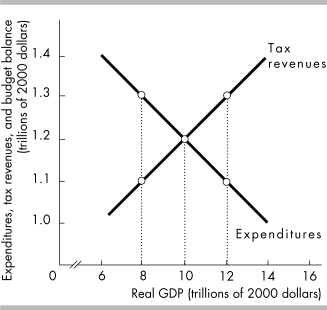 -The figure above shows tax revenues and government expenditures in the economy of Meadowlake. Potential GDP is $10 trillion. If real GDP is $10 trillion, then the government has a
)
-The figure above shows tax revenues and government expenditures in the economy of Meadowlake. Potential GDP is $10 trillion. If real GDP is $10 trillion, then the government has a
) (Multiple Choice)
4.8/5 (80)
(80) If the economy has a structural deficit of $25 billion and a cyclical deficit of $75, we can conclude that the current budget deficit is billion.
(Multiple Choice)
4.8/5 (85)
(85)  -Economic data for a mythical economy in the years 2002- 2006 are summarized in the figure above. Assume that the spending formulas and tax schedules are identical for all years. When the economy is at less than full employment, the government has a
 (Multiple Choice)
4.8/5 (71)
(71) The Employment Act of 1946 states that it is the responsibility of the federal government to
(Multiple Choice)
4.9/5 (83)
(83) The present value of the government's commitments to pay benefits minus the present value of its tax revenues is called
(Multiple Choice)
4.9/5 (81)
(81)
-Economic data for a mythical economy in the years 2002- 2006 are summarized in the figure above. Assume that the spending formulas and tax schedules are identical for all years. When the economy is above full employment, the government has a
-Economic data for a mythical economy in the years 2002- 2006 are summarized in the figure above. Assume that the spending formulas and tax schedules are identical for all years. When the economy is above full employment, the government has a (Multiple Choice)
4.8/5 (77)
(77) 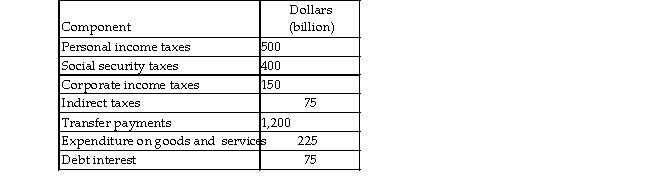 -Consider the above table with data for a country's government budget. Government outlays for the economy equal _ billion.
 (Multiple Choice)
4.7/5 (91)
(91) The government begins year 1 with $25 billion of debt. Based on the information in the above table, what is the amount of debt following year 3?
(Multiple Choice)
4.9/5 (75)
(75) If the government has a balanced budget, the total amount of government debt is
(Multiple Choice)
4.8/5 (87)
(87) What does the Employment Act of 1946 specify? Why is it an important economic milestone?
(Essay)
4.9/5 (77)
(77) Social Security benefits and expenditures on Medicare and Medicaid are classified as
(Multiple Choice)
4.7/5 (79)
(79) Federal government expenditures as a percentage of GDP are currently equal to approximately 10 percent.
(True/False)
5.0/5 (87)
(87) The effect of a change in taxes is less than the same sized change in government expenditures because
(Multiple Choice)
4.9/5 (71)
(71) In the short run, an increase in government expenditure will
I. shift the aggregate demand curve rightward.
II. increase real GDP.
III. increase the government expenditure multiplier.
IV. increase the autonomous tax multiplier.
(Multiple Choice)
4.8/5 (81)
(81) All of the following components represent sources of government revenue EXCEPT
(Multiple Choice)
4.8/5 (85)
(85) 
Filters
- Essay(0)
- Multiple Choice(0)
- Short Answer(0)
- True False(0)
- Matching(0)