



 Chat with AI
Exam 21: Organic Chemistry Ii: Reactions

Exam 1: Units of Measurement for Physical and Chemical Change192 Questions
Exam 2: Atoms and Elements174 Questions
Exam 3: Molecules, Compounds, and Nomenclature187 Questions
Exam 4: Chemical Reactions and Stoichiometry261 Questions
Exam 5: Gases163 Questions
Exam 6: Thermochemistry161 Questions
Exam 7: The Quantum-Mechanical Model of the Atom170 Questions
Exam 8: Periodic Properties of the Elements144 Questions
Exam 9: Chemical Bonding I: Lewis Theory155 Questions
Exam 10: Chemical Bonding Ii: Molecular Shapes, Valence Bond Theory, and Molecular Orbital Theory180 Questions
Exam 11: Liquids, Solids, and Intermolecular Forces144 Questions
Exam 12: Solutions167 Questions
Exam 13: Chemical Kinetics170 Questions
Exam 14: Chemical Equilibrium150 Questions
Exam 15: Acids and Bases156 Questions
Exam 16: Aqueous Ionic Equilibrium173 Questions
Exam 17: Gibbs Energy and Thermodynamics134 Questions
Exam 18: Electrochemistry122 Questions
Exam 19: Radioactivity and Nuclear Chemistry116 Questions
Exam 20: Organic Chemistry I: Structures109 Questions
Exam 21: Organic Chemistry Ii: Reactions102 Questions
Exam 22: Biochemistry55 Questions
Exam 23: Chemistry of the Nonmetals50 Questions
Exam 24: Metals and Metallurgy49 Questions
Exam 25: Transition Metals and Coordination Compounds55 Questions
Select questions type


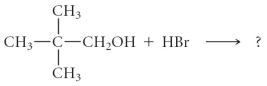

What is the product obtained from the reaction between an aldehyde and a primary alcohol?
(Multiple Choice)
4.8/5  (74)
(74) Which of the following is a compound that is acid anhydride?
(Multiple Choice)
4.9/5 (65)
(65) Which part of HCN, the hydrogen or the cyano group, adds to the O in a C=O bond and why?
(Essay)
5.0/5 (91)
(91) Complete and balance the following addition reaction: CH3C  CCH3 + 2Cl2 → ?
 (Multiple Choice)
4.8/5 (63)
(63) In which of the following families would the strongest organic bases be found?
(Multiple Choice)
4.9/5 (61)
(61) Draw a clear mechanism for the formation of a hemiacetal from CH3CH2CHO and methanol under acidic conditions. Make sure to indicate each step of the mechanism (if there is more than one) as well as to use arrows to show the electron flow.
(Essay)
4.8/5 (78)
(78) Find the suitable base for the following reaction: CH3C(=O)CH3 + :B → CH3C(=O)CH2:- + H:B+
The pKa for CH3C(=O)CH3 (acetone) is 20. The formula for the base is followed by the pKa of its conjugate acid.
(Multiple Choice)
4.7/5 (82)
(82) Determine the products of the following reaction:
Benzene + Br2  ?
? (Multiple Choice)
4.9/5 (82)
(82) Which combination of reagents would you use to brominate an aromatic compound?
(Multiple Choice)
4.9/5 (89)
(89) Predict the correct mechanism and product for the following reaction: 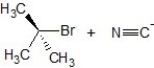
(Multiple Choice)
4.9/5 (73)
(73) Draw a clear mechanism for SN2 substitution reactions. Make sure to indicate each step of the mechanism (if there is more than one) as well as to use arrows to show the electron flow.
(Essay)
4.8/5 (83)
(83) 
Filters
- Essay(0)
- Multiple Choice(0)
- Short Answer(0)
- True False(0)
- Matching(0)