



 Chat with AI
Exam 21: Organic Chemistry Ii: Reactions

Exam 1: Units of Measurement for Physical and Chemical Change192 Questions
Exam 2: Atoms and Elements174 Questions
Exam 3: Molecules, Compounds, and Nomenclature187 Questions
Exam 4: Chemical Reactions and Stoichiometry261 Questions
Exam 5: Gases163 Questions
Exam 6: Thermochemistry161 Questions
Exam 7: The Quantum-Mechanical Model of the Atom170 Questions
Exam 8: Periodic Properties of the Elements144 Questions
Exam 9: Chemical Bonding I: Lewis Theory155 Questions
Exam 10: Chemical Bonding Ii: Molecular Shapes, Valence Bond Theory, and Molecular Orbital Theory180 Questions
Exam 11: Liquids, Solids, and Intermolecular Forces144 Questions
Exam 12: Solutions167 Questions
Exam 13: Chemical Kinetics170 Questions
Exam 14: Chemical Equilibrium150 Questions
Exam 15: Acids and Bases156 Questions
Exam 16: Aqueous Ionic Equilibrium173 Questions
Exam 17: Gibbs Energy and Thermodynamics134 Questions
Exam 18: Electrochemistry122 Questions
Exam 19: Radioactivity and Nuclear Chemistry116 Questions
Exam 20: Organic Chemistry I: Structures109 Questions
Exam 21: Organic Chemistry Ii: Reactions102 Questions
Exam 22: Biochemistry55 Questions
Exam 23: Chemistry of the Nonmetals50 Questions
Exam 24: Metals and Metallurgy49 Questions
Exam 25: Transition Metals and Coordination Compounds55 Questions
Select questions type



Which of the following is the balanced chemical equation for the catalytic hydrogenation (addition of H2) to CH3CH=CHCH3?
(Multiple Choice)
4.8/5  (78)
(78) To prepare nitrobenzene (C6H5NO2) from benzene (C6H6), two strong mineral acids are required. Which ones?
(Multiple Choice)
4.8/5 (77)
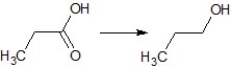
(77) 
Draw a clear mechanism for E1 elimination reactions. Make sure to indicate each step of the mechanism (if there is more than one) as well as to use arrows to show the electron flow.
(Essay)
4.7/5 (84)
(84) Write chemical formulas for the missing products in the following reaction.
CH3COOH + (COCl)2 → CH3COCl + HCl + ? + ?
(Short Answer)
4.7/5 (84)
(84) Identify reagents A and B required for the following transformation of acyl groups: C2H5COOH  C2H5COCl
 C2H5CONHCH3 + HCl
C2H5COCl C2H5CONHCH3 + HCl (Multiple Choice)
4.9/5 (76)
(76) Give the product of the oxidation of the following compound: 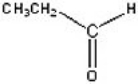
(Multiple Choice)
4.8/5 (86)
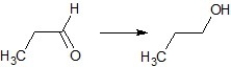
(86) 

Filters
- Essay(0)
- Multiple Choice(0)
- Short Answer(0)
- True False(0)
- Matching(0)