



 Chat with AI
Exam 11: Money Growth and Inflation

Exam 1: Ten Principles of Economics218 Questions
Exam 2: Thinking Like an Economist231 Questions
Exam 3: Interdependence and the Gains From Trade206 Questions
Exam 4: The Market Forces of Supply and Demand307 Questions
Exam 5: Measuring a Nations Income169 Questions
Exam 6: Measuring the Cost of Living181 Questions
Exam 7: Production and Growth190 Questions
Exam 8: Saving, Investment, and the Financial System214 Questions
Exam 9: Unemployment and Its Natural Rate197 Questions
Exam 10: The Monetary System204 Questions
Exam 11: Money Growth and Inflation195 Questions
Exam 12: Open-Economy Macroeconomics: Basic Concepts219 Questions
Exam 13: A Macroeconomic Theory of the Small Open Economy195 Questions
Exam 14: Aggregate Demand and Aggregate Supply257 Questions
Exam 15: The Influence of Monetary Policy on Aggregate Demand130 Questions
Exam 16: The Influence of Fiscal Policy on Aggregate Demand126 Questions
Exam 17: The Short-Run Tradeoff Between Inflation and Unemployment207 Questions
Exam 18: Five Debates Over Macroeconomic Policy126 Questions
Select questions type


What kind of economic variables are the interest rates when adjusted for the effects of inflation?
(Multiple Choice)
4.7/5  (84)
(84) Casimir purchased one share of Norcet stock for $100 in year 1 and sold that share in year 2 for $200. The inflation rate between year 1 and year 2 was 50 percent. If the capital gains tax is imposed at a rate of 50 percent, what is Casimir's after-tax real capital gain?
(Multiple Choice)
4.8/5 (76)
(76) People use more resources to reduce their money holdings because of high inflation. What is this an example of?
(Multiple Choice)
4.7/5 (84)
(84) The velocity of money in the small Republic of Sloagia is always the same. Last year, the money supply was $2 billion and real GDP was $5 billion. This year, the money supply increased by 6 percent, real GDP by 4 percent, and nominal GDP is $6.5 billion.
a) Calculate the velocity of money and the price levels in the two years, and then calculate the inflation rate.
b) Calculate the inflation rate using the formula ÄM/M + ÄV/V = ÄP/P + ÄY/Y, where the Greek letter Ä represents a change and the ratio ÄM/M × 100 is the percentage change (or the rate of change) in M. Compare this result with the result you obtained in part
a. Why could there be some difference?
(Essay)
4.8/5 (86)
(86) If P represents the price of goods and services measured in money, then 1/P is the value of money measured in terms of goods and services.
(True/False)
4.7/5 (84)
(84) Figure 11-1 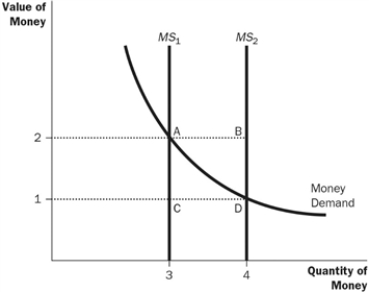 -Refer to Figure 11-1. If the current money supply is located at MS1 and the value of money is 2, what is the excess demand or supply?
 (Multiple Choice)
4.8/5 (84)
(84) Which statement best explains why governments may prefer an inflation tax to some other kind of tax?
(Multiple Choice)
4.9/5 (68)
(68) What would be the effect of indexing the tax system to take into account the effects of inflation on taxing capital gains?
(Multiple Choice)
4.7/5 (87)
(87) In a graph having the price level P on the vertical axis and the quantity of money M on the horizontal axis and considering V and Y independent on the price level or the quantity of money demanded, draw the Md - P curve that is implied by the quantity equation. Now, replace the price level in your graph with the value of money on the vertical axis and redraw the money demand curve. What do you observe?
(Essay)
4.9/5 (66)
(66) How are debtors and creditors affected when the economy unexpectedly goes from inflation to deflation?
(Multiple Choice)
4.8/5 (88)
(88) When the money market is represented in a diagram with the value of money on the vertical axis, how does the money supply curve shift from a decrease in the money supply?
(Multiple Choice)
4.8/5 (80)
(80) Since 1992, at what level has the Bank of Canada successfully maintained the inflation rate?
(Multiple Choice)
4.9/5 (78)
(78) Canadian prices rose at an average annual rate of about 4 percent over the past 70 years.
(True/False)
4.9/5 (83)
(83) Use a money supply and demand diagram to answer the following problem: "The introduction of automated teller machines was equivalent to an increase in money supply." Discuss this assertion.
(Essay)
4.7/5 (83)
(83) What assumptions are necessary to argue that the quantity equation implies that increases in the money supply lead to proportional changes in the price level?
(Essay)
4.9/5 (82)
(82) When the money market is depicted in a diagram with the value of money on the vertical axis, in which situation does the price level decrease?
(Multiple Choice)
4.9/5 (65)
(65) According to the quantity equation, if Y and M are constant and V doubles, what factor does the price level multiply by?
(Multiple Choice)
4.8/5 (84)
(84) What is the inflation tax, and how might it explain the creation of inflation by a central bank?
(Essay)
4.8/5 (63)
(63) This problem compares the effect of a tax on interest earnings over a number of years, when interest is compounded annually. Suppose you purchase $1000 worth of mutual funds paying an average of 5 percent per year.
a) How much is your interest after 30 years if there was no tax on interest?
b) How much is your interest after 30 years if there is a 20 percent tax on interest earnings?
(Essay)
4.8/5 (74)
(74) 
Filters
- Essay(0)
- Multiple Choice(0)
- Short Answer(0)
- True False(0)
- Matching(0)