



 Chat with AI
Exam 11: Money Growth and Inflation

Exam 1: Ten Principles of Economics218 Questions
Exam 2: Thinking Like an Economist231 Questions
Exam 3: Interdependence and the Gains From Trade206 Questions
Exam 4: The Market Forces of Supply and Demand307 Questions
Exam 5: Measuring a Nations Income169 Questions
Exam 6: Measuring the Cost of Living181 Questions
Exam 7: Production and Growth190 Questions
Exam 8: Saving, Investment, and the Financial System214 Questions
Exam 9: Unemployment and Its Natural Rate197 Questions
Exam 10: The Monetary System204 Questions
Exam 11: Money Growth and Inflation195 Questions
Exam 12: Open-Economy Macroeconomics: Basic Concepts219 Questions
Exam 13: A Macroeconomic Theory of the Small Open Economy195 Questions
Exam 14: Aggregate Demand and Aggregate Supply257 Questions
Exam 15: The Influence of Monetary Policy on Aggregate Demand130 Questions
Exam 16: The Influence of Fiscal Policy on Aggregate Demand126 Questions
Exam 17: The Short-Run Tradeoff Between Inflation and Unemployment207 Questions
Exam 18: Five Debates Over Macroeconomic Policy126 Questions
Select questions type


Figure 11-1 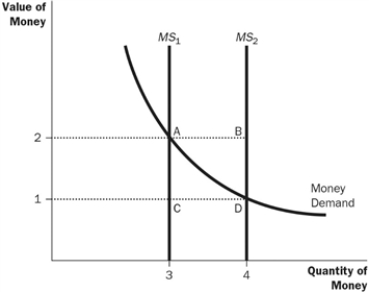 -Refer to Figure 11-1. If the money supply is MS2 and the value of money is 2, which relationship holds?
 (Multiple Choice)
5.0/5  (78)
(78) When the money market is depicted in a diagram with the value of money on the vertical axis, which statement best describes the effects of an increase in money supply?
(Multiple Choice)
5.0/5 (75)
(75) The quantity theory implies that if output and velocity are constant, then a 50 percent increase in the money supply would lead to less than a 50 percent increase in the price level.
(True/False)
4.8/5 (80)
(80) According to the quantity equation, if P = 20, Y = 100, and M = 250, what is V?
(Multiple Choice)
4.9/5 (68)
(68) According to the classical dichotomy, what is influenced by monetary factors?
(Multiple Choice)
4.9/5 (85)
(85) Velocity in the country of Aquilonia is always stable. In 2018, the money supply was $100 billion, nominal GDP was $500 billion, and the real interest rate was 3 percent. In 2019, the money supply was $105 billion, and real GDP did not change from its level in 2018. What was the approximate nominal interest rate in 2019?
(Multiple Choice)
5.0/5 (80)
(80) In the 1990s, Canadian prices rose at about the same rate as in the 1970s.
(True/False)
4.8/5 (75)
(75) Which of the following does an increase in the money supply growth rate increase?
(Multiple Choice)
4.7/5 (67)
(67) What does the evidence from hyperinflations indicate with respect to the quantity theory of money?
(Multiple Choice)
4.8/5 (91)
(91) According to the quantity equation, if P = 3 and Y = 400, which of the following pairs could M and V be?
(Multiple Choice)
4.9/5 (76)
(76) You put money in an account and earn a real interest rate of 10 percent. Inflation is 4 percent, and your marginal tax rate is 40 percent. What is your after-tax real interest rate?
(Multiple Choice)
4.8/5 (75)
(75) Velocity in the country of Nanoland is always stable. In 2018, the money supply was $200 billion and the GDP price deflator was four times as high as it was in the base year. In 2019, the money supply increased to $240 billion, the price level increased by 15 percent, and nominal GDP equalled $1200 billion. By how much did real GDP increase between 2018 and 2019?
(Multiple Choice)
4.8/5 (69)
(69) Which statement best characterizes the effects of monetary policy?
(Multiple Choice)
4.9/5 (83)
(83) Which inflation cost matters even if actual inflation and expected inflation are the same?
(Multiple Choice)
4.9/5 (70)
(70) The source of all four classic hyperinflations was high rates of money growth.
(True/False)
4.8/5 (84)
(84) 
Filters
- Essay(0)
- Multiple Choice(0)
- Short Answer(0)
- True False(0)
- Matching(0)