



 Chat with AI
Exam 15: The Influence of Monetary Policy on Aggregate Demand

Exam 1: Ten Principles of Economics218 Questions
Exam 2: Thinking Like an Economist231 Questions
Exam 3: Interdependence and the Gains From Trade206 Questions
Exam 4: The Market Forces of Supply and Demand307 Questions
Exam 5: Measuring a Nations Income169 Questions
Exam 6: Measuring the Cost of Living181 Questions
Exam 7: Production and Growth190 Questions
Exam 8: Saving, Investment, and the Financial System214 Questions
Exam 9: Unemployment and Its Natural Rate197 Questions
Exam 10: The Monetary System204 Questions
Exam 11: Money Growth and Inflation195 Questions
Exam 12: Open-Economy Macroeconomics: Basic Concepts219 Questions
Exam 13: A Macroeconomic Theory of the Small Open Economy195 Questions
Exam 14: Aggregate Demand and Aggregate Supply257 Questions
Exam 15: The Influence of Monetary Policy on Aggregate Demand130 Questions
Exam 16: The Influence of Fiscal Policy on Aggregate Demand126 Questions
Exam 17: The Short-Run Tradeoff Between Inflation and Unemployment207 Questions
Exam 18: Five Debates Over Macroeconomic Policy126 Questions
Select questions type


Describe the process in the money market by which the interest rate reaches its equilibrium value if it starts above equilibrium.
(Essay)
4.8/5  (73)
(73) In the short run, what effect does an increase in the money supply have on interest rates and aggregate demand?
(Multiple Choice)
4.9/5 (83)
(83) If a central bank targets the interest rate, what does this imply?
(Multiple Choice)
4.7/5 (80)
(80) According to liquidity-preference theory, when would the money-supply curve shift right?
(Multiple Choice)
4.8/5 (95)
(95) According to liquidity-preference theory, if the price level increases, in which direction does the demand curve shift, and how does the interest rate change?
(Multiple Choice)
4.7/5 (86)
(86) When a central bank sets a target for the interest rate, what does it commit itself to?
(Multiple Choice)
4.8/5 (66)
(66) How does a reduction in the money supply by the Bank of Canada make owning stocks less attractive?
(Essay)
4.9/5 (69)
(69) What do some economists believe will happen when interest rates drop to almost zero percent?
(Multiple Choice)
4.9/5 (85)
(85) According to liquidity-preference theory, what is the shape of the money-supply curve?
(Multiple Choice)
4.9/5 (85)
(85) According to liquidity-preference theory, if the price level increases, how do the equilibrium interest rate and the aggregate quantity of goods change?
(Multiple Choice)
4.8/5 (70)
(70) In this question, we try to find out whether using the bank rate as a monetary policy tool is consistent with the liquidity-preference theory. Theoretically, when the Bank of Canada changes the bank rate and implicitly the money supply, the market interest rate would change to become equal to the bank rate AND to equate the new money supply with the money demand. But is this double role of the market interest rate possible? Let us give an example and see what happens. Assume the money demand curve is MD=150 - 15r, and the money supply curve is MS = 100 - 10R, where r is the market interest rate and R is the bank rate announced by the Bank of Canada.
a) Show that, for a given value of bank rate R, the equilibrium market rate is different from R. What does this example show?
b) Given the money demand equation MD=150 - 15r, find a money supply equation such that, for any value of R, the equilibrium market interest rate r is equal to R.
c) For the money supply equation MS = 100 - 10R and a given bank rate R, show how the market could balance at the market interest rate r = R (show what the Bank of Canada should do to balance the money market).
d) What have we learned from this exercise?
(Essay)
4.8/5 (84)
(84) According to liquidity-preference theory, how does a decrease in the price level affect the interest rate and output demanded, respectively?
(Multiple Choice)
4.9/5 (80)
(80) Figure 15-1 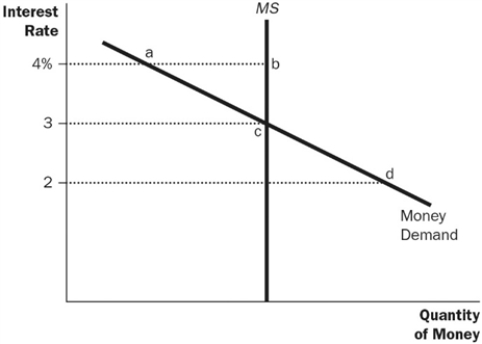 -Refer to Figure 15-1. What is most likely to happen if the interest rate is equal to 2?
 (Multiple Choice)
4.9/5 (74)
(74) In liquidity-preference theory, an increase in the interest rate decreases the quantity of money demanded, but does not shift the money-demand curve.
(True/False)
4.8/5 (80)
(80) If the U.S. puts tariffs on Canadian-manufactured products and Canada has a flexible exchange, which of the following will occur?
(Multiple Choice)
4.9/5 (79)
(79) 
Filters
- Essay(0)
- Multiple Choice(0)
- Short Answer(0)
- True False(0)
- Matching(0)