



 Chat with AI
Exam 15: The Influence of Monetary Policy on Aggregate Demand

Exam 1: Ten Principles of Economics218 Questions
Exam 2: Thinking Like an Economist231 Questions
Exam 3: Interdependence and the Gains From Trade206 Questions
Exam 4: The Market Forces of Supply and Demand307 Questions
Exam 5: Measuring a Nations Income169 Questions
Exam 6: Measuring the Cost of Living181 Questions
Exam 7: Production and Growth190 Questions
Exam 8: Saving, Investment, and the Financial System214 Questions
Exam 9: Unemployment and Its Natural Rate197 Questions
Exam 10: The Monetary System204 Questions
Exam 11: Money Growth and Inflation195 Questions
Exam 12: Open-Economy Macroeconomics: Basic Concepts219 Questions
Exam 13: A Macroeconomic Theory of the Small Open Economy195 Questions
Exam 14: Aggregate Demand and Aggregate Supply257 Questions
Exam 15: The Influence of Monetary Policy on Aggregate Demand130 Questions
Exam 16: The Influence of Fiscal Policy on Aggregate Demand126 Questions
Exam 17: The Short-Run Tradeoff Between Inflation and Unemployment207 Questions
Exam 18: Five Debates Over Macroeconomic Policy126 Questions
Select questions type


Figure 15-1 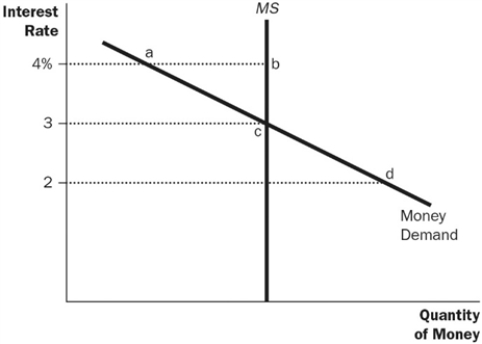 -Refer to Figure 15-1. At which interest rate is there an excess money supply?
 (Multiple Choice)
4.7/5  (67)
(67) Figure 15-1
-Refer to Figure 15-1. What will happen if the current interest rate is 4 percent?
-Refer to Figure 15-1. What will happen if the current interest rate is 4 percent? (Multiple Choice)
4.8/5 (78)
(78) Figure 15-1
-Refer to Figure 15-1. What is most likely to happen if the interest rate is equal to 4?
-Refer to Figure 15-1. What is most likely to happen if the interest rate is equal to 4? (Multiple Choice)
4.8/5 (67)
(67) If expected inflation is constant and the nominal interest rate increases, how does the real interest rate change?
(Multiple Choice)
4.9/5 (64)
(64) If at some interest rate the quantity of money supplied is greater than the quantity of money demanded, what will people desire to do and what happens to the interest rate?
(Multiple Choice)
4.9/5 (89)
(89) According to liquidity-preference theory, what is the opportunity cost of holding money?
(Multiple Choice)
4.9/5 (95)
(95) For Canada, the most important reason for the downward slope of the aggregate demand curve is the real exchange-rate effect.
(True/False)
4.9/5 (78)
(78) How do open-market sales affect the price level and real GDP?
(Multiple Choice)
4.9/5 (74)
(74) The wealth effect helps explain the downward slope of the aggregate-demand curve. How important is this effect and why?
(Multiple Choice)
4.9/5 (79)
(79) Which statement does NOT accurately explain the slope of the aggregate-demand curve?
(Multiple Choice)
4.8/5 (68)
(68) If the stock market crashes, what would be the effect on aggregate demand and how could the Bank of Canada offset those effects?
(Multiple Choice)
4.8/5 (92)
(92) For the Canadian economy, what is the least important of the three reasons for the downward slope of the aggregate-demand curve?
(Multiple Choice)
4.9/5 (84)
(84) In a small open economy with a flexible exchange rate, what does a monetary injection cause?
(Multiple Choice)
4.7/5 (76)
(76) What was Alan Greenspan, the former U.S. Federal Reserve Chairman, referring to when he called it "irrational exuberance"?
(Multiple Choice)
4.8/5 (79)
(79) What is the effect of a stock market boom, and how could the Bank of Canada offset that effect?
(Multiple Choice)
4.7/5 (83)
(83) Which statement is consistent with the long-run theories studied?
(Multiple Choice)
4.8/5 (78)
(78) If at some interest rate the quantity of money demanded is greater than the quantity of money supplied, what will people desire to do and what will happen to the interest rate?
(Multiple Choice)
4.9/5 (75)
(75) Why are monetary authorities concerned about stock market booms?
(Multiple Choice)
4.8/5 (71)
(71) When the Bank of Canada sells government bonds, how do the reserves of the banking system change and what happens to the money supply?
(Multiple Choice)
4.8/5 (83)
(83) Use the money market to explain why the aggregate demand curve slopes downward.
(Essay)
5.0/5 (74)
(74) 
Filters
- Essay(0)
- Multiple Choice(0)
- Short Answer(0)
- True False(0)
- Matching(0)