



 Chat with AI
Exam 22: Touring Our Solar System

Exam 1: Introduction to Earth Science51 Questions
Exam 2: Minerals: Building Blocks of Rocks59 Questions
Exam 3: Rocks: Materials of the Solid Earth86 Questions
Exam 4: Weathering, Soil, and Mass Wasting87 Questions
Exam 5: Running Water and Groundwater93 Questions
Exam 6: Glaciers, Deserts, and Winds95 Questions
Exam 7: Plate Tectonics: a Scientific Theory Unfolds75 Questions
Exam 8: Earthquakes and Earths Interior62 Questions
Exam 9: Volcanoes and Other Igneous Activity97 Questions
Exam 11: Geologic Time77 Questions
Exam 12: Earths Evolution Through Geologic Time108 Questions
Exam 13: The Ocean Floor64 Questions
Exam 14: Ocean Water and Ocean Life59 Questions
Exam 15: The Dynamic Ocean79 Questions
Exam 16: The Atmosphere: Composition, Structure, and Temperature99 Questions
Exam 17: Moisture, Clouds, and Precipitation89 Questions
Exam 18: Air Pressure and Wind78 Questions
Exam 19: Weather Patterns and Severe Weather71 Questions
Exam 20: Climate82 Questions
Exam 21: Origin of Modern Astronomy91 Questions
Exam 22: Touring Our Solar System81 Questions
Exam 23: Light, Astronomical Observations, and the Sun62 Questions
Exam 24: Beyond Our Solar System69 Questions
Select questions type


________ is the principal gas in the Venusian atmosphere and also a minor component of the atmospheres of Earth and Mars.
(Multiple Choice)
4.9/5  (94)
(94) Why are meteorites a possible source of information regarding the origin and composition of Earth? Also, what other "clues" might be present in meteorites?
(Not Answered)
This question doesn't have any answer yet
The surface features of ________ are known only through satellite radar mapping.
(Multiple Choice)
4.7/5 (81)
(81) The Moon has highland areas which approach the height of mountains on Earth.
(True/False)
4.7/5 (90)
(90) Saturn's rings are clusters of relatively small, individual particles; the rings observed on Jupiter are violent storm clouds swirling above the polar regions of the planet.
(True/False)
4.9/5 (66)
(66) This planet has ice caps which change in size with the seasons.
(Multiple Choice)
4.7/5 (91)
(91) An extreme example of the greenhouse effect is thought to be associated with an abundance of carbon dioxide in the Martian atmosphere.
(True/False)
4.8/5 (69)
(69) The Jovian planets are more massive but less dense than the terrestrial planets.
(True/False)
4.8/5 (76)
(76) ________ meteorites are thought to be analogous in composition to Earth's core.
(Multiple Choice)
4.9/5 (81)
(81) Word Analysis. Examine the words and/or phrases for each question below and determine the relationship among the majority of words/phrases. Choose the option which does not fit the pattern.
(Multiple Choice)
4.9/5 (82)
(82) Label the planets on the diagram below. 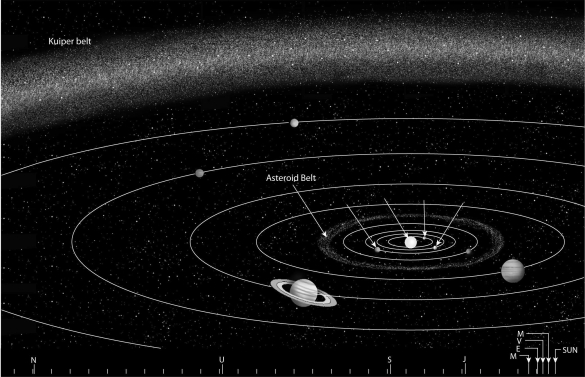
(Not Answered)
This question doesn't have any answer yet
________ has atmospheric pressures at its surface that are roughly comparable to those at Earth's surface.
(Multiple Choice)
4.8/5 (74)
(74) Which pair of solar system bodies comes closest to approximating a "double planet," that is, two bodies of roughly equal mass close enough to revolve around each other as they orbit around the Sun?
(Multiple Choice)
5.0/5 (90)
(90) How is Earth unique as compared to other planets in our solar system? How is it similar? And finally, what geologic information might we obtain by visiting Mars or Venus that would further link Earth to these planets?
(Essay)
4.9/5 (77)
(77) Comets are thought to be composed of dust and tiny, icy particles encased in small, solidified, metallic fragments.
(True/False)
4.8/5 (80)
(80) 
Filters
- Essay(0)
- Multiple Choice(0)
- Short Answer(0)
- True False(0)
- Matching(0)