



 Chat with AI
Exam 22: Touring Our Solar System

Exam 1: Introduction to Earth Science51 Questions
Exam 2: Minerals: Building Blocks of Rocks59 Questions
Exam 3: Rocks: Materials of the Solid Earth86 Questions
Exam 4: Weathering, Soil, and Mass Wasting87 Questions
Exam 5: Running Water and Groundwater93 Questions
Exam 6: Glaciers, Deserts, and Winds95 Questions
Exam 7: Plate Tectonics: a Scientific Theory Unfolds75 Questions
Exam 8: Earthquakes and Earths Interior62 Questions
Exam 9: Volcanoes and Other Igneous Activity97 Questions
Exam 11: Geologic Time77 Questions
Exam 12: Earths Evolution Through Geologic Time108 Questions
Exam 13: The Ocean Floor64 Questions
Exam 14: Ocean Water and Ocean Life59 Questions
Exam 15: The Dynamic Ocean79 Questions
Exam 16: The Atmosphere: Composition, Structure, and Temperature99 Questions
Exam 17: Moisture, Clouds, and Precipitation89 Questions
Exam 18: Air Pressure and Wind78 Questions
Exam 19: Weather Patterns and Severe Weather71 Questions
Exam 20: Climate82 Questions
Exam 21: Origin of Modern Astronomy91 Questions
Exam 22: Touring Our Solar System81 Questions
Exam 23: Light, Astronomical Observations, and the Sun62 Questions
Exam 24: Beyond Our Solar System69 Questions
Select questions type


Rays in the rings of Saturn are bright, radial streaks that converge inward toward the planet's surface.
(True/False)
4.8/5  (84)
(84) The ________ explains how our solar system probably formed from a giant cloud of gases and dispersed solid particles.
(Multiple Choice)
4.8/5 (79)
(79) The two most abundant gases in Earth's atmosphere are ________ and ________.
(Short Answer)
4.9/5 (78)
(78) Which planet has a densely cratered surface similar to that of the Moon?
(Short Answer)
4.9/5 (90)
(90) The large volcano known in the solar system, Mons Olympus, is located on the planet ________.
(Short Answer)
4.9/5 (78)
(78) The lunar highlands exhibit rugged, topographic relief and a high density of impact craters.
(True/False)
4.9/5 (70)
(70) The only planet in the solar system whose axis of rotation lies close to its equatorial plane is ________.
(Short Answer)
4.9/5 (77)
(77) Lunar regolith breccia contains crystalline rock fragments and glassy fragments.
(True/False)
4.9/5 (83)
(83) Jupiter is the largest and most massive planet in the solar system.
(True/False)
4.8/5 (69)
(69) Carefully examine the telescopic view of the lunar surface (near side) below and the features labeled A, B, and C. 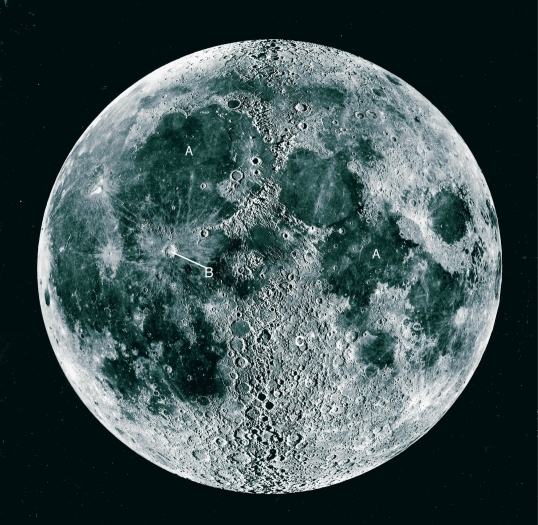 (a) Give a brief description that characterizes the bright area around C.
(b) Notice the features like those labeled A. What are such features called?
(c) How are craters like the one labeled B different from the craters of the area labeled C?
(d) In what order (from first to latest) did the features form that are labeled A, B, and C?
(a) Give a brief description that characterizes the bright area around C.
(b) Notice the features like those labeled A. What are such features called?
(c) How are craters like the one labeled B different from the craters of the area labeled C?
(d) In what order (from first to latest) did the features form that are labeled A, B, and C? (Essay)
4.8/5 (77)
(77) A cluster of three large, fresh-looking impact craters shown in radar images of the surface of Venus best supports the conclusion that ________.
(Multiple Choice)
4.8/5 (81)
(81) The largest shield volcano yet observed in the solar system is located on ________.
(Short Answer)
4.8/5 (87)
(87) Eruptive plumes and lava flows rich in sulfur have been photographed on Jupiter's moon, Io.
(True/False)
4.7/5 (89)
(89) The high surface temperatures of this planet have been attributed to the greenhouse effect.
(Multiple Choice)
4.9/5 (85)
(85) Which one of the terrestrial planets has a surface landscape similar to that of the older areas of the Moon?
(Multiple Choice)
5.0/5 (77)
(77) Which of the following statements concerning ring satellites of the planets is true?
(Multiple Choice)
4.8/5 (84)
(84) Which one of the following statements is believed to be true of comets?
(Multiple Choice)
4.8/5 (81)
(81) The Cassini gap refers to the planetless belt of asteroids between Mars and Earth.
(True/False)
4.8/5 (89)
(89) 
Filters
- Essay(0)
- Multiple Choice(0)
- Short Answer(0)
- True False(0)
- Matching(0)