



 Chat with AI
Exam 8: Economic Growth

Exam 1: Economics: the Study of Choice145 Questions
Exam 3: Demand and Supply251 Questions
Exam 4: Applications of Supply and Demand113 Questions
Exam 5: Macroeconomics: the Big Picture145 Questions
Exam 6: Measuring Total Output and Income161 Questions
Exam 7: Aggregate Demand and Aggregate Supply166 Questions
Exam 8: Economic Growth136 Questions
Exam 9: The Nature and Creation of Money224 Questions
Exam 10: Financial Markets and the Economy175 Questions
Exam 11: Monetary Policy and the Fed178 Questions
Exam 12: Government and Fiscal Policy177 Questions
Exam 13: Consumption and the Aggregate Expenditures Model219 Questions
Exam 14: Investment and Economic Activity138 Questions
Exam 15: Net Exports and International Finance199 Questions
Exam 16: Inflation and Unemployment132 Questions
Exam 17: A Brief History of Macroeconomic Thought and Policy123 Questions
Exam 18: Inequality, Poverty, and Discrimination140 Questions
Select questions type


Which of the following would shift the production function upward?
(Multiple Choice)
4.7/5  (90)
(90) Suppose labor is the only variable that changes. If production displays diminishing marginal returns, each additional unit of labor
(Multiple Choice)
4.9/5 (81)
(81) Use the following to answer questions.
Exhibit: Aggregate Production Function, Labor Market, and LRAS 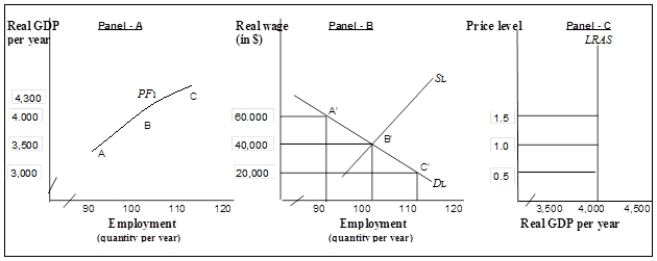 -(Exhibit: Aggregate Production Function, Labor Market, and LRAS) In Panel (c), the position of the long-run aggregate supply curve is determined by
 (Multiple Choice)
4.7/5 (73)
(73) Economic growth is represented by an outward shift of the production possibilities curve.
(True/False)
4.8/5 (97)
(97) If real GDP grows at 3% and population grows at 1.2%, then real GDP per capita grows by 4.2%.
(True/False)
4.8/5 (81)
(81) According to the rule of 72, a 12% annual increase in real GDP would lead to a doubling of real GDP in 8 years.
(True/False)
4.8/5 (80)
(80) Towards the end of the twentieth century, some of the world's more affluent countries experienced robust growth while others experienced growth slowdown or even stagnation. Which of the following is not a reason for the divergent growth trend?
(Multiple Choice)
4.8/5 (79)
(79) Use the following to answer questions .
Exhibit: Aggregate Production Function 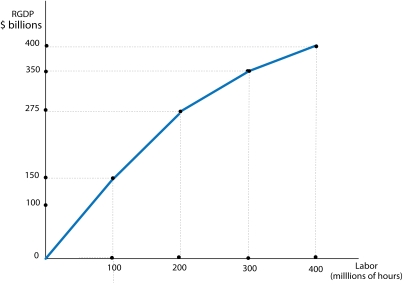 -(Exhibit: Aggregate Production Function) In drawing the aggregate production function, which of the following variables is not held constant?
 (Multiple Choice)
4.8/5 (75)
(75) All other things unchanged, which of the following events leads to a shift further outward in the country's production possibility curve?
(Multiple Choice)
4.9/5 (76)
(76) The rate of economic growth per capita in Mamoogia from 2006 to 2010 was 3.6% per year, while in Kennan, over the same period it was 7.2%. In 2010, per capita real GDP was $28,900 in Mamoogia and $12,700 in Kennan. Assume the growth rate for each country remains the same. Calculate the percentage difference in their levels of potential output in 2050.
(Multiple Choice)
4.9/5 (83)
(83) An increase in the capital stock would shift the production function _______ and the long-run aggregate supply curve to the _______.
(Multiple Choice)
4.9/5 (79)
(79) Use the following to answer questions .
Exhibit: Economic Growth, AD and AS Analysis 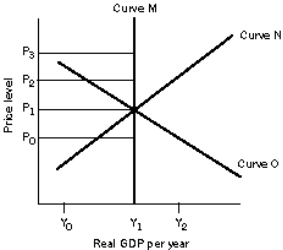 -(Exhibit: Economic Growth, AD and AS Analysis) Assume that the economy is initially in long-run equilibrium. If oil prices in the economy increased dramatically and remained high for so long that most of the industries in the economy had to significantly form new capital and retool much of its existing capital, the economy would suffer. In this event,
 (Multiple Choice)
4.9/5 (86)
(86) Holding everything else unchanged, if a nation's output grows at approximately 2.4% per year and its population doubles in 45 years, calculate the approximate rate of change in per capita real GDP.
(Multiple Choice)
4.9/5 (72)
(72) Suppose the world's population in 2012 is 7.1 billion and is projected to grow at a rate of 1.2% per year. In approximately what year will the world's population be 14.2 billion?
(Multiple Choice)
4.9/5 (70)
(70) If output per capita doubles in 30 years and the population doubles in 60 years, what is the growth rate of output?
(Multiple Choice)
4.7/5 (89)
(89) Which of the following applies to economic growth?
I. Economic growth allows people to buy more goods and services.
II. Economic growth is the expansion of the economy's production possibilities.
III. Economic growth is represented by a movement from a point inside the production possibilities curve to a point on the curve.
(Multiple Choice)
4.9/5 (82)
(82) 
Filters
- Essay(0)
- Multiple Choice(0)
- Short Answer(0)
- True False(0)
- Matching(0)