



 Chat with AI
Exam 8: Economic Growth

Exam 1: Economics: the Study of Choice145 Questions
Exam 3: Demand and Supply251 Questions
Exam 4: Applications of Supply and Demand113 Questions
Exam 5: Macroeconomics: the Big Picture145 Questions
Exam 6: Measuring Total Output and Income161 Questions
Exam 7: Aggregate Demand and Aggregate Supply166 Questions
Exam 8: Economic Growth136 Questions
Exam 9: The Nature and Creation of Money224 Questions
Exam 10: Financial Markets and the Economy175 Questions
Exam 11: Monetary Policy and the Fed178 Questions
Exam 12: Government and Fiscal Policy177 Questions
Exam 13: Consumption and the Aggregate Expenditures Model219 Questions
Exam 14: Investment and Economic Activity138 Questions
Exam 15: Net Exports and International Finance199 Questions
Exam 16: Inflation and Unemployment132 Questions
Exam 17: A Brief History of Macroeconomic Thought and Policy123 Questions
Exam 18: Inequality, Poverty, and Discrimination140 Questions
Select questions type


Suppose a country's real GDP increases. At the same time, its population also increases. What happens to its standard of living?
(Multiple Choice)
4.9/5  (83)
(83) Using a three-panel diagram of the labor market, the aggregate production function, and long-run aggregate supply, show and explain the effect of an increase in capital stock on wages, employment, and potential output.
(Essay)
4.7/5 (71)
(71) Economic growth is an exponential process. What does this mean?
(Multiple Choice)
4.9/5 (75)
(75) Use the following to answer questions .
Exhibit: Aggregate Production Function 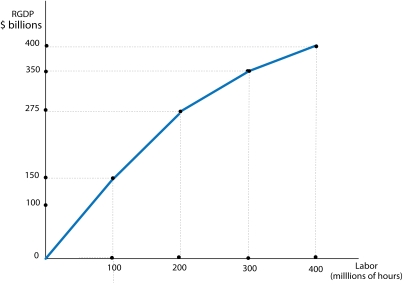 -(Exhibit: Aggregate Production Function) The production function displays
 (Multiple Choice)
4.9/5 (75)
(75) The skills, training, and education possessed by workers contribute to economic growth
(Multiple Choice)
4.9/5 (69)
(69) If a nation's real GDP grows at approximately 3.4% per year and its population doubles in 120 years, calculate the approximate rate of change in per capita real GDP.
(Multiple Choice)
4.8/5 (81)
(81) All else constant, if a nation's potential output doubles in 36 years, its average annual growth rate is
(Multiple Choice)
4.9/5 (71)
(71) If population increases at an average rate of 1% per year and output increases at an average rate of 5% per year, then per capita real GDP will double in
(Multiple Choice)
4.9/5 (82)
(82) The rule of 72 states that grows at some exponential rate of z percent
(Multiple Choice)
4.8/5 (90)
(90) In the U.S., between 1990 and 2007, capital stock and the level of technology increased dramatically. During the same period, employment and real wages rose. What do these set of events suggest?
(Multiple Choice)
4.9/5 (78)
(78) Holding all else constant, a country's standard of living will decline if its
(Multiple Choice)
4.8/5 (86)
(86) Use the rule of 72 to determine how long it takes for real GDP to double if real GDP grows at 3% per year.
(Multiple Choice)
4.7/5 (58)
(58) Use the following to answer questions .
Exhibit: Production Possibilities Curves 1 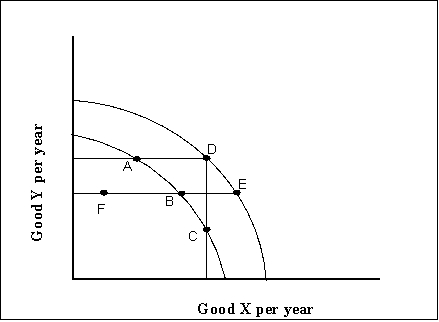 -(Exhibit: Production Possibilities Curves 1) A cyclical increase in real GDP is represented by a movement
 (Multiple Choice)
4.8/5 (85)
(85) Which of the following events will shift the long-run aggregate supply curve?
(Multiple Choice)
4.7/5 (71)
(71) Use the following to answer questions.
Exhibit: Aggregate Production Function, Labor Market, and LRAS 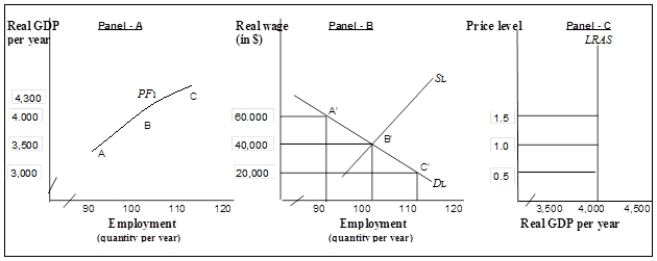 -(Exhibit: Aggregate Production Function, Labor Market, and LRAS) The economy could achieve its potential output at a price level-nominal wage combination of
 (Multiple Choice)
4.8/5 (78)
(78) The determinants of economic growth include all of the following except
(Multiple Choice)
4.7/5 (80)
(80) Economic growth is the process through which the economy's potential output is increased.
(True/False)
4.9/5 (79)
(79) 
Filters
- Essay(0)
- Multiple Choice(0)
- Short Answer(0)
- True False(0)
- Matching(0)