



 Chat with AI
Exam 16: Inflation and Unemployment

Exam 1: Economics: the Study of Choice145 Questions
Exam 3: Demand and Supply251 Questions
Exam 4: Applications of Supply and Demand113 Questions
Exam 5: Macroeconomics: the Big Picture145 Questions
Exam 6: Measuring Total Output and Income161 Questions
Exam 7: Aggregate Demand and Aggregate Supply166 Questions
Exam 8: Economic Growth136 Questions
Exam 9: The Nature and Creation of Money224 Questions
Exam 10: Financial Markets and the Economy175 Questions
Exam 11: Monetary Policy and the Fed178 Questions
Exam 12: Government and Fiscal Policy177 Questions
Exam 13: Consumption and the Aggregate Expenditures Model219 Questions
Exam 14: Investment and Economic Activity138 Questions
Exam 15: Net Exports and International Finance199 Questions
Exam 16: Inflation and Unemployment132 Questions
Exam 17: A Brief History of Macroeconomic Thought and Policy123 Questions
Exam 18: Inequality, Poverty, and Discrimination140 Questions
Select questions type


In the recovery phase of the inflation-unemployment relationship, a falling rate of inflation implies a falling price level.
(True/False)
4.8/5  (68)
(68) Use the following to answer questions .
Exhibit: Aggregate Demand Shifts and Expectations 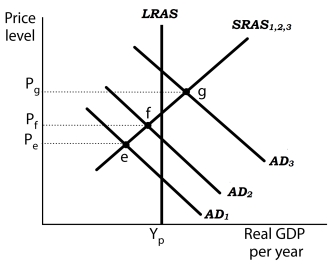 -(Exhibit: Aggregate Demand Shifts and Expectations) Suppose the economy was operating at point e in period 1. Expansionary fiscal and monetary policies adopted in period 1 resulted in a movement to point g in period 3. What happens when workers and firms adjust their expectations in a higher price level and act on these expectations?
 (Multiple Choice)
4.8/5 (82)
(82) Which of the following characterizes the relationship between inflation and unemployment in the United States?
I. There have been periods in which a clear tradeoff between inflation and unemployment
Seemed to exist.
II. There have been periods in which inflation and unemployment rose together.
III. There have been periods in which inflation and unemployment fell together.
(Multiple Choice)
5.0/5 (78)
(78) Using the equation of exchange, the rate of money growth can be expressed as
(Multiple Choice)
4.9/5 (80)
(80) Use the following to answer questions .
Exhibit: Aggregate Demand Shifts and Expectations
-(Exhibit: Aggregate Demand Shifts and Expectations) Suppose the economy was operating at point e in period 1. Expansionary fiscal and monetary policies adopted in period 1 resulted in a movement to point g in period 3. What happens when workers and firms become aware of a rise in the general price to Pg?
-(Exhibit: Aggregate Demand Shifts and Expectations) Suppose the economy was operating at point e in period 1. Expansionary fiscal and monetary policies adopted in period 1 resulted in a movement to point g in period 3. What happens when workers and firms become aware of a rise in the general price to Pg? (Multiple Choice)
4.9/5 (79)
(79) Which of the following statements is true of the U.S. experience with regards to the Phillips curve hypothesis?
I. Values of inflation and unemployment rates during the 1960s generally conformed to the tradeoff implied by the Phillips curve.
II. Annual observations of inflation and unemployment from 1961 to 2015 do not
Seem consistent with a Phillips curve.
III. Annual observations of inflation and unemployment from 1961 to 2015 seem consistent
With a Phillips curve.
(Multiple Choice)
4.9/5 (92)
(92) Use the following to answer questions .
Exhibit: AD-AS and the Inflation-Unemployment Cycle 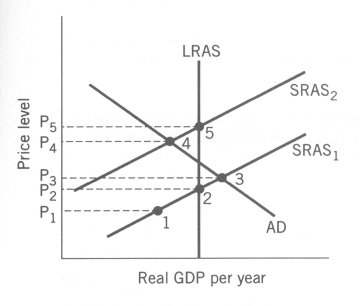 -(Exhibit: AD-AS and the Inflation-Unemployment Cycle) If the economy is in equilibrium at point 3,
 (Multiple Choice)
4.9/5 (88)
(88) Suppose that rising productivity increases potential output in each period by 4%. Using the equation of exchange, what kind of monetary policy would be needed to maintain a zero rate of inflation at full employment?
(Multiple Choice)
4.9/5 (85)
(85) In early in 1994, the Federal Reserve shifted to a contractionary policy although the economy
Was still in a recessionary gap left over from the 1990-1991 recession. Which of the
Following best explains this move?
(Multiple Choice)
4.9/5 (85)
(85) In the short run, if the economy is in a Phillips phase of the inflation-unemployment relationship, an increase in aggregate demand will generate
(Multiple Choice)
4.8/5 (74)
(74) Suppose an economy is operating with a recessionary gap. In this case, policymakers would seek to move the economy
(Multiple Choice)
4.7/5 (71)
(71) In a recovery phase, a falling rate of inflation means that the price level is
(Multiple Choice)
4.9/5 (69)
(69) 
Filters
- Essay(0)
- Multiple Choice(0)
- Short Answer(0)
- True False(0)
- Matching(0)