



 Chat with AI
Exam 16: Inflation and Unemployment

Exam 1: Economics: the Study of Choice145 Questions
Exam 3: Demand and Supply251 Questions
Exam 4: Applications of Supply and Demand113 Questions
Exam 5: Macroeconomics: the Big Picture145 Questions
Exam 6: Measuring Total Output and Income161 Questions
Exam 7: Aggregate Demand and Aggregate Supply166 Questions
Exam 8: Economic Growth136 Questions
Exam 9: The Nature and Creation of Money224 Questions
Exam 10: Financial Markets and the Economy175 Questions
Exam 11: Monetary Policy and the Fed178 Questions
Exam 12: Government and Fiscal Policy177 Questions
Exam 13: Consumption and the Aggregate Expenditures Model219 Questions
Exam 14: Investment and Economic Activity138 Questions
Exam 15: Net Exports and International Finance199 Questions
Exam 16: Inflation and Unemployment132 Questions
Exam 17: A Brief History of Macroeconomic Thought and Policy123 Questions
Exam 18: Inequality, Poverty, and Discrimination140 Questions
Select questions type


In the 1960s and early 70s, economists believed that the short-run Phillips curve indicated that policymakers could choose the mix of inflation and unemployment they were willing to accept and achieved this with appropriate fiscal and monetary policies.
(True/False)
4.8/5  (72)
(72) Use the following to answer questions .
Exhibit: Shifts in Aggregate Demand and Aggregate Supply and Inflation-Unemployment Phases 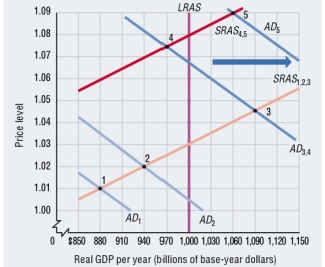 -(Exhibit: Shifts in Aggregate Demand and Aggregate Supply and Inflation-Unemployment Phases) The recessionary gap at point 4 was created
 (Multiple Choice)
4.7/5 (82)
(82) Suppose the full-employment level of real GDP is increasing at a rate of 3% per period and the money supply is growing at a 3% rate. Using the equation of exchange, what is the value of the long-run inflation rate, assuming constant velocity?
(Multiple Choice)
4.9/5 (84)
(84) Use the following to answer questions .
Exhibit: AD-AS and the Inflation-Unemployment Cycle 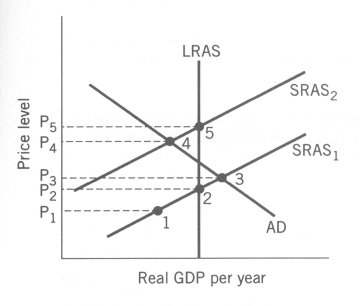 -(Exhibit: AD-AS and the Inflation-Unemployment Cycle) At point 4, the economy is experiencing
 (Multiple Choice)
4.8/5 (86)
(86) The vertical long-run Phillips curve occurs in the long run because
(Multiple Choice)
4.8/5 (82)
(82) In the long run, unemployment
I. will be at the natural rate of unemployment.
II. is made up of structural and frictional unemployment.
III. could be made up of structural, frictional, and cyclical unemployment.
(Multiple Choice)
4.8/5 (92)
(92) In a recovery phase, a falling inflation rate means that the price level is rising by smaller and smaller percentages.
(True/False)
4.9/5 (83)
(83) In the long-run, only a change in the _______ is likely to affect the inflation rate associated
With a particular rate of growth in the money supply.
(Multiple Choice)
4.8/5 (74)
(74) The Phillips phase of the inflation-unemployment relationship emerges because
(Multiple Choice)
4.9/5 (82)
(82) What are the three phases of the inflation-unemployment relationship? What are the critical features that mark these phases?
(Essay)
4.8/5 (87)
(87) If a Phillips curve relationship between inflation and unemployment was completely valid at all times, would this be a good thing? Would this create any problems for policymakers? Explain.
(Essay)
4.8/5 (97)
(97) Use the following to answer questions .
Exhibit: The Inflation-Unemployment Cycle 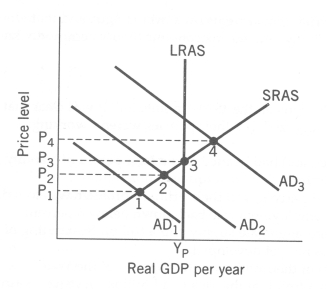 -(Exhibit: The Inflation-Unemployment Cycle) The shifts of AD from point 1 to 2 to 3 to 4 are characteristic of the _______ phase of the inflation-unemployment cycle.
 (Multiple Choice)
4.8/5 (85)
(85) Expectations of higher inflation rates cause a leftward shift in the short-run aggregate supply curve and usher in a stagflation phase of the inflation-unemployment relationship.
(True/False)
4.7/5 (96)
(96) Use the theory behind the equation of exchange to demonstrate that "inflation is always and everywhere a monetary phenomenon."
(Essay)
4.9/5 (79)
(79) The short-run Phillips curve implies a positive relationship between inflation and unemployment.
(True/False)
4.8/5 (66)
(66) 
Filters
- Essay(0)
- Multiple Choice(0)
- Short Answer(0)
- True False(0)
- Matching(0)