



 Chat with AI
Exam 18: Inequality, Poverty, and Discrimination

Exam 1: Economics: the Study of Choice145 Questions
Exam 3: Demand and Supply251 Questions
Exam 4: Applications of Supply and Demand113 Questions
Exam 5: Macroeconomics: the Big Picture145 Questions
Exam 6: Measuring Total Output and Income161 Questions
Exam 7: Aggregate Demand and Aggregate Supply166 Questions
Exam 8: Economic Growth136 Questions
Exam 9: The Nature and Creation of Money224 Questions
Exam 10: Financial Markets and the Economy175 Questions
Exam 11: Monetary Policy and the Fed178 Questions
Exam 12: Government and Fiscal Policy177 Questions
Exam 13: Consumption and the Aggregate Expenditures Model219 Questions
Exam 14: Investment and Economic Activity138 Questions
Exam 15: Net Exports and International Finance199 Questions
Exam 16: Inflation and Unemployment132 Questions
Exam 17: A Brief History of Macroeconomic Thought and Policy123 Questions
Exam 18: Inequality, Poverty, and Discrimination140 Questions
Select questions type


The percentage of the U.S. population living in poverty in 2015 was:
(Multiple Choice)
4.8/5  (85)
(85) One explanation for why the poor tend to receive more noncash assistance than cash assistance is that:
(Multiple Choice)
4.8/5 (80)
(80) After adjusting for noncash aid, the poverty rate in the United States is:
(Multiple Choice)
4.9/5 (79)
(79) Use the following to answer questions.
Exhibit: Income Distribution 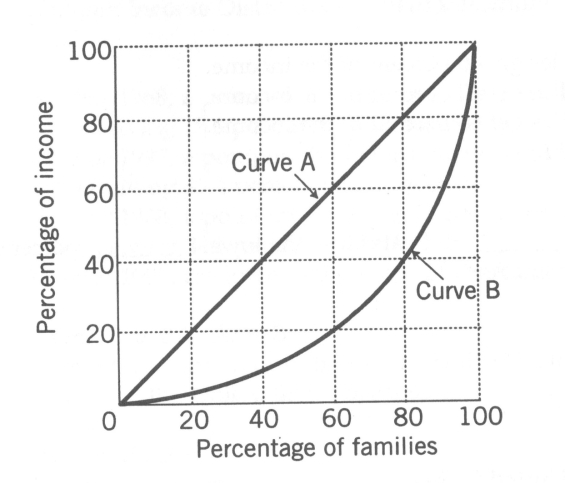 -(Exhibit: Income Distribution) Curve B indicates that:
 (Multiple Choice)
4.9/5 (73)
(73) In 2015, white female wages were about 80% of white male wages.
(True/False)
4.9/5 (75)
(75) Since the late 1960s, a factor that is associated with the _______ in income _______ in the United States has been the _______ in the percentage of families headed by _______ .
(Multiple Choice)
4.8/5 (83)
(83) Use the following to answer questions .
Exhibit: Income Distribution in the United States
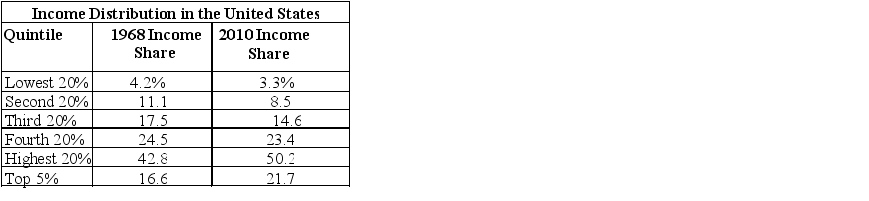 -(Exhibit: Income Distribution in the United States) Which of the following statements is true?
 (Multiple Choice)
4.8/5 (81)
(81) The percentage of the population that falls below the poverty line is called the:
(Multiple Choice)
4.8/5 (81)
(81) Affirmative action attempts to eliminate discrimination by:
(Multiple Choice)
4.9/5 (84)
(84) Use the following to answer questions .
Exhibit: Discrimination Model 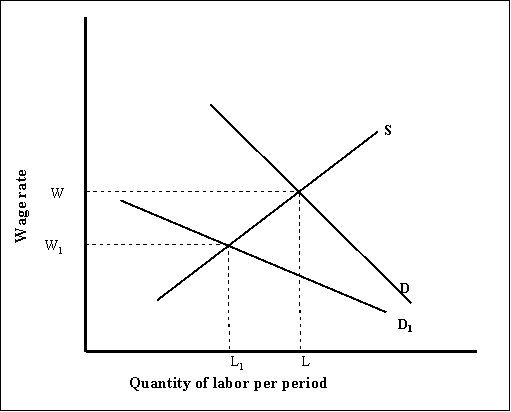 -(Exhibit: Discrimination Model) If blacks and white have the same supply curve, but employers have discriminatory attitudes that cause them to assume a black worker is less productive, then the demand curve for blacks will be _______ and the wage for blacks will be _______ .
 (Multiple Choice)
4.9/5 (77)
(77) Use the following to answer questions.
Exhibit: Discrimination  -(Exhibit: Discrimination) If blacks and whites have the same supply curve S, while blacks have demand curve D and whites have demand curve D', employment for blacks will be given by:
 (Multiple Choice)
4.8/5 (77)
(77) When people with similar economic characteristics experience different economic outcomes because of their race, sex, or other noneconomic characteristics the result is:
(Multiple Choice)
4.9/5 (75)
(75) The Case in Point titled "Attitudes and Inequality" suggested that:
(Multiple Choice)
4.8/5 (67)
(67) Use the following to answer questions.
Exhibit: Income Distribution
-(Exhibit: Income Distribution) Curve B shows that the lowest quintile of families gets approximately _______ percent of the income.
-(Exhibit: Income Distribution) Curve B shows that the lowest quintile of families gets approximately _______ percent of the income. (Multiple Choice)
5.0/5 (75)
(75) The Case in Point titled "Welfare Reform in Britain and the United States indicated that the program in _____ did not require recipients to obtain jobs and that the reduction in case loads was smaller in _____.
(Multiple Choice)
4.8/5 (74)
(74) Use the following to answer questions .
Exhibit: Discrimination Model
-(Exhibit: Discrimination Model) If blacks and whites have the same supply curve, but employers have discriminatory attitudes that cause them to assume a black worker is less productive, the wage of whites will be _______ , the quantity of whites hired will be ________ , the wage of blacks will be _______ , and the quantity of blacks hired will be ________ .
-(Exhibit: Discrimination Model) If blacks and whites have the same supply curve, but employers have discriminatory attitudes that cause them to assume a black worker is less productive, the wage of whites will be _______ , the quantity of whites hired will be ________ , the wage of blacks will be _______ , and the quantity of blacks hired will be ________ . (Multiple Choice)
4.9/5 (84)
(84) In 2015 in the United States, approximately 5 percent of the families headed by females with no husband present fell below the poverty line.
(True/False)
4.9/5 (85)
(85) Between 1968 and 2015, the income group in the United States showing the greatest income gains was the _______ 20 percent.
(Multiple Choice)
4.9/5 (71)
(71) Suppose that racism and sexism don't exist on the customer side of perfectly competitive markets. Then, according to the text, competition among profit-maximizing firms:
(Multiple Choice)
4.8/5 (85)
(85) 
Filters
- Essay(0)
- Multiple Choice(0)
- Short Answer(0)
- True False(0)
- Matching(0)