



 Chat with AI
Exam 18: Inequality, Poverty, and Discrimination

Exam 1: Economics: the Study of Choice145 Questions
Exam 3: Demand and Supply251 Questions
Exam 4: Applications of Supply and Demand113 Questions
Exam 5: Macroeconomics: the Big Picture145 Questions
Exam 6: Measuring Total Output and Income161 Questions
Exam 7: Aggregate Demand and Aggregate Supply166 Questions
Exam 8: Economic Growth136 Questions
Exam 9: The Nature and Creation of Money224 Questions
Exam 10: Financial Markets and the Economy175 Questions
Exam 11: Monetary Policy and the Fed178 Questions
Exam 12: Government and Fiscal Policy177 Questions
Exam 13: Consumption and the Aggregate Expenditures Model219 Questions
Exam 14: Investment and Economic Activity138 Questions
Exam 15: Net Exports and International Finance199 Questions
Exam 16: Inflation and Unemployment132 Questions
Exam 17: A Brief History of Macroeconomic Thought and Policy123 Questions
Exam 18: Inequality, Poverty, and Discrimination140 Questions
Select questions type


The primary source of cash payments to the poor in the United States is Temporary Assistance for Needy Families.
(True/False)
4.8/5  (86)
(86) Research by Rob Grunewald and Art Rolnick, cited in the Case in Point on early intervention programs suggested that governments can better promote economic development by supporting early childhood programs rather than by:
(Multiple Choice)
4.8/5 (66)
(66) An income test devised to indicate poverty for those people whose incomes fall at the bottom quintile of the income distribution list is called an absolute income test.
(True/False)
4.8/5 (78)
(78) The poverty rate for whites (not Hispanic) in 2015 in the United States was approximately ________ percent.
(Multiple Choice)
4.8/5 (78)
(78) In the United States in the 1990s, and 2000s, the gap between the wages of college- and high-school-trained workers _______ and contributed to _______ .
(Multiple Choice)
4.8/5 (89)
(89) Which of the following is (are) examples of discriminatory practices?
(Multiple Choice)
4.9/5 (78)
(78) The percentage of the population living in households whose income falls below the poverty line is the:
(Multiple Choice)
4.9/5 (77)
(77) In determining the poverty rate in the United States, only cash income is counted.
(True/False)
4.9/5 (76)
(76) America's poverty rate is lower than that of most industrialized nations.
(True/False)
4.8/5 (62)
(62) In 2015, approximately ________ percent of the families in the United States headed by ________ fell below the poverty line.
(Multiple Choice)
4.9/5 (82)
(82) Use the following to answer questions.
Exhibit: Income Distribution  -(Exhibit: Income Distribution) Curve B:
 (Multiple Choice)
4.9/5 (74)
(74) In 2015, approximately 5 percent of the families headed by married couple families in the United States fell below the poverty line.
(True/False)
4.7/5 (81)
(81) Discrimination in the work place can result from prejudices by employers, other employees, or consumers.
(True/False)
4.7/5 (82)
(82) In the United States over the last couple of decades, the gap between the wages of skilled and unskilled workers:
(Multiple Choice)
4.8/5 (77)
(77) Between 1968 and 2015, income inequality in the United States:
(Multiple Choice)
4.9/5 (82)
(82) What is a Lorenz curve? How can it be used to show the degree of inequality of income distribution? Given the data for Brazil shown, draw a Lorenz curve. Is the income distribution relatively equal or unequal? Explain how you reached your answer. 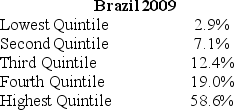
(Not Answered)
This question doesn't have any answer yet
Much of the recently declining wage gap between white males and blacks and women is due to _______ blacks and women, but some of the decline is due to _______ .
(Multiple Choice)
4.9/5 (90)
(90) 
Filters
- Essay(0)
- Multiple Choice(0)
- Short Answer(0)
- True False(0)
- Matching(0)