



 Chat with AI
Exam 20: Succession and Stability

Exam 1: Introduction to Ecology: Historical Foundations and Developing Frontiers25 Questions
Exam 2: Life on Land35 Questions
Exam 3: Life in Water39 Questions
Exam 4: Population Genetics and Natural Selection36 Questions
Exam 5: Temperature Relations43 Questions
Exam 6: Water Relations37 Questions
Exam 7: Energy and Nutrient Relations33 Questions
Exam 8: Social Relations36 Questions
Exam 9: Population Distribution and Abundance31 Questions
Exam 10: Population Dynamics38 Questions
Exam 11: Population Growth29 Questions
Exam 12: Life Histories35 Questions
Exam 13: Competition33 Questions
Exam 14: Exploitative Interactions: Predation, Herbivory, Parasitism, and Disease42 Questions
Exam 15: Mutualism31 Questions
Exam 16: Species Abundance and Diversity27 Questions
Exam 17: Species Interactions and Community Structure28 Questions
Exam 18: Primary Production and Energy Flow34 Questions
Exam 19: Nutrient Cycling and Retention41 Questions
Exam 20: Succession and Stability39 Questions
Exam 21: Landscape Ecology32 Questions
Exam 22: Geographic Ecology32 Questions
Exam 23: Global Ecology36 Questions
Select questions type


You are restoring a previously farmed area to the historic prairie community. You add seeds of pioneer species that are known to fix nitrogen. You then place enclosures over your seeded areas. The enclosures allow light and water to reach the seedlings, but keep insects, mammals, and birds out. What successional factor(s) have you managed with your actions? (Select all that apply.)
(Multiple Choice)
4.9/5  (88)
(88) A community in which secondary succession is very rapid has
(Multiple Choice)
4.8/5 (79)
(79) Match the level of taxonomic resolution with the result it supports in the Park Grass Experiment.
-Whole plant community
(Multiple Choice)
4.8/5 (82)
(82) What statement about geologic features and community resilience in Sycamore Creek is correct?
(Multiple Choice)
4.8/5 (71)
(71) Succession in old fields in the Piedmont of North Carolina involves succession driven
(Multiple Choice)
4.8/5 (85)
(85) ________ is the ability of a community or ecosystem to maintain structure in the face of potential disturbance.
(Multiple Choice)
4.8/5 (86)
(86) During the first 200 years of succession, total soil depth increased significantly from the pioneer community to the spruce stage, while organic layer depth remained approximately stable.
(True/False)
4.9/5 (73)
(73) A set of sites differing in successional age is called a ________.
(Short Answer)
4.9/5 (80)
(80) According to the "inhibition" hypothesis, pioneer species modify the environment in ways that
(Multiple Choice)
5.0/5 (69)
(69) Match the level of taxonomic resolution with the result it supports in the Park Grass Experiment.
-Plant groups
(Multiple Choice)
4.9/5 (80)
(80) A tendency for a community to maintain its structure even when subject to potential disturbance is called ________.
(Short Answer)
5.0/5 (88)
(88) What conclusion is supported by the research of Lloyd, Lohse, and Ferré on logging road restoration? 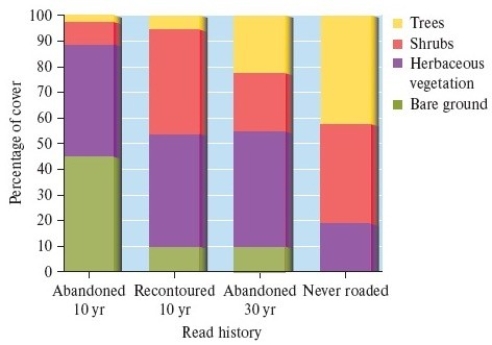 data from Lloyd, Lohse, and Ferré 2013
 (Multiple Choice)
4.9/5 (79)
(79) The change in plant, animal, and microbial communities in an area following disturbance or the creation of new substrate is called ________.
(Multiple Choice)
5.0/5 (90)
(90) Primary forest succession at Glacier Bay, Alaska can be measured in ________, while secondary forest succession on the Piedmont Plateau, North Carolina can be measured in ________.
(Multiple Choice)
4.9/5 (72)
(72) What was the effect of adding fertilizer to plots in the Park Grass experiment?
(Multiple Choice)
4.9/5 (84)
(84) Which statement about ecosystem properties in Sycamore Creek, Arizona after flooding is false?
(Multiple Choice)
4.9/5 (83)
(83) 
Filters
- Essay(0)
- Multiple Choice(0)
- Short Answer(0)
- True False(0)
- Matching(0)